Integrated Digital Marketing for Small Teams

Written by
Springbrand Editor Team
Editorial team
Springbrand Editor Team creates and maintains blog guides on AI tools, automation, marketing, and agent workflows.

Reviewed by
Springbrand Audit Team
Editorial review team
Springbrand Audit Team supports editorial quality through source checking, clarity, and consistency across the blog.
Updated
Published
Integrated digital marketing helps small teams align channels, messaging, data, and ownership. Learn how to build a practical operating plan.
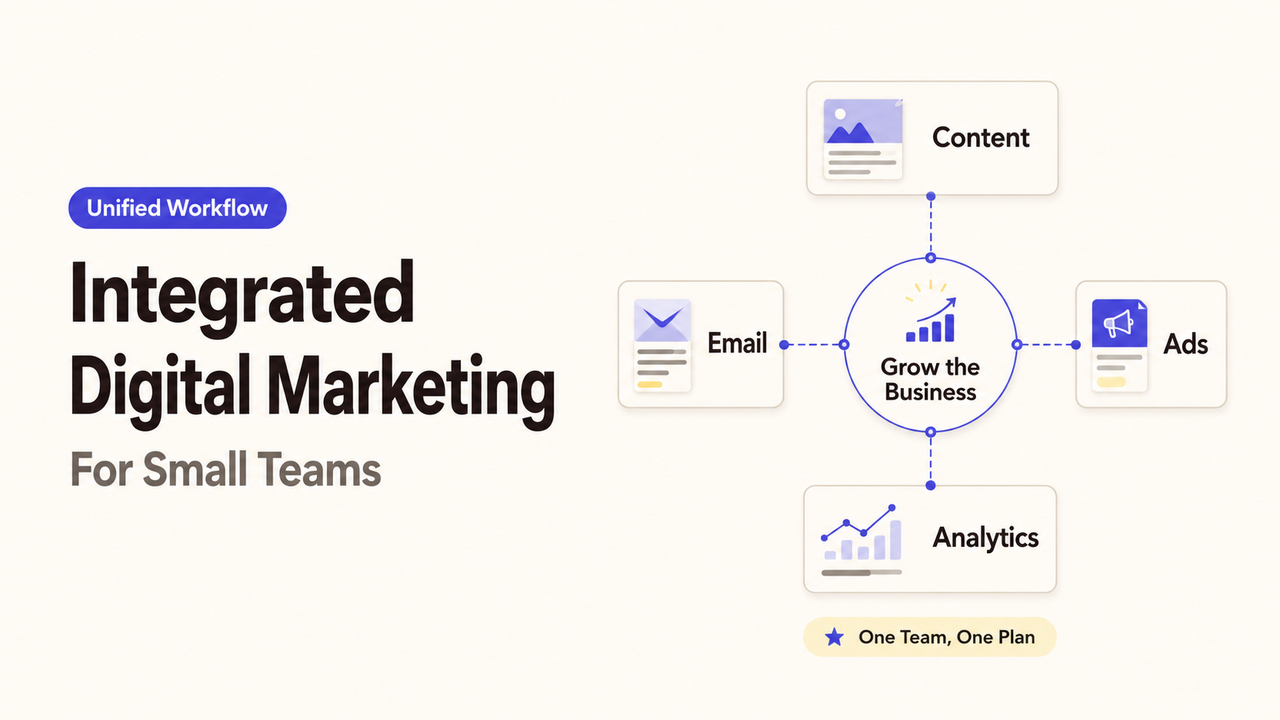
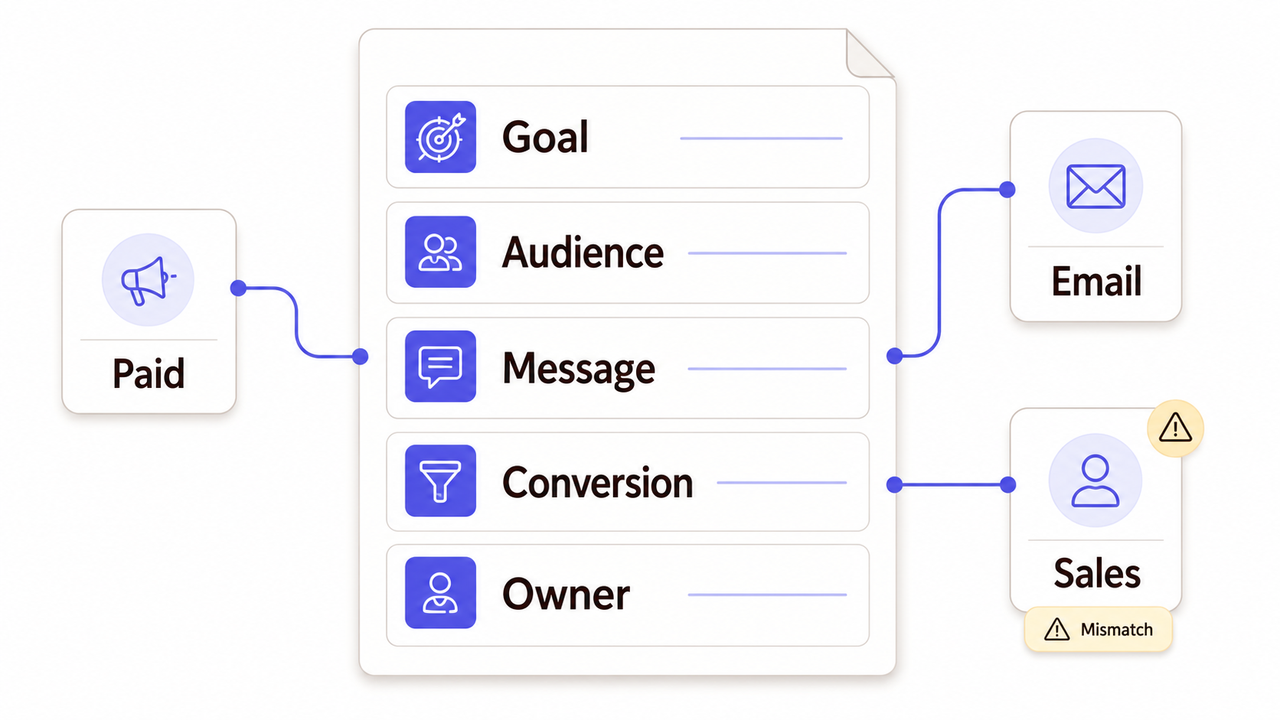
A small team can run paid search, send email, and post on social around the same offer while sales sorts the resulting inquiries using a completely different rule. Every channel is active, yet the operating plan is not shared. This guide turns integrated digital marketing into five things a team can actually agree on: one goal, one audience, one message, one set of data definitions, and one review owner. I’m Alex—my rule here is simple: do not add another channel until those five items fit on one page.
What Integrated Marketing Means for a Small Team
Integrated marketing does not mean appearing on every channel or publishing identical content everywhere. Each channel has a defined job and feeds the same business outcome: paid may capture demand, organic may answer questions, email can continue the conversation, and sales records the outcome.
The shared system matters more than the size of the channel list. A practical integrated marketing strategy establishes:
- the business outcome and audience;
- the offer, core claim, and evidence;
- the action that counts as a conversion;
- the handoff point and next owner; and
- the reporting definitions and review schedule.
Even full service marketing does not remove the need for this agreement. A provider may execute several channels; the business still owns its goals, customer knowledge, and approvals.
Treat attribution reports as decision aids, not a perfect account of cause. Traffic-source dimensions in Google Analytics use different scopes and attribution rules, so two reports can credit activity differently without either one representing the complete customer journey.
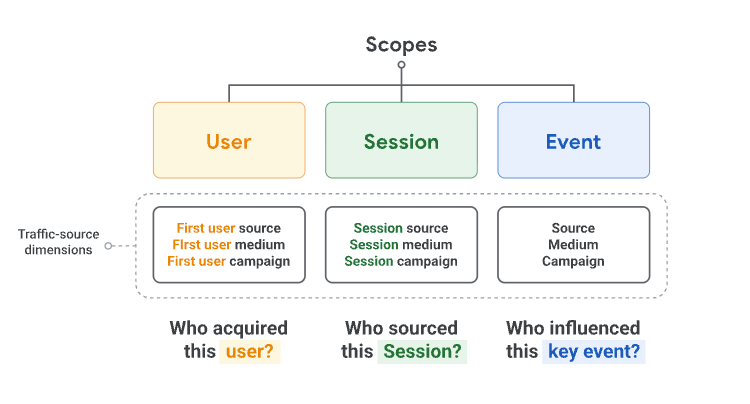
Here is the basic operating flow:
One business goal
        ↓
Shared audience + message
        ↓
Paid | Organic | Email | Social | Sales
        ↓
Shared lead definitions + handoff rules
        ↓
Regular review → next owner and next decision
Start With One Goal and a Shared Audience
Begin with the decision the plan needs to support. “Grow awareness” is too loose because channel owners can interpret it differently. A useful goal names the desired business movement, audience, review evidence, and approval owner.
The audience definition must work for both marketing and sales. Add the situation that prompted the search, the buyer’s problem, the decision role, likely delays, and proof that could reduce doubt.
A one-page small business marketing plan can start with six fields:
Field | What the team records |
Business goal | The outcome being pursued and the review horizon |
Shared audience | Buying situation, problem, decision role, and main objections |
Offer | What is being offered, to whom, and under what conditions |
Primary conversion | The action that signals meaningful interest |
Sales handoff | Where the record goes, who responds, and what must be captured |
Review owner | The person who can approve a budget, message, or channel change |
This page is the control surface for daily work. If paid media optimizes form fills while sales values booked consultations, resolve that disagreement here before debating campaign performance.
Align Paid, Organic, Email, Social, and Sales
In multichannel marketing, alignment does not require every channel to use the same wording. It requires each channel to serve a clear stage of the same customer movement.
Channel | Typical job | Evidence to bring to the review |
Paid | Reach or capture a defined audience quickly | Spend, campaign response, landing-page actions, qualified inquiries |
Organic | Build discovery and answer recurring questions | Search visibility, engaged landing pages, inquiries by topic |
Nurture, educate, or reactivate known contacts | Delivery, response, progression, unsubscribes | |
Social | Distribute ideas and create conversation | Relevant engagement, site visits, direct inquiries |
Sales | Qualify demand and return market feedback | Accepted leads, stage movement, loss reasons, customer outcome |
Handoffs connect the table. A sales question might become an article and social post; paid can test the offer; email can nurture people who are not ready to speak. Sales then records whether the inquiry progressed and why.
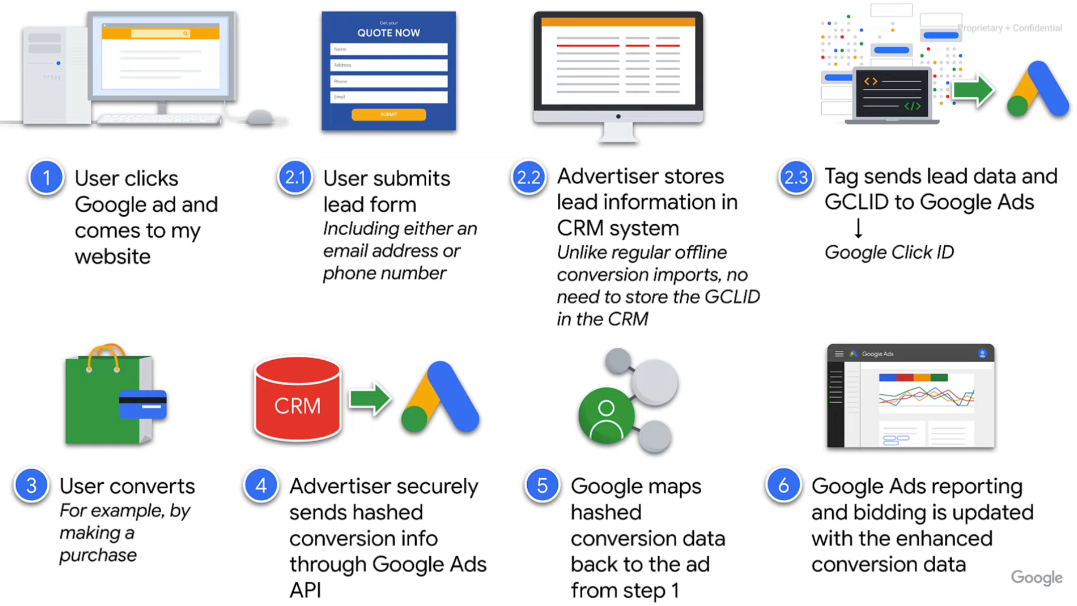
Some businesses need to connect advertising with outcomes recorded after a call, store visit, or sales conversation. For Google Ads, offline conversion imports can return eligible offline outcomes to the advertising platform. The option still requires consent, reliable identifiers, consistent definitions, and an owner; it is not universal attribution.
Create Shared Messaging and Data Definitions
Shared messaging starts with a compact source sheet. Record the audience, triggering problem, promise, proof, qualification, and next action. Adapt the expression without changing the claim.
Define inquiry, marketing-qualified lead, sales-accepted lead, and customer for this business. For each term, record its evidence, system of record, and definition owner.
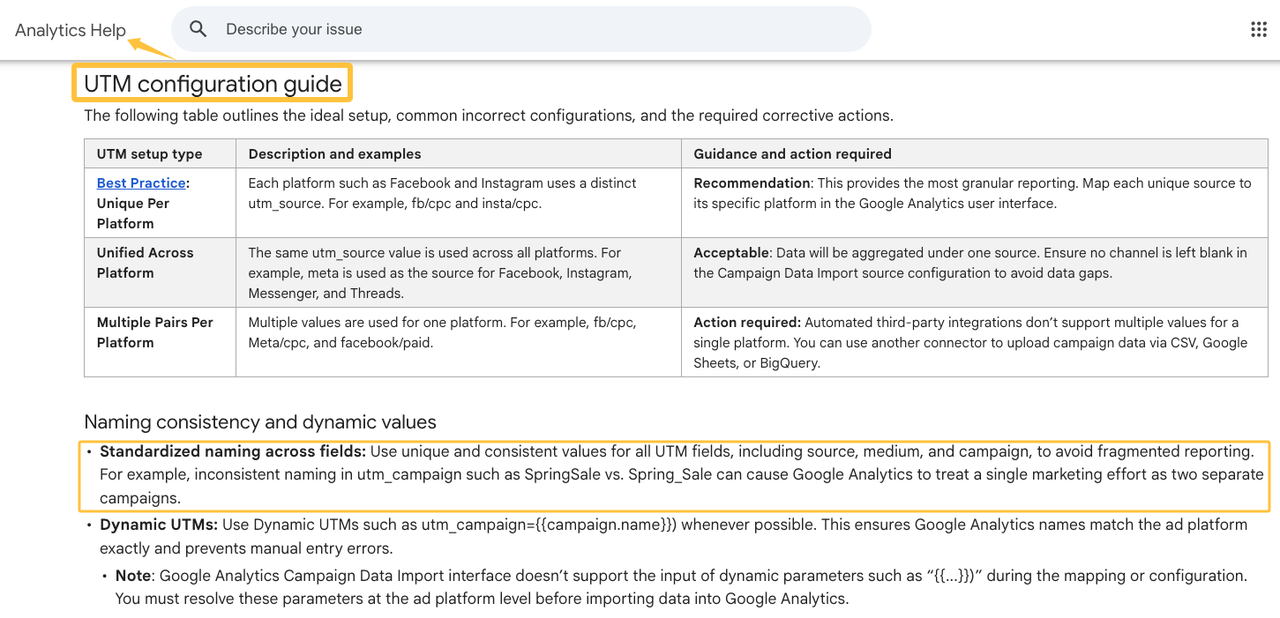
Campaign naming also needs a common rule. Consistent UTM fields and values help keep campaign data together; inconsistent capitalization or naming can split activity that the team intended to review as one campaign. Keep a short convention with approved channel, source, campaign, and offer labels.
Do not force customer-level matching simply because a dashboard looks cleaner with it. If a channel cannot share personal data, use the least detailed reliable view—such as aggregated activity by campaign, region, or period—and document what the team cannot observe. The data-minimization principle supports limiting transfers to necessary data and using de-identified data where possible.
Keep gaps visible instead of hiding them behind a blended number. Mark facts as observed, values as modeled or estimated, and relationships as hypotheses until tested.
Assign Channel Owners and a Review Cadence
Integration fails quietly when everyone can edit a plan but nobody is responsible for the next decision. Give each operating item one primary owner, even when several people contribute.
Work item | Primary owner | Contributors | Evidence of completion |
Goal and offer approval | Business lead | Marketing, sales | Approved one-page plan |
Core message and proof | Marketing lead | Sales, subject expert | Current messaging sheet |
Channel execution | Named channel owner | Creative or technical support | Published work and change log |
Lead handoff | Sales or operations lead | Marketing | Routing test and response record |
Shared reporting | Marketing operations owner | Channel owners, sales | Dated dashboard and issue list |
The right cadence depends on sales volume, campaign pace, and the buying cycle. Each review should answer four questions: what changed, what evidence is trustworthy, what remains unknown, and who owns the next action.
Record the report date and measurement settings. Modeled key events can estimate activity that was not directly observed, and attributed data may update later. A useful review distinguishes that uncertainty instead of presenting every dashboard figure as final.
Decide What to Keep In-House or Outsource
Keep the goal, audience, offer, commercial constraints, approvals, customer-data rules, and sales feedback in-house. A provider can inform them, but an internal owner must approve them.
Outsource work that requires missing expertise or capacity, such as paid media, technical SEO, lifecycle email, analytics, creative production, or cross-channel coordination. Before requesting help, document:
- the business outcome and audience;
- the channels already in use;
- the current message and offer;
- available data and known measurement gaps;
- access restrictions and approval owners;
- required deliverables and handoffs; and
- what the internal team will continue to own.
Do not choose a full service marketing arrangement merely because coordination is difficult. Identify whether the gap is strategy, specialist execution, capacity, measurement, or ownership. The diagnosis makes proposals easier to compare.
If one missing capability is blocking the plan, bring that defined gap to SpringBrand for a scoped marketing-service match while your team retains approval of the shared brief.
FAQ
What if one channel cannot share customer-level data?
Do not invent a customer-level join. Use aggregated measures that the channel can share reliably, align campaign and time-period labels, and document the blind spot. Review whether the team truly needs more detailed data and whether collecting or transferring it would be appropriate. Decisions can still use directional evidence, but the report should state its limits.
How should offline conversions enter shared reporting?
Start with one agreed event name and a dependable internal record, such as a qualified call, accepted opportunity, or completed purchase. Preserve the event time, stage, responsible owner, and permitted campaign identifier. If data is later imported into an advertising platform, monitor rejected records and keep the internal system as the reference for the business outcome.
When should a channel be removed from the mix?
Consider removal when the channel has no distinct job, cannot produce evidence relevant to the shared goal, consumes capacity needed elsewhere, or repeatedly fails an agreed test. Do not remove it because of one weak reporting period alone. Record the reason, affected handoffs, and conditions that would justify testing the channel again.
What changes when the business has a very long sales cycle?
Use meaningful intermediate stages instead of judging every channel by immediate revenue. Track whether the right accounts engage, return, request information, enter an opportunity, and progress over time. Review comparable cohorts and allow for the full decision period. The final commercial outcome still matters, but earlier signals help the team manage work before it arrives.
How should regional teams manage different offers within one marketing plan?
Keep the core goal, audience logic, brand claim, and data definitions shared. Then specify which fields regions may change, such as offer terms, language, proof, landing page, or channel mix. Give each variation a named owner and version label. Regional reporting should preserve those distinctions rather than blending unlike offers into one result.
Conclusion
Integrated digital marketing works when every channel points to the same goal, uses the same definition of a meaningful response, and names the next decision owner. If a channel cannot explain its job, handoff, or evidence, fix that gap before adding budget, content, or another provider.
Recommended Reads
Explore SpringBrand
Turn ideas into working workflows
Connect agents, APIs and tools in one workspace. Start with a task you want to get done.
Get started free
One account. 10,000+ APIs & capabilities
Give your agent APIs and plugins without separate keys or integrations for every provider.
Explore APIs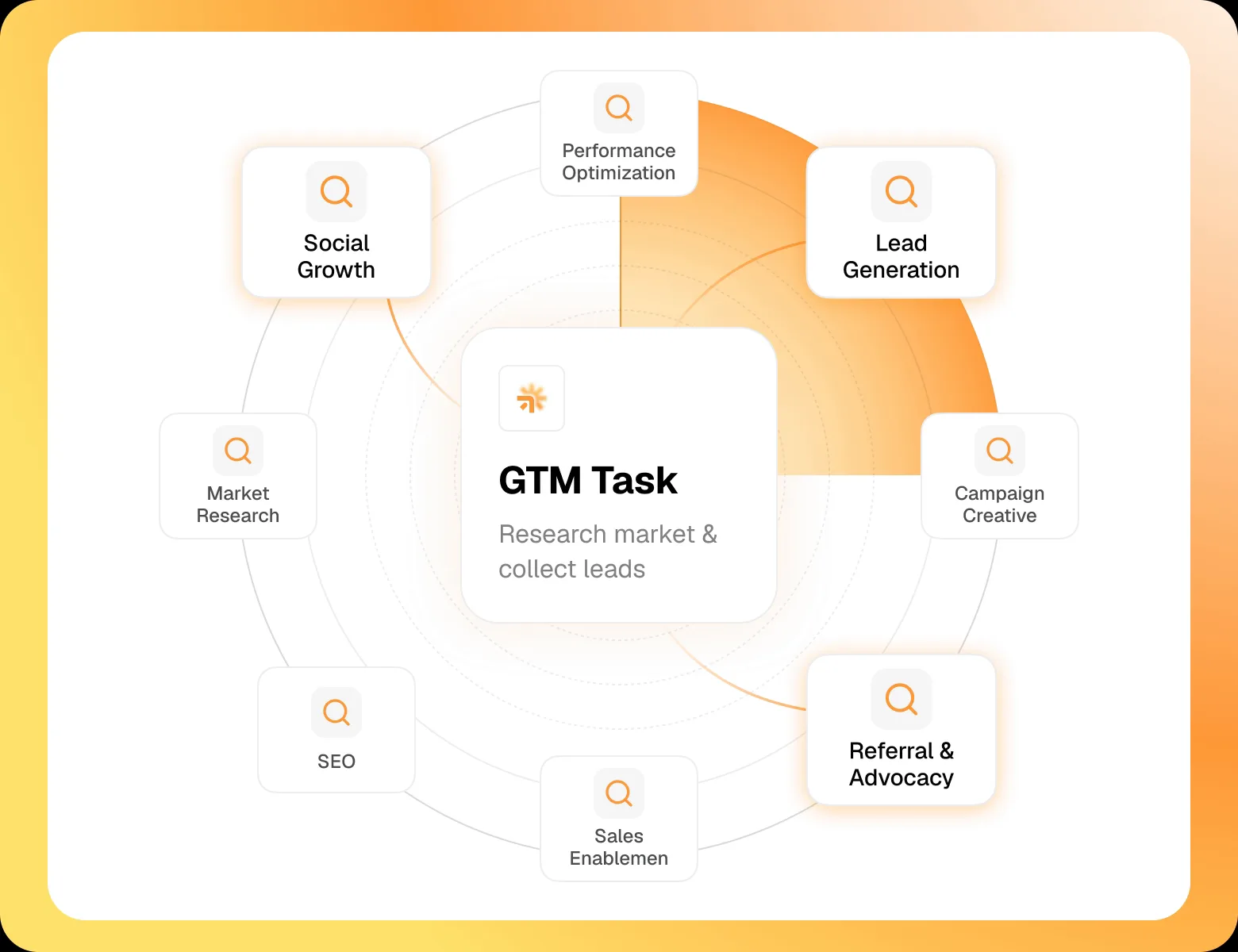
No tool expertise needed
Describe your GTM task. SpringBrand chooses the right APIs and plugins for your agent automatically.
Find tools for your task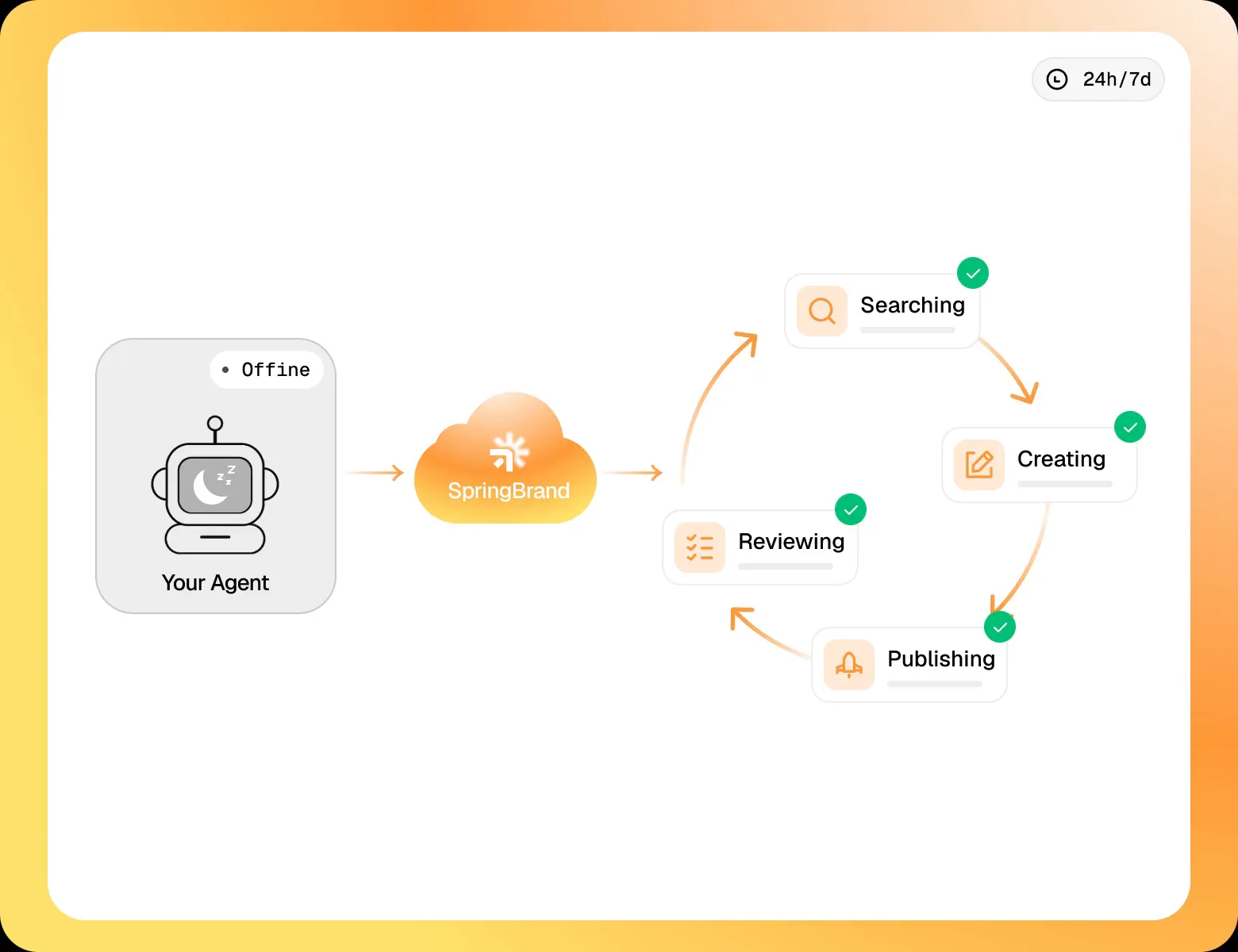
Run tasks 24/7
Connect your agent to SpringBrand to keep tasks running automatically, day and night.
Connect your agent