One Video, Ten Assets: Small Business Workflow
Video content repurposing helps small businesses turn one recording into posts, blogs, emails, FAQs, ads, and sales follow-ups.
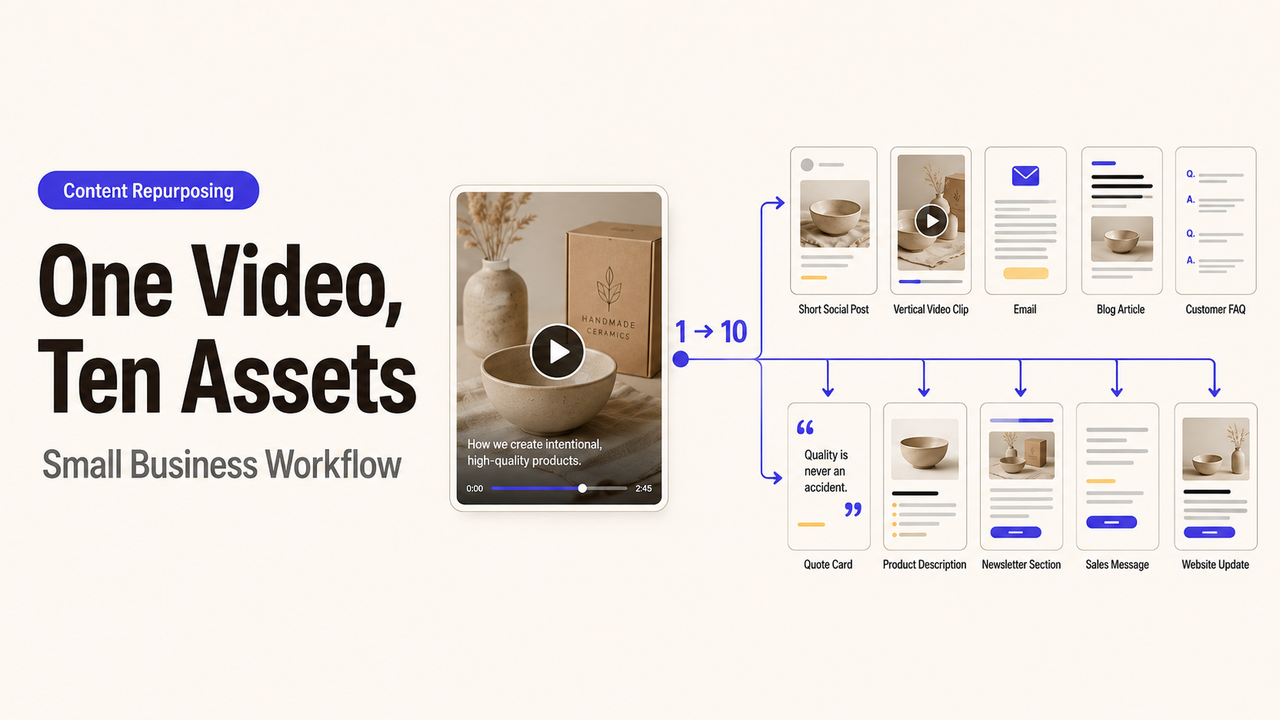
The marketing lead opens Monday’s content board and finds one approved video beside a request for ten assets. The list is full, but its owner and business-goal columns are blank, so every item risks repeating the same message. This guide gives a small team a video content repurposing system with a channel, job, reviewer, and measurement signal for each asset. I’m Alex; let any asset disappear when its owner cannot explain what it is meant to change.
What One Video Can Become
Ten assets is a planning example, not a promise. A detailed interview may support all ten; a short announcement may support only two. Each destination must need the material.
Imagine an example recording from a local service business. In seven minutes, the owner answers three questions customers ask before a first appointment: what is included, what the customer should prepare, and what can change the schedule. The team could consider the following outputs.
# | Candidate asset | Channel | Business goal | Owner | Measurement signal |
1 | Search-focused explainer | Website blog | Bring the full answer into search discovery | Content editor | Organic entrances and engaged visits |
2 | Service-page FAQ block | Website | Remove a recurring pre-booking doubt | Web owner | Contact starts from the page |
3 | Email newsletter | Email list | Reintroduce the process to existing contacts | Email owner | Clicks and direct replies |
4 | Educational carousel | Instagram or LinkedIn | Make the preparation steps easy to save | Social owner | Saves and qualified comments |
5 | Point-of-view text post | Social feed | State the owner’s main judgment | Social owner | Shares and profile visits |
6 | Short video cut | Reels or Shorts | Put one complete answer in front of new viewers | Video editor | Completion rate and profile visits |
7 | Process copy | Service page | Clarify what happens before the appointment | Web owner | Relevant CTA clicks |
8 | Sales follow-up message | CRM or email | Answer a question raised after an inquiry | Sales owner | Replies or next meetings |
9 | Paid-ad concept | Paid social | Test one approved problem-and-response angle | Media buyer | Qualified actions, not reach alone |
10 | Internal objection card | Sales workspace | Keep answers consistent across the team | Sales lead | Usage and unresolved objections |
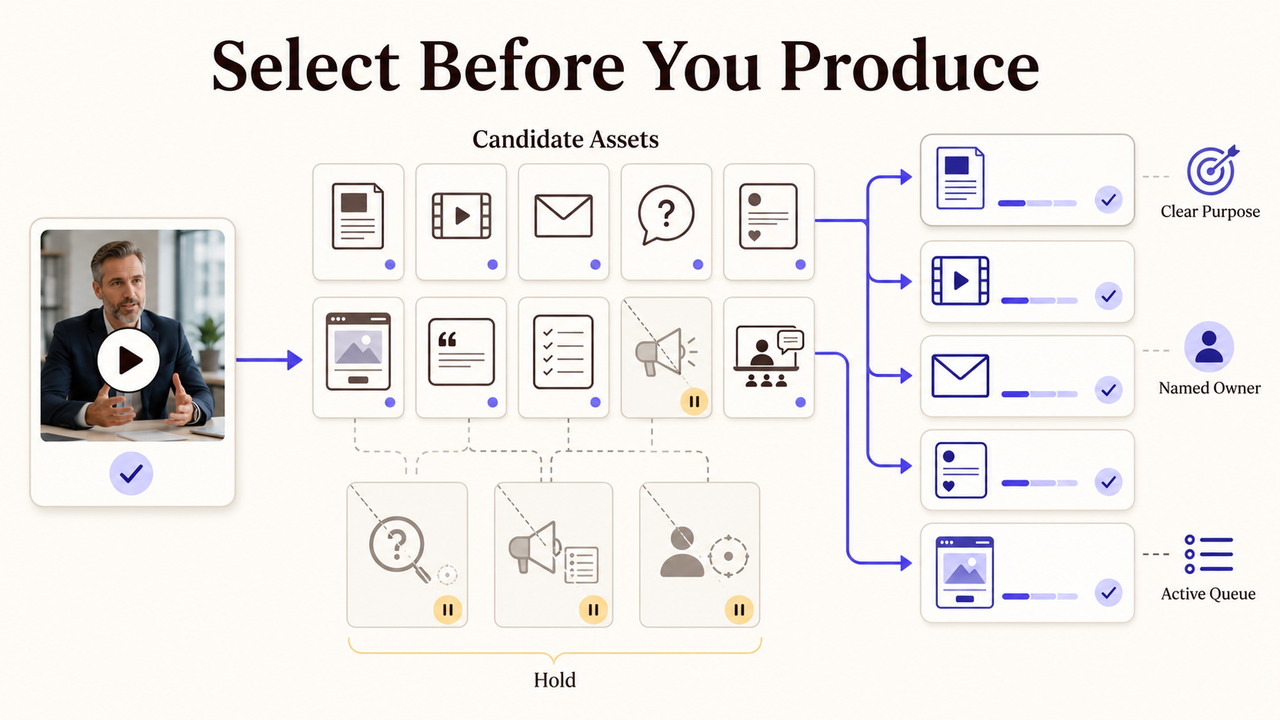
If the video has no credible search question, skip the blog. If no campaign is ready, hold the ad concept. Good small business content marketing removes weak outputs before production.
Map Each Asset to a Business Goal
Begin with the state you want the audience to move from and the next action you can observe. A blog may move an unfamiliar visitor toward understanding. An FAQ may move a prospect from uncertainty to a contact start. A sales follow-up may help an existing opportunity decide whether to continue.
Do not assign “engagement” to every row. Name a closer signal: a checklist save, email reply, service-page click, or resolved sales objection. These do not prove revenue, but they show whether the asset performed its assigned job.
The same transcript fragment can serve different goals only after its framing changes. A sentence about appointment preparation may become a concise carousel step, a fuller FAQ answer, or a question in a sales email. Copying the same paragraph into all three channels creates volume without respecting the reader’s context.
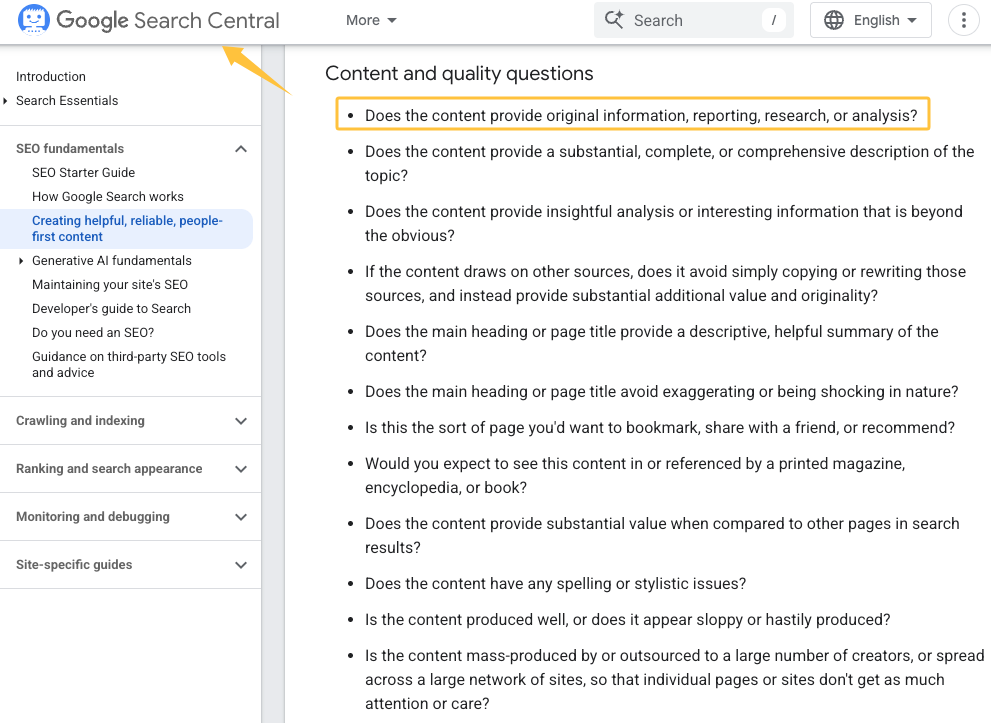
Google’s questions for helpful, people-first content ask whether a page adds original information or analysis instead of merely copying or rewriting its source. Apply the same editorial standard beyond search: every derivative asset should add context, compression, a useful example, or a channel-specific action.
Before production begins, approve four fields for each candidate:
- Audience state: what the person knows or needs now;
- Intended action: what the asset helps that person do next;
- Named owner: who prepares, reviews, and distributes it;
- Measurement signal: what the team will inspect after publication.
If any field remains blank, the asset stays out of the active queue. That is a practical decision, not a failure to maximize content.
Repurposing Workflow From Transcript to Distribution
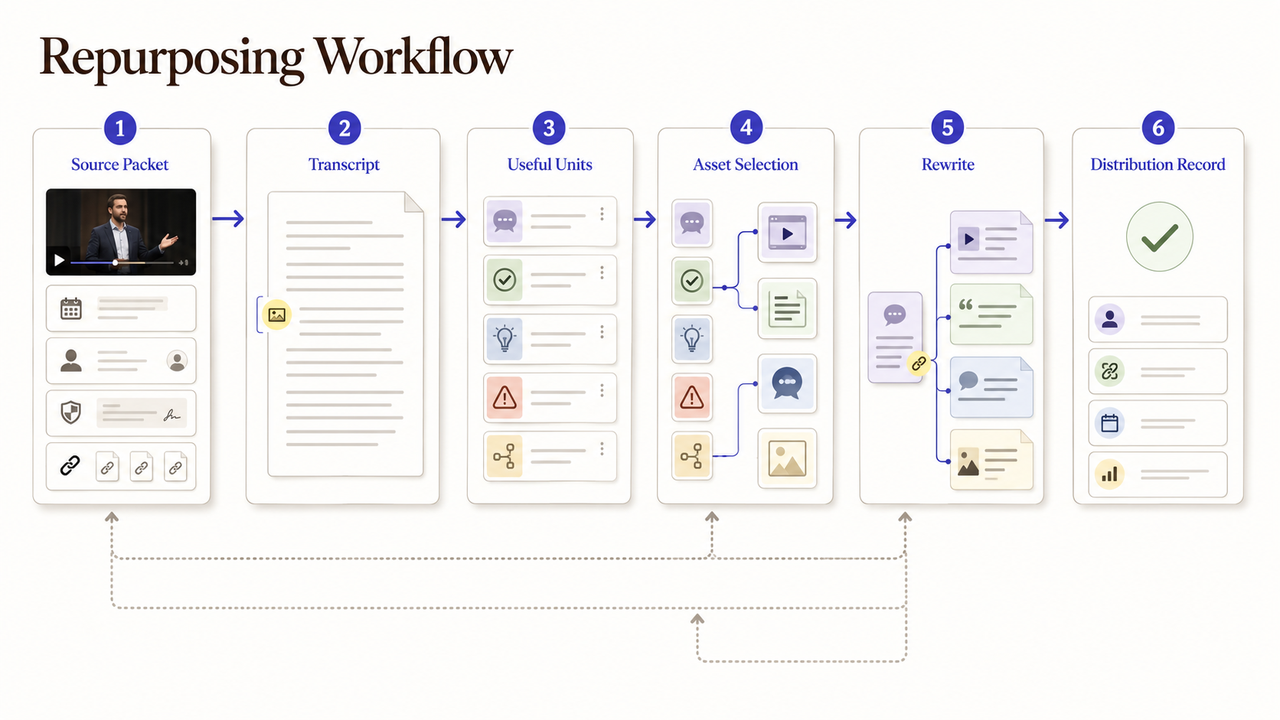
1. Create the source packet. Save the original file, date, speaker names, usage permissions, and purpose. Keep approved claims and supporting links beside it.
2. Produce a transcript with visual notes. Correct names and technical terms against the recording. The W3C’s audio and video guidance explains that descriptive transcripts may include visual information as well as speech and non-speech audio. Record any demonstration, label, expression, or on-screen qualification that would disappear in text.
3. Mark the useful units. Tag customer questions, clear answers, examples, objections, process steps, and statements that require verification. Do not rewrite yet. This pass establishes what the source actually contains.
4. Select assets against the goal map. Match each useful unit to a channel and audience state. A transcript to social posts workflow may need one strong claim and three supporting steps, while a video to email newsletter edit may need a short setup and one relevant link. Reject any format that would require invented detail.
5. Rewrite for the destination. Change the opening, context, length, and action while preserving the source meaning. A video to blog workflow adds structure and evidence; a sales follow-up keeps only the material relevant to the active conversation. Avoid publishing channel copies that differ only in line breaks.
6. Review, schedule, and record distribution. Route factual claims to the subject-matter owner, brand language to the editor, and final release to the channel owner. For commercial email sent to US recipients, use the FTC’s CAN-SPAM compliance guide as one review input and check all requirements that apply to the business. Record the live URL, send date, campaign tag, and approved version.
If an asset fails review, move it back to the relevant state rather than quietly repairing the final file. A disputed claim returns to source verification; missing permission returns to the owner; a weak channel fit returns to asset selection. The handoff needs a named owner at each step.
Quality Control for Brand Voice and Accuracy
Read each asset beside the source, then read the full set together. The first pass catches meaning drift; the second catches an email sounding cautious while the ad turns the same statement into a guarantee.
For claims used in US-facing promotional content, the FTC says they must be truthful, non-deceptive, and evidence-based; its advertising and marketing guidance is a useful checkpoint rather than a substitute for advice about a specific campaign. Keep the evidence link, approver, and approval date attached to every material claim.
Check customer information separately. Remove names, contact details, account information, and identifying story details unless the business needs them and has the appropriate permission. The FTC’s guide to protecting personal information recommends knowing what information the business holds, retaining only what it needs, and protecting it appropriately.
Then run a channel-level voice check:
- Does the asset sound like the same business without using identical copy?
- Does its certainty match the approved source?
- Can a new reader understand it without watching the recording?
- Does the CTA follow from the asset’s assigned business goal?
- Has the correct channel owner approved the final version?
One source message should survive all ten assets, but its form should not. Consistency belongs in the claim and point of view; adaptation belongs in the context, depth, and requested action.
When to Outsource the Workflow
Keep the work in-house when recordings are occasional, one person can review every derivative, and the team already knows which channels matter. Outsourcing becomes more useful when the backlog keeps growing, specialized formats require different editors, or approval coordination consumes more time than the team can protect.
A content repurposing service still needs a precise scope. Give the provider the source packet, candidate-asset matrix, brand guidance, approved claims, prohibited details, channel specifications, naming rules, revision limits, and approval owners. Define acceptance by deliverable and evidence, not by a request for “as much content as possible.”
With the asset matrix and approval owner defined, match the workflow to a content repurposing service through SpringBrand.
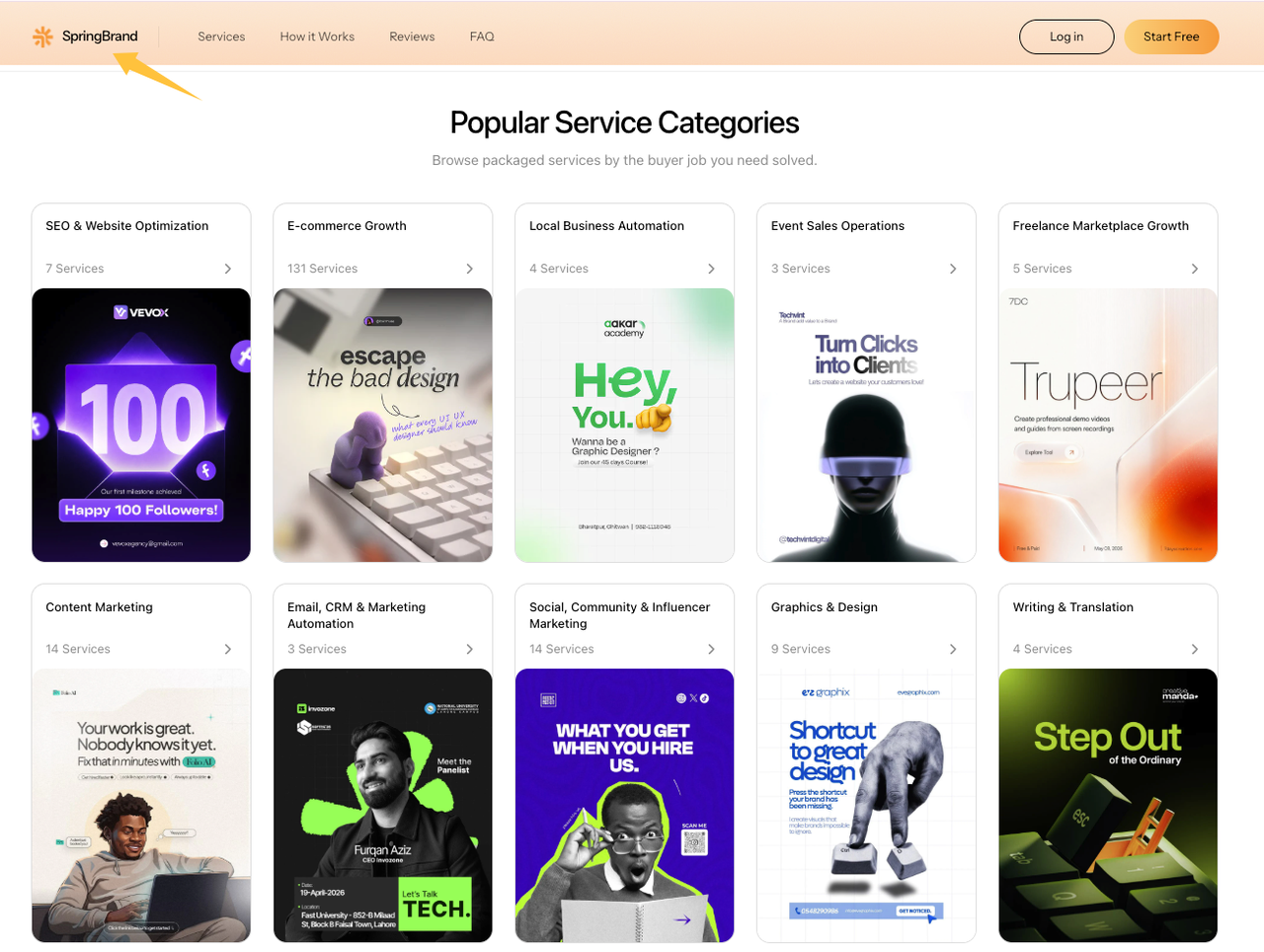
Outsourcing should remove production and coordination work without transferring final accountability. The business still owns source accuracy, permission decisions, offer changes, and the final release.
FAQ
When should a video not be repurposed at all?
Do not reuse it when the central claim is wrong or outdated, required permission is missing, the recording exposes private information, or no target audience needs the message. A source that relies entirely on a visual demonstration may also need a new format before text reuse. Archive the decision instead of forcing output.
What metrics show the workflow is working?
Use the metric assigned to each asset: engaged search visits for a blog, saves for a checklist, replies for an email, qualified actions for an ad, or resolved objections for sales material. Review the set for assisted inquiries and repeated themes, but do not treat publication count or raw reach as proof of business impact.
What files should be saved for future reuse?
Keep the original recording, corrected transcript, visual notes, permissions, source links, approved claims, asset matrix, final channel files, captions, thumbnails, live URLs, and performance snapshot. Include version dates and owners. That archive shows which derivative assets need correction when a claim, offer, or brand rule changes.
Conclusion
Video content repurposing is ready to close only when every published asset can be traced to the recording, its approved claims, and its assigned business goal. Keep the source packet, approval record, distribution link, and measurement signal together; that evidence is what makes the ten-asset workflow reusable rather than merely busy.