Branding Services for Small Businesses: What to Buy
Branding services for small business: compare strategy, identity, messaging, deliverables, ownership, and hiring questions before you buy.
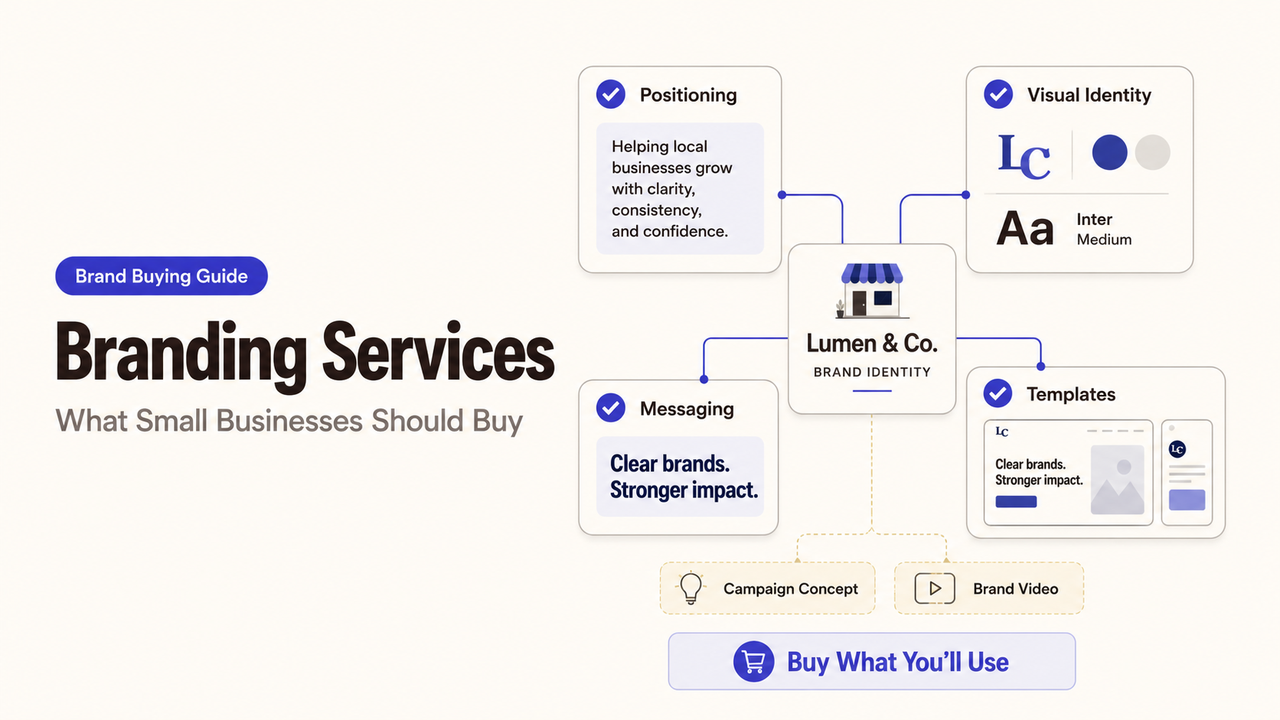
Consider three proposals for the same rebrand. One sells a logo package, another promises brand strategy, and the third combines naming, messaging, identity, and rollout—yet every cover calls the work “branding.” This guide separates the decisions from the design files so you can compare scope, revisions, ownership, and handoff before choosing branding services for small business. I’m Alex. I’ll keep strategy, creative direction, production files, and usage terms separate, because that is what makes unlike proposals comparable.
Quick Fit: Strategy, Identity, Messaging, or Rebrand
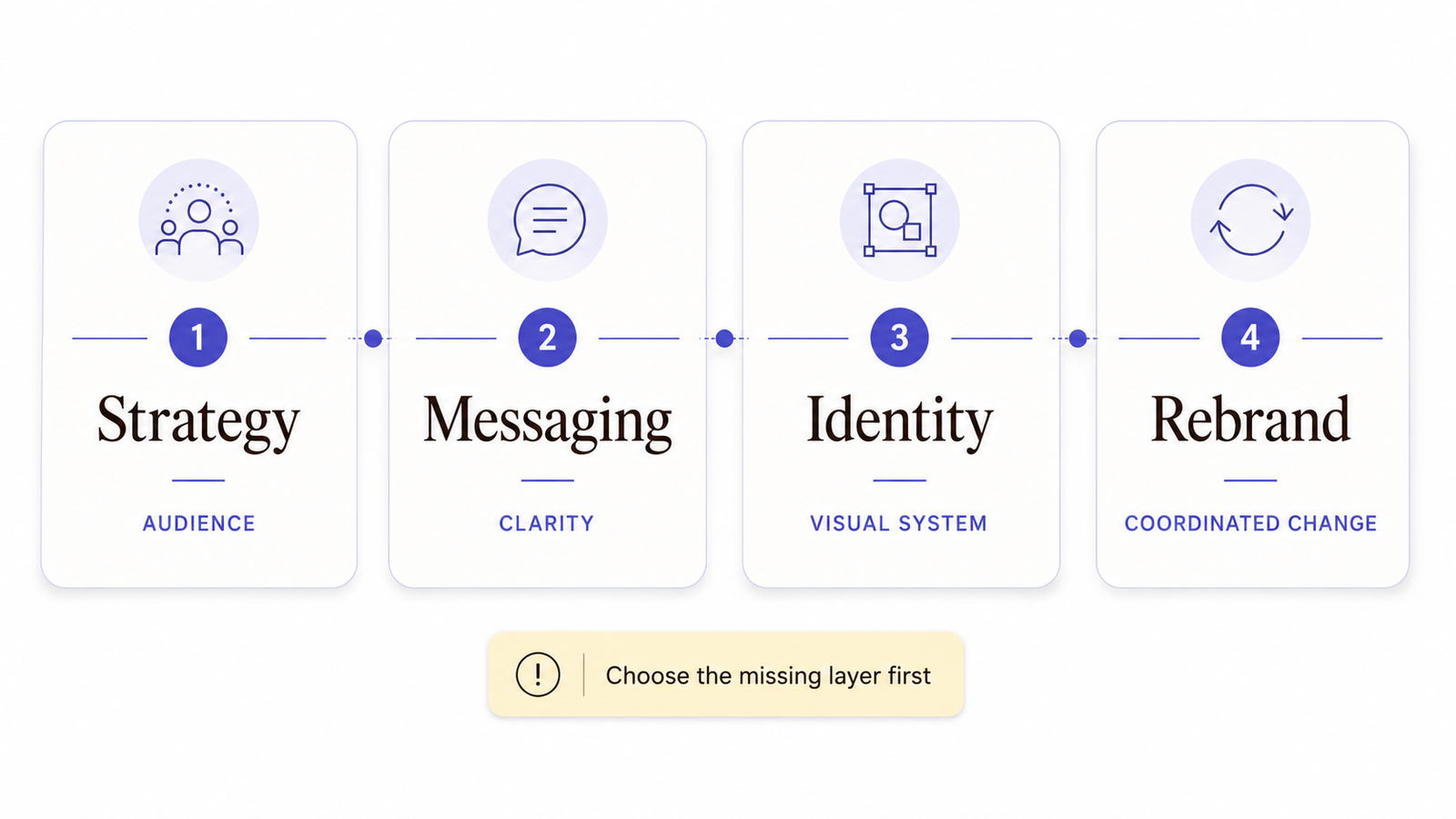
Start with what is unsettled. A company that cannot explain whom it serves has a strategy problem. One with a clear position but inconsistent visuals may need an identity system. Buying design to avoid a strategy decision usually produces a polished version of the same confusion.
Service | Buy it when | Typical scope | What it does not settle by itself |
Brand strategy services | The audience, position, promise, or brand architecture is unclear | Research, positioning, audience priorities, differentiation, and a strategy brief | A finished identity, website, or trademark clearance |
Messaging | Customers misunderstand the offer or teams describe it differently | Value proposition, message hierarchy, proof points, voice, and samples | Visual identity, final channel copy, or evidence for claims |
Logo and identity services | The direction is stable but the visual system is inconsistent | Logo suite, color, typography, graphic elements, and usage guidance | Strategy, naming, every production asset, or legal protection |
Small business rebranding | The name, audience, offer, position, or public identity needs coordinated change | Strategy, messaging, identity, migration, and rollout support | Automatic customer acceptance or every implementation task |
A full rebrand is not a larger logo package. It affects customer recognition, domains, signs, packaging, sales materials, account names, and internal habits. If only one layer is broken, commission that layer and record what remains unchanged.
Common Deliverables and Their Purpose
Ask what each file helps someone decide or produce. “Brand guide included” could mean a five-page logo sheet or a system that employees and vendors can use without weekly clarification.
Deliverable | Business purpose | Check before acceptance |
Research and strategy brief | Records the evidence and defines audience, position, promise, and differentiation | Sources, assumptions, approved language, and a decision owner |
Naming work | Develops and evaluates possible names | Number of routes, evaluation criteria, and who handles legal clearance |
Messaging guide | Gives teams a shared way to explain the business | Message hierarchy, proof requirements, examples, and claims to avoid |
Logo and identity system | Makes the brand recognizable across spaces and backgrounds | Marks, color values, type rules, image direction, and misuse examples |
Guidelines, assets, and templates | Helps the team apply the system repeatedly | Channel examples, editable formats, fonts, licenses, and instructions |
Rollout plan | Replaces the old brand in a controlled order | Channel inventory, owner, sequence, dependencies, and rollback decisions |
Color choices need practical pairings, not just attractive swatches. The W3C’s explanation of text contrast requirements distinguishes ordinary text from large text and exempts logotypes themselves. Ask for accessible pairings for websites, presentations, and social graphics; not every brand color works in every role.
Put file requirements in the proposal: vector artwork, print-ready PDFs, transparent PNGs, web formats, color specifications, font details, image licenses, and templates for the software the team uses. Source files have little value without the software, fonts, or rights needed to reuse them.
Process From Discovery to Handoff
Discovery should produce a decision record, not a folder of workshop notes. The provider needs the current website, sales materials, customer language, research, and examples of where the brand fails. The client names one approval owner; everyone else provides input.
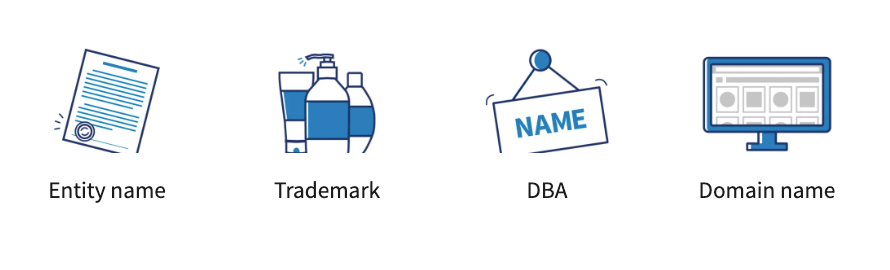
If naming is in scope, decide how far design may proceed before clearance. The U.S. Small Business Administration explains that entity names, trademarks, DBAs, and domain names are different forms of name registration. Availability in one system does not answer every question in the others.
A workable project usually moves through these checkpoints:
- Discovery and diagnosis: confirm the problem, audience, existing equity, constraints, and decision process.
- Strategy approval: settle the central direction before visual concepts multiply.
- Creative routes: compare a stated number of directions against agreed criteria.
- Refinement: consolidate feedback, record requested changes, and distinguish correction from new scope.
- Production: create approved versions, templates, and specifications.
- Handoff: deliver the inventory, license records, training, open issues, and rollout responsibilities.
Define a “revision round” before the first concept arrives. Is it one consolidated feedback document, a week of comments, or a new presentation? The AIGA Standard Form of Agreement for Design Services shows why proposals separate changes, outside costs, client review, deliverables, and intellectual-property terms. It is a reference, not advice on the contract you will sign.
The handoff is complete only when the business can find the approved files, identify the current version, understand permitted uses, and name who owns future updates. A presentation alone does not prove the operating team can use the system.
Compare Freelancer, Studio, and Agency Options
Provider type is a capacity clue, not a quality verdict. Compare who does the work, which disciplines are included, and what happens when another skill is needed.
Option | Often fits | Buyer should verify |
Freelancer | A defined identity, messaging, or strategy assignment | Availability, specialist limits, collaborators, and handoff depth |
Design studio | Identity-led work needing a small senior creative team | Whether research, messaging, production, and rollout are included |
Branding agency | A broader rebrand with several disciplines or stakeholders | Assigned team, subcontractors, and approval flow |
Portfolio fit matters, but process fit is easier to miss. Ask a finalist to explain one project from brief to handoff: who approved the direction, what counted as a revision, and what the client received. The answer shows more than a logo gallery.
A larger team does not remove work from the client. Someone inside the business must supply facts, resolve stakeholder conflict, approve claims, and plan the rollout. A provider cannot invent internal agreement.
Ownership, Usage Rights, Revisions, and Files
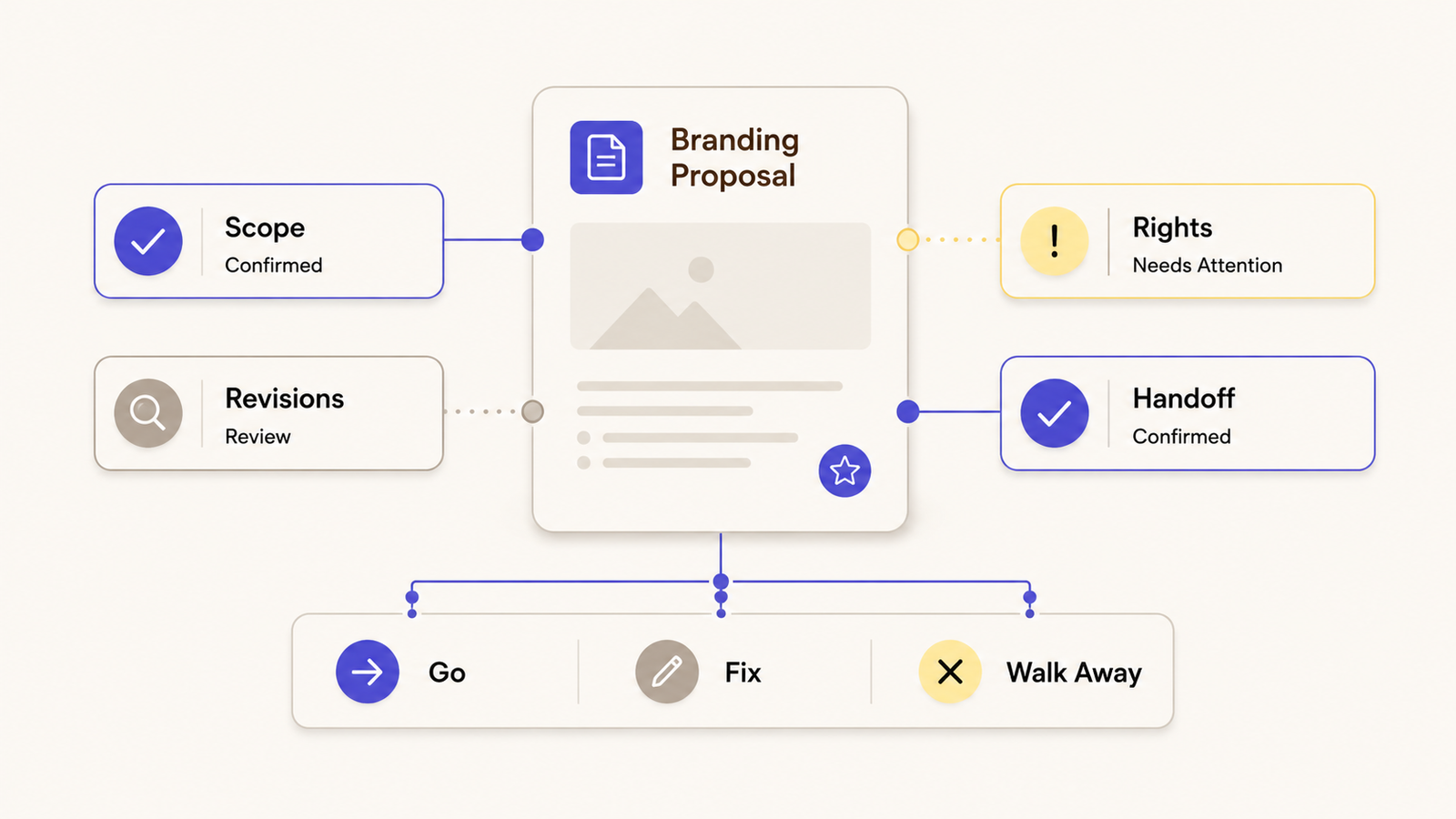
Payment, file possession, copyright ownership, trademark rights, and permission to use third-party material are different. The contract should identify each category rather than saying the client “owns the brand.”
For each deliverable, ask:
- Is it newly created for the project, pre-existing provider material, or third-party material?
- Does the client receive ownership, an exclusive license, or a limited one?
- Are fonts, stock images, mockups, or templates subject to separate terms?
- Are working files included, and what tools are required to edit them?
- May the provider show the work in a portfolio, and when?
- What happens to unused concepts?
- Do rights or file delivery depend on final payment or another condition?
In the United States, “work made for hire” is a legal category, not shorthand for anything a contractor was paid to create. The U.S. Copyright Office’s Circular 30 describes different requirements for employee work and certain commissioned work. Jurisdiction, contract language, and the asset matter, so ask qualified counsel to review important ownership or usage terms rather than assuming an invoice answers them.
State the included revision rounds, feedback deadline, approval owner, and process for changes beyond scope. If co-founders send conflicting comments, the provider should wait for one consolidated instruction.
Finish with a manifest naming each asset, version, format, font, license record, location, and intended use. Accept it against the proposal so nobody must reconstruct the project six months later.
Build a Branding Brief and Shortlist
A useful brief gives every candidate the same problem. Otherwise, one provider may price identity design while another prices a company-wide rebrand, making unlike quotes look comparable.
Include:
- the reason for the project and intended business result;
- the primary audience, offer, market, and current perception;
- what changes and what must remain recognizable;
- whether the business name and key claims are final;
- existing research, assets, guidelines, and known constraints;
- required strategy, messaging, identity, templates, and rollout;
- priority channels and production formats;
- decision participants and the final approval owner;
- revision expectations, timing dependencies, and budget boundary;
- questions about files, third-party assets, rights, licenses, and portfolio use; and
- acceptance evidence for each major deliverable.
Send the brief to a short list and request comparable proposals. Review scope, team, exclusions, timing assumptions, client workload, and handoff—not just the fee. A low quote with unclear files may create a second purchase later. A broad proposal is not automatically better; remove work that does not address the problem.
FAQ
When should trademark counsel be involved?
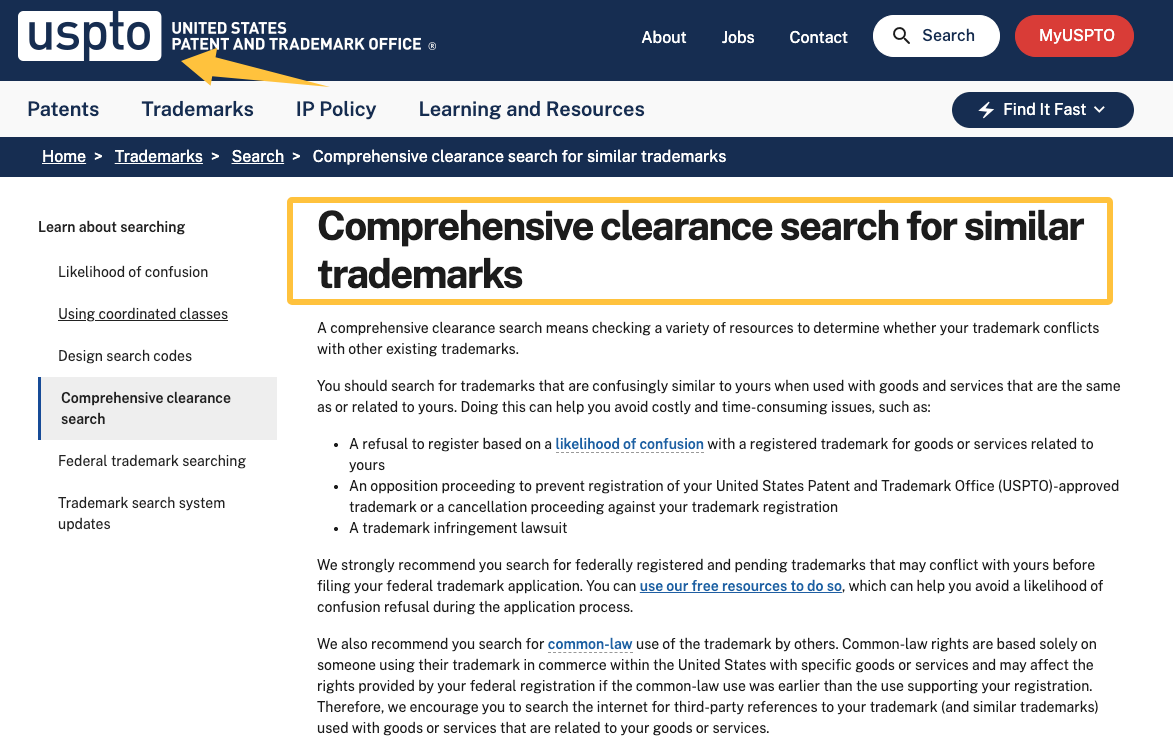
Consider qualified trademark counsel before committing substantial design or rollout spending to a new name, slogan, or important mark. The USPTO notes that a comprehensive clearance search can extend beyond its federal database and that similar marks may conflict for related goods or services. A branding provider can support naming; creative screening is not a legal conclusion.
Can branding begin before the final business name is chosen?
Yes. Audience research, positioning, brand principles, naming criteria, and message exploration can begin first. Avoid finalizing a logo system or replacing public materials while the name is unsettled. Put a decision gate between naming and production so an abandoned name does not carry a finished identity.
What if co-founders disagree on the direction?
Return to the approved criteria: audience fit, position, readability, channel needs, and implementation constraints. Separate factual disagreement from preference. One named owner should decide after input is consolidated. Asking the designer to average incompatible preferences weakens the direction without resolving the conflict.
What if existing customers respond negatively to a proposed rebrand?
Separate dislike from business risk. Check whether customers misunderstand the company, fail to recognize it, question continuity, or prefer the old look. Test the concern, connect old and new identifiers during transition where appropriate, and revise the rollout if recognition or trust is breaking. Do not discard the strategy because of a few reactions.
Can a business test new branding before replacing every existing asset?
Yes. Use a controlled setting such as a landing page, sales deck, sample packaging run, or one location. Define the audience, question, observation period, and decision rule first. Keep public identities coherent enough for customer recognition, and preserve old assets until the team approves the wider rollout.
Conclusion
Branding services for small business are ready to close when the approved strategy, final asset manifest, revision record, license and rights schedule, and rollout responsibilities are attached to the handoff. The final presentation shows the work; that acceptance package is what lets the business keep using it after the project team leaves.