Google Ads Management Services: Hiring Checklist
Google Ads management services vary in strategy, execution, reporting, and account ownership. Use this checklist to compare providers and scope.
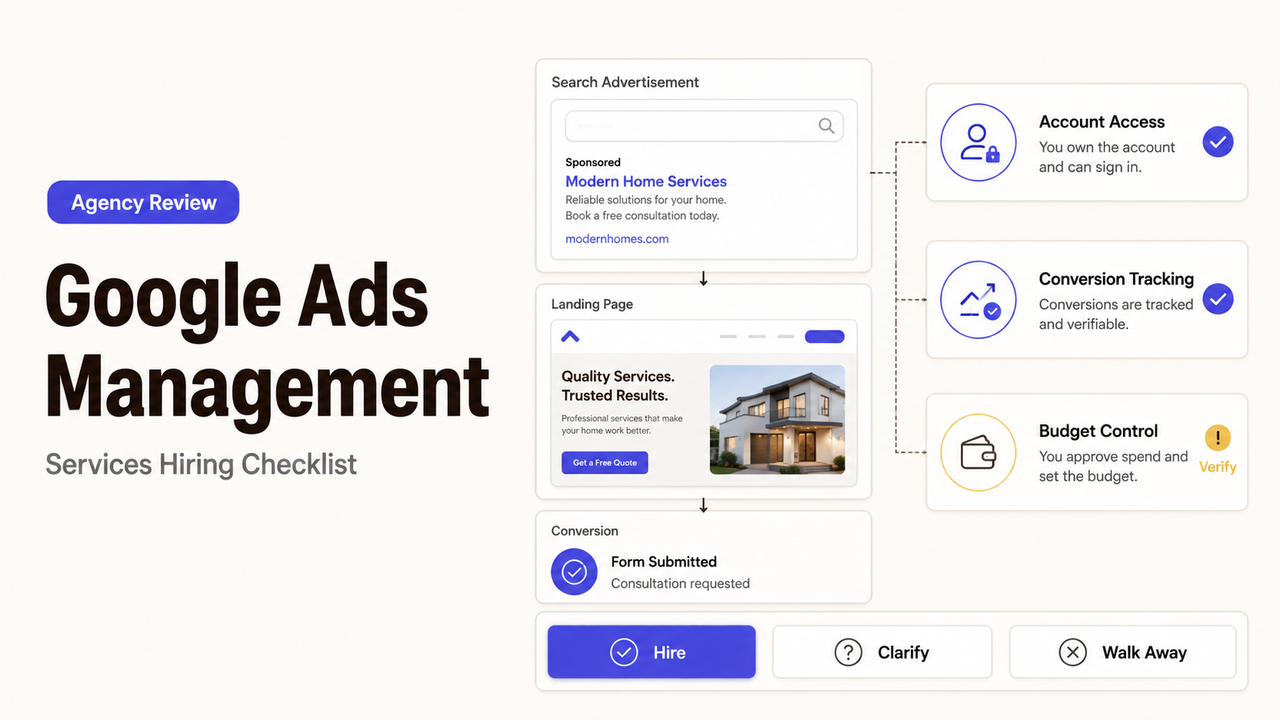
The proposal promises weekly optimization, conversion tracking, and a monthly report. It does not say whether the owner keeps admin access, which customer actions the campaign will optimize toward, or whether landing-page repairs sit outside the fee. Those gaps must close before the first budget is released. This guide turns Google Ads management services into a buying checklist for scope, fees, approvals, evidence, and exit. I’m Alex. My rule for this purchase is simple: no provider should control the account more clearly than the business paying for it.
Quick Fit: When Google Ads Management Is Worth Buying
Paid search management is useful when no internal person can reliably build campaigns, verify measurement, control spend, and connect results with sales feedback. The service should close a capability gap, not merely add another report.
Management may be worth buying when:
- several products, locations, audiences, or campaign types share the account;
- the business cannot explain which changes affected performance;
- tracking does not match the sales process;
- campaigns receive attention only after spending or lead quality moves sharply.
A Google Ads consultant could audit the account, build an initial structure, repair measurement, or train an internal owner without taking over ongoing work. Full management fits when those decisions require continuing attention.

Use this fit test:
| Situation | Possible engagement | Evidence required before approval |
|---|---|---|
New account with one clear offer | Setup plus limited review | Launch checklist, tested conversion, named owner |
Existing account with unclear performance | Diagnostic audit | Baseline, findings, priorities, access needs |
Several active campaigns | Ongoing management | Change cadence, approval rules, reporting method |
Tracking or website dependencies | Combined specialist scope | Data map, developer owner, acceptance tests |
Buy management when the provider will own defined decisions and the business can still inspect them.
Define the Business Goal and Account Baseline
“Get more leads” is not enough to guide a campaign or evaluate a provider. Name the offer, customer, location, desired action, qualification rule, sales owner, and capacity limit. A booked consultation, completed purchase, qualified phone call, and form submission are not interchangeable outcomes.
Before a provider changes anything, preserve a baseline: account ID, active campaigns, spend, bidding settings, conversion actions, landing pages, locations, major exclusions, and tracking problems. Use enough history to show normal demand and seasonality where data exists. Mark events that distort the comparison.
The baseline also needs a conversion inventory:
| Conversion action | Business meaning | Data source | Current status | Review owner |
|---|---|---|---|---|
Form submission | New inquiry, not yet qualified | Website tag or analytics | Tested / open | Marketing |
Qualified call | Call meets agreed criteria | Call system or CRM | Tested / open | Sales |
Purchase | Completed order | Store or analytics | Tested / open | Ecommerce |
Website conversion measurement depends on a connected data source and a working tag or analytics property. The provider can configure it; the business must define the valuable action and test the resulting record.
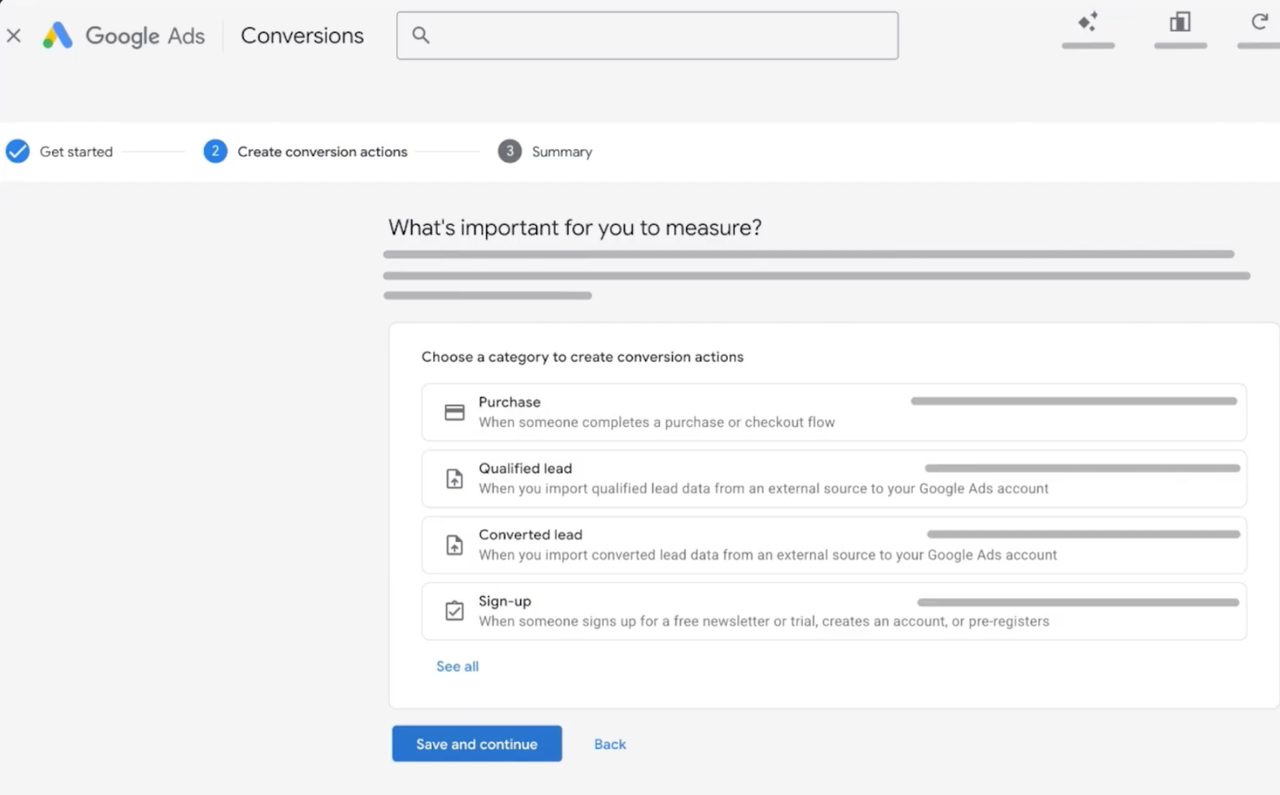
More reported conversions can reflect a tracking change rather than more valuable customer activity. Keep the platform event, qualified lead, opportunity, and sale as separate states.
Compare Strategy, Build, Optimization, and Reporting Scope
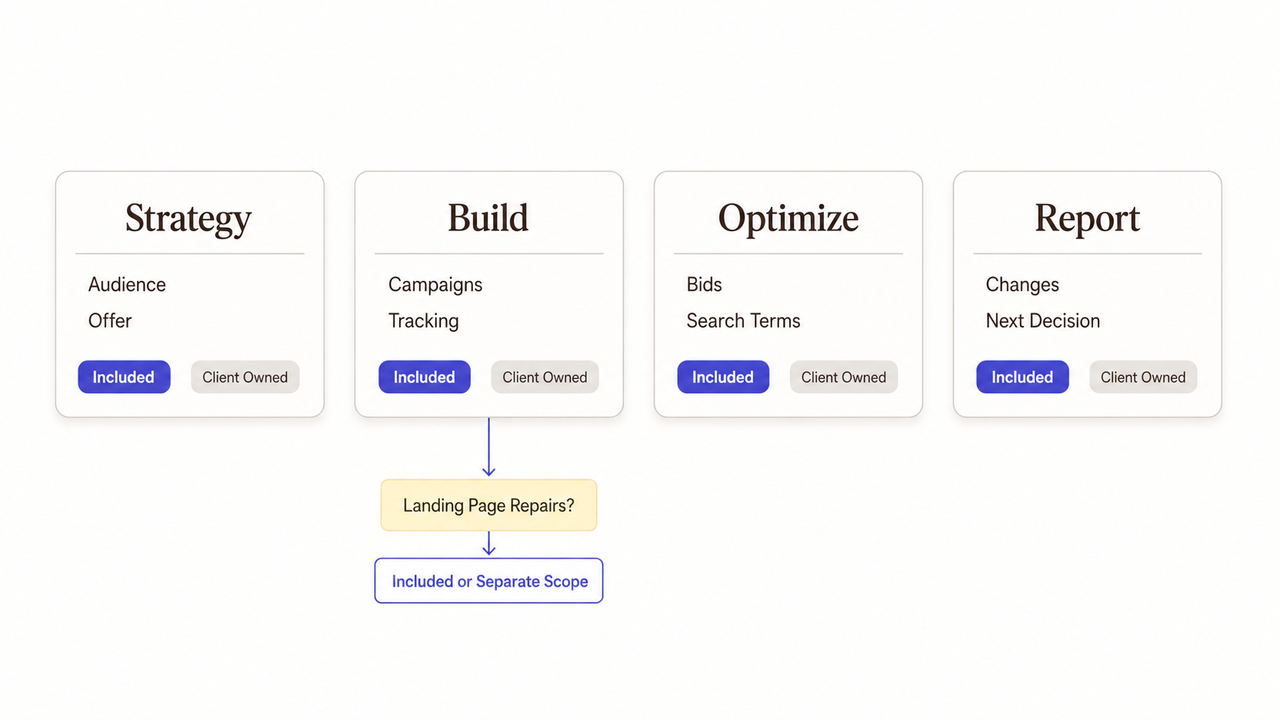
Many PPC agency services present google ads campaign management as one line item, although it can hide four different jobs. Separate them before comparing proposals.
| Workstream | Possible scope | Inspectable output |
|---|---|---|
Strategy | Offer, audience, channel role, budget logic, measurement plan | Written assumptions and campaign plan |
Build | Campaign structure, targeting, ads, assets, landing-page requirements | Reviewed build sheet and launch test |
Optimization | Query review, exclusions, bids, budgets, ads, audiences, experiments | Dated change record and rationale |
Reporting | Spend, traffic, conversions, lead quality, decisions, next actions | Account-linked report with owner |
Ask whether the provider will also touch Analytics, Tag Manager, Merchant Center, call tracking, landing pages, feeds, or the CRM. Access does not mean the work is included.
Define approval boundaries. Routine adjustments may sit within the mandate; a new market, major budget increase, different offer, landing page, conversion goal, or claim may need client approval.
Reporting should show what changed, why, which evidence was reviewed, and what comes next. Clicks and impressions do not show whether suitable inquiries were followed up.
Understand Fees, Media Spend, and Excluded Work
Separate media spend from the management fee, then identify setup, creative, landing-page, tracking, software, call-recording, feed, tax, or currency costs where applicable.
Fees may be flat, spend-based, hourly, project-based, or hybrid. Compare the activity or capacity purchased, what changes the amount, and who approves an overage.
Companies managing client advertising must provide transparency about services, associated costs, and expected results. Any management fee, commission, software cost, or pass-through expense needs a visible calculation and trigger.
Use four cost buckets:
- Media: money paid for advertising.
- Management: strategy, operation, communication, and reporting.
- Production and technology: copy, design, pages, tags, feeds, or external tools.
- Change work: approved activity outside the original scope.
Replace “ongoing optimization” or “creative support” with a cadence, quantity, approval path, and exclusions. There is no universal PPC management pricing range because scope, market, account condition, and media level change the work.
Set Account Access, Tracking, and Approval Responsibilities
The business should retain direct account access and avoid shared logins. Account owners can grant, edit, and remove individual access at different responsibility levels.
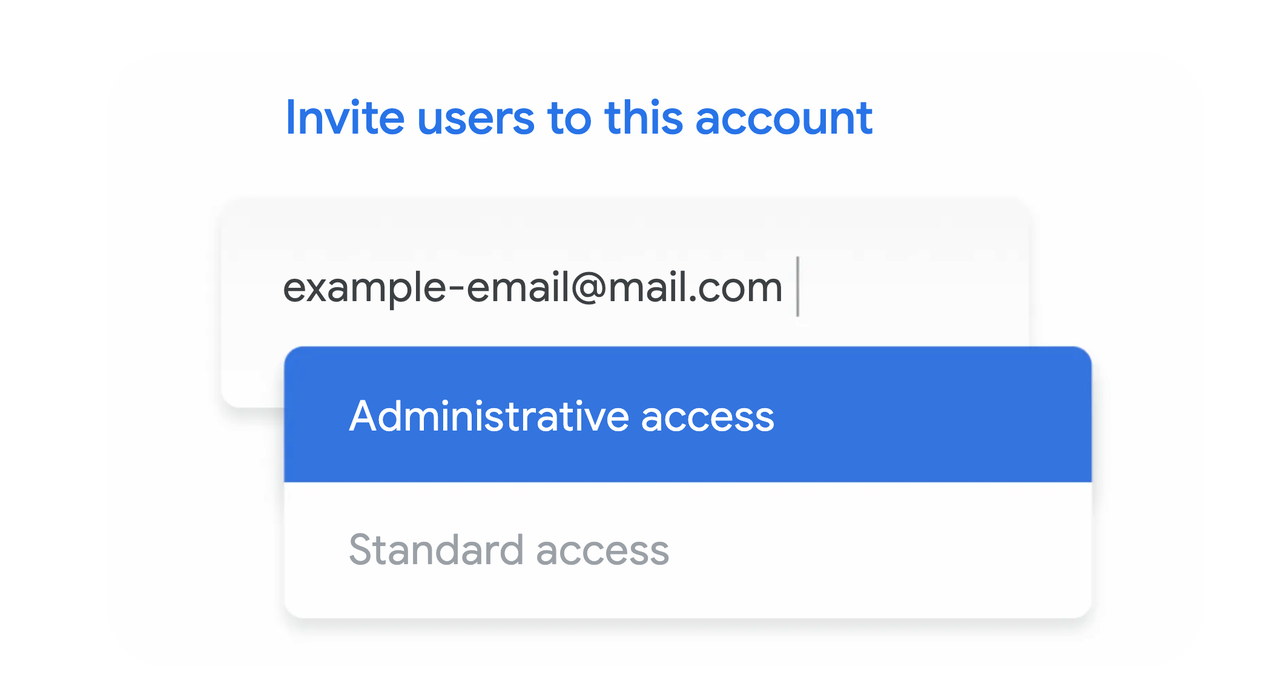
An agency can link a manager account instead of building in an account the client cannot reach. In manager accounts, user permissions and ownership are distinct controls. Record the required access, billing authority, and remaining internal administrator.
Create an approval matrix:
| Decision | Provider can act | Client approval required | Evidence retained |
|---|---|---|---|
Routine optimization within agreed limits | Define in scope | Define exception | Change record |
Budget beyond agreed threshold | No | Named budget owner | Written approval |
New offer, market, or regulated claim | No | Business reviewer | Approved copy or brief |
Conversion-goal change | Recommend | Marketing or revenue owner | Test and decision note |
New external tool or data connection | Recommend | System or privacy owner | Access and data record |
Also name who installs tags, tests forms and calls, selects optimization actions, monitors status, and investigates discrepancies. Require a business-side test before accepting the setup.
Evaluate Providers With Evidence and Practical Questions
Ask every provider to review the same baseline. Methods can differ, but commitments must be comparable.
Useful questions include:
- Which business assumption would you test first?
- What requires website, CRM, or client action?
- Which changes need approval?
- Who performs the work or uses subcontractors?
- How will sales feedback affect decisions?
- What happens when tracking fails or lead capacity is reached?
Request a redacted report, change rationale, testing record, or launch checklist. A performance screenshot lacks the starting condition, scope, period, and outside factors.
Reviews can use the change history that identifies affected campaigns, change types, users, and tools. Ask how it supports incidents; budget or targeting changes should not need reconstruction from email.
A provider can commit to work, response times, reviews, documentation, and controls. It cannot guarantee clicks, qualified leads, sales, or a particular cost.
Define Handoff, Review, and Exit Requirements
Write the exit process before onboarding. Cancellation should not reveal that the provider controls the only admin login, dashboard, files, or call-tracking number.
The initial handoff record should include:
- account and linked-system IDs;
- users, manager accounts, and access levels;
- active campaigns, budgets, and pending changes;
- conversion actions, tags, data sources, and test results;
- reports, naming rules, creative files, and landing pages;
- automated rules, scripts, feeds, exclusions, and unresolved issues;
- billing owner, approval owners, and escalation contacts.
Use reviews to connect account activity with business evidence. Marketing reports spend and platform conversions; sales reports qualification, duplicate inquiries, location problems, and follow-up delays. Record campaign decisions and owners.
At exit, preserve the campaign status, recent changes, open tests, conversion health, budget decisions, and known risks. Transfer files before removing access, then have the internal administrator confirm that no workflow depends on the former agency.
Turn the approved checklist into a service brief and compare current business-service options through SpringBrand before granting account access.
FAQ
Can management begin before a website rebuild is complete?
Yes, but separate preparation from activation. The provider can audit, plan campaigns, review measurement, and document page requirements during the rebuild. Do not send traffic to an unfinished path merely to keep the engagement moving. Test mobile use, message accuracy, tracking, routing, and approval first.
What happens when a seasonal campaign needs to pause?
Define what “pause” changes. Media may stop while monitoring, reporting, or preparation continues under another fee rule. Record who pauses campaigns, which rules remain active, how pending leads are handled, and what permits a restart. Review the account before the next season.
Can one account support several business locations?
It may, when the locations belong to the same advertiser and budgets, targeting, conversions, and reporting remain clear. Google requires separate accounts for separate end-advertisers, not automatically for every location. Confirm the structure against the entities, billing, access, policy needs, and reporting responsibilities.
How should an existing agency hand over active campaigns?
Keep an internal administrator in place. Capture campaigns, recent changes, linked accounts, conversions, billing contacts, rules, creative, reports, and unresolved issues. Set a cutoff for changes. The incoming provider should verify access and measurement before the former agency is removed.
What should regulated businesses verify before appointing a provider?
Identify the policies, industry rules, approvals, claim evidence, targeting restrictions, disclosures, and data controls that may apply. Assign qualified reviewers before production. The provider’s review process is not legal or regulatory advice and does not replace appropriate professional review.
Conclusion
Useful Google Ads management services give the provider a defined operating role while the business retains account control, budget approval, measurement definitions, and access to the evidence behind each decision.
Do not approve a proposal because it promises optimization. Approve it when scope, fees, media spend, access, conversion ownership, reporting, change control, and exit records are explicit. The engagement is ready when a named internal administrator can open the account, explain what the primary customer action means, trace significant changes, and remove provider access without losing campaign history.