Content Marketing Lead Generation: A Practical Funnel

Written by
Springbrand Editor Team
Editorial team
Springbrand Editor Team creates and maintains blog guides on AI tools, automation, marketing, and agent workflows.

Reviewed by
Springbrand Audit Team
Editorial review team
Springbrand Audit Team supports editorial quality through source checking, clarity, and consistency across the blog.
Updated
Published
Content marketing lead gen connects useful content to capture, nurture, and sales follow-up. Build a measurable funnel without chasing empty traffic.
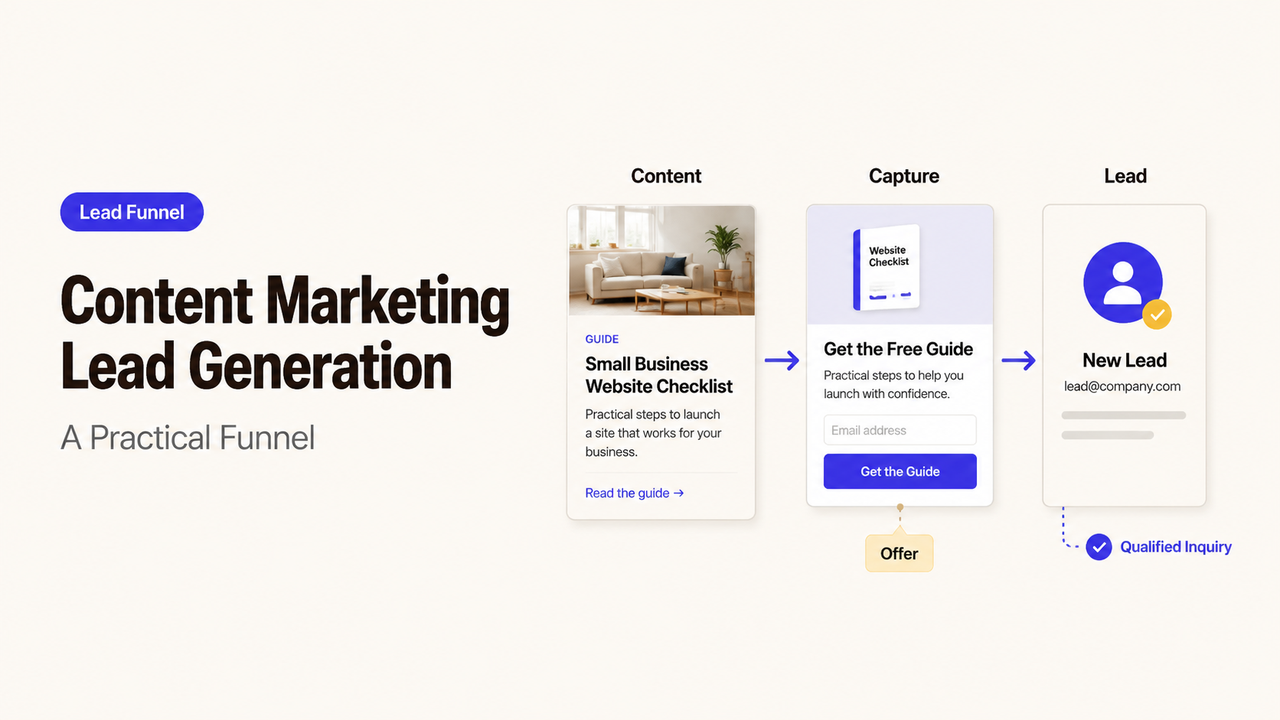
The article is attracting visits, the form is collecting names, and sales has stopped opening the notifications. Inside the CRM, product questions, job seekers, existing customers, and serious buyers all enter the same status. This guide builds a content marketing lead gen funnel that separates traffic, captured contacts, qualified leads, and pipeline contribution, then assigns the next action at each handoff. Alex here: keep the CRM open as you read, because the record—not the pageview—shows where the funnel breaks.
Why Traffic Alone Is Not Lead Generation
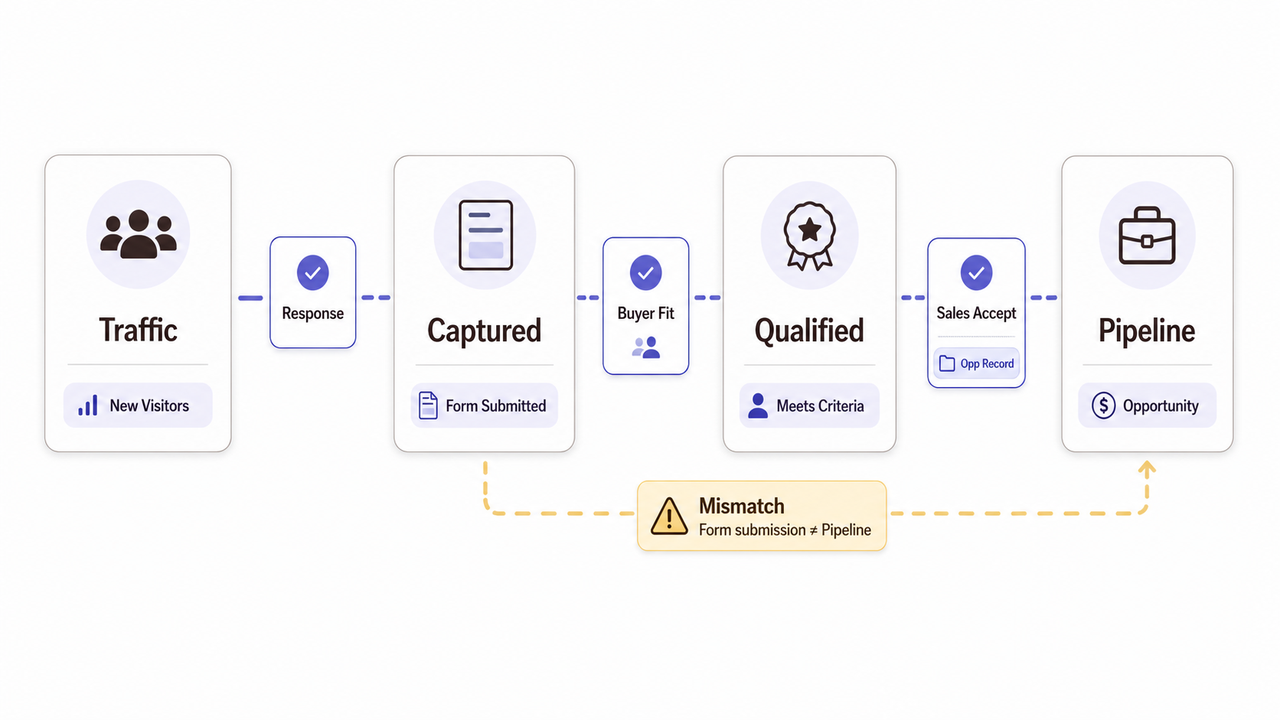
Traffic shows that people reached a page. It does not show that they fit the target account, want a sales conversation, or entered the pipeline. A useful report keeps those states separate.
State | Minimum evidence | What it does not prove |
Traffic | A measured visit or content interaction | Buyer fit or commercial intent |
Captured contact | A valid form, reply, registration, or request | Qualification or sales acceptance |
Qualified lead | The record meets criteria agreed by marketing and sales | An opportunity will be created |
Pipeline contribution | Content interaction is attached to an accepted opportunity | The content caused the opportunity or revenue |
This distinction changes what the team publishes. A page can answer an important buyer question without collecting an email address. Google’s guidance on helpful, people-first content asks whether the intended audience would find the material useful and leave able to pursue its goal.
Traffic can reveal demand, weak distribution, or a page that fails to earn attention. It cannot stand in for the business outcome. If sales rejects every captured contact, more visits will not repair the qualification path.
Map Content to Buyer Questions and Funnel Stage
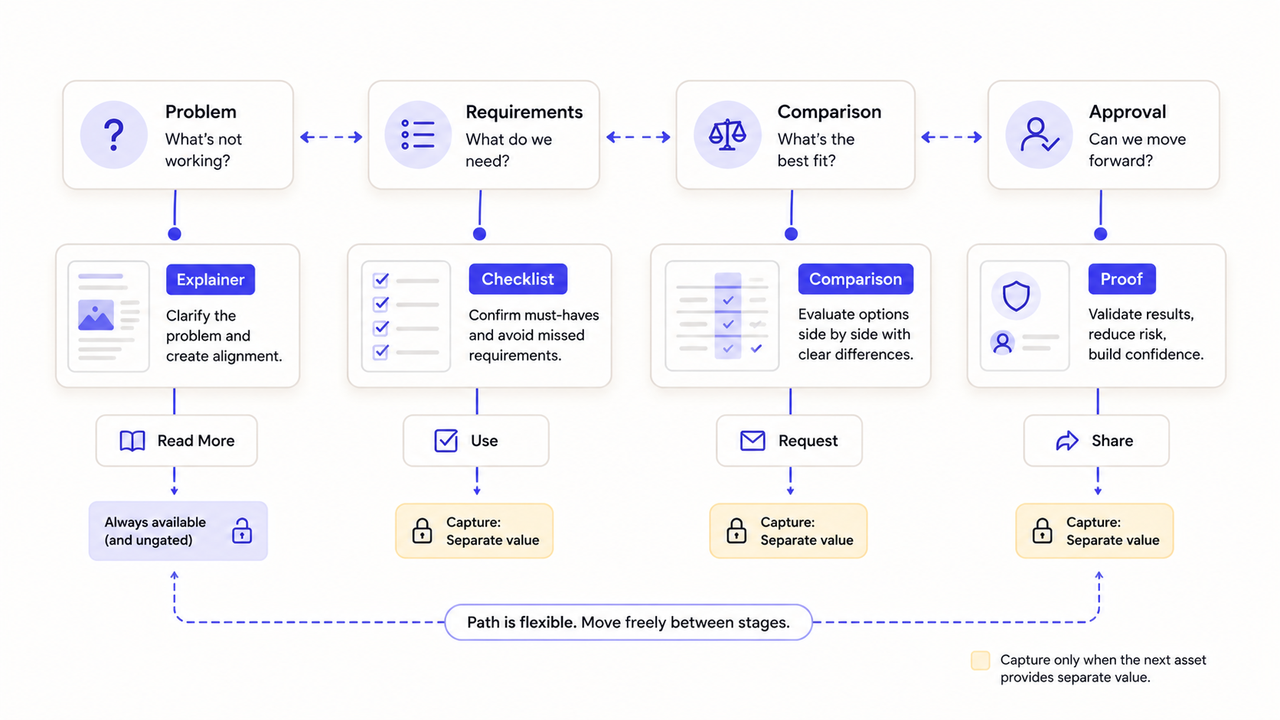
A content funnel is a decision map, not a linear journey. A buyer may enter through a comparison, return to an explainer, forward a technical guide, and speak with sales before downloading anything.
Map each asset to the question it must answer and the next observable step:
Buyer situation | Core question | Content job | Useful next signal |
Problem recognition | “Is this issue worth addressing?” | Explain the problem and its operating cost | Visits a related guide or subscribes for updates |
Requirement building | “What would a workable solution include?” | Define criteria, process, and common failure states | Uses a checklist or reviews a solution page |
Solution comparison | “Which approach fits our constraints?” | Compare scope, tradeoffs, and evidence | Requests a brief, assessment, or conversation |
Internal approval | “Can I defend this decision?” | Provide proof, implementation detail, and risk answers | Shares the asset or enters a sales process |
For a small B2B content marketing team, the practical unit is the buyer question. Give it one primary page, owner, approved claim set, and intended next action. Reused formats should point back to that source.
Do not manufacture a conversion where the buyer only needs an answer. Keep a self-contained definition page ungated. Add capture when the next asset provides separate value, such as a template, assessment, event, update, or relevant consultation.
Build Capture and Conversion Paths
Follow the published path as a new visitor. The CTA should describe what comes next, and the form should request only what delivery or routing requires. The confirmation should explain what happened; the resulting record needs a system and owner.
Use this path check for every piece of lead generation content:
- Asset: Which page, guide, webinar, or tool created the response?
- Offer: What did the visitor expect after acting?
- Capture: Which fields are required, and why are they needed?
- Confirmation: What does the visitor see or receive?
- Routing: Which queue, CRM stage, or mailbox receives the record?
- Ownership: Who reviews it, and by what team-defined deadline?
- Exception: What alert appears if the form, delivery, or routing fails?
The handoff needs a named owner. “Marketing” cannot investigate a notification, and “sales” cannot approve a definition. Name a role beside the form, automation, and acceptance decision.
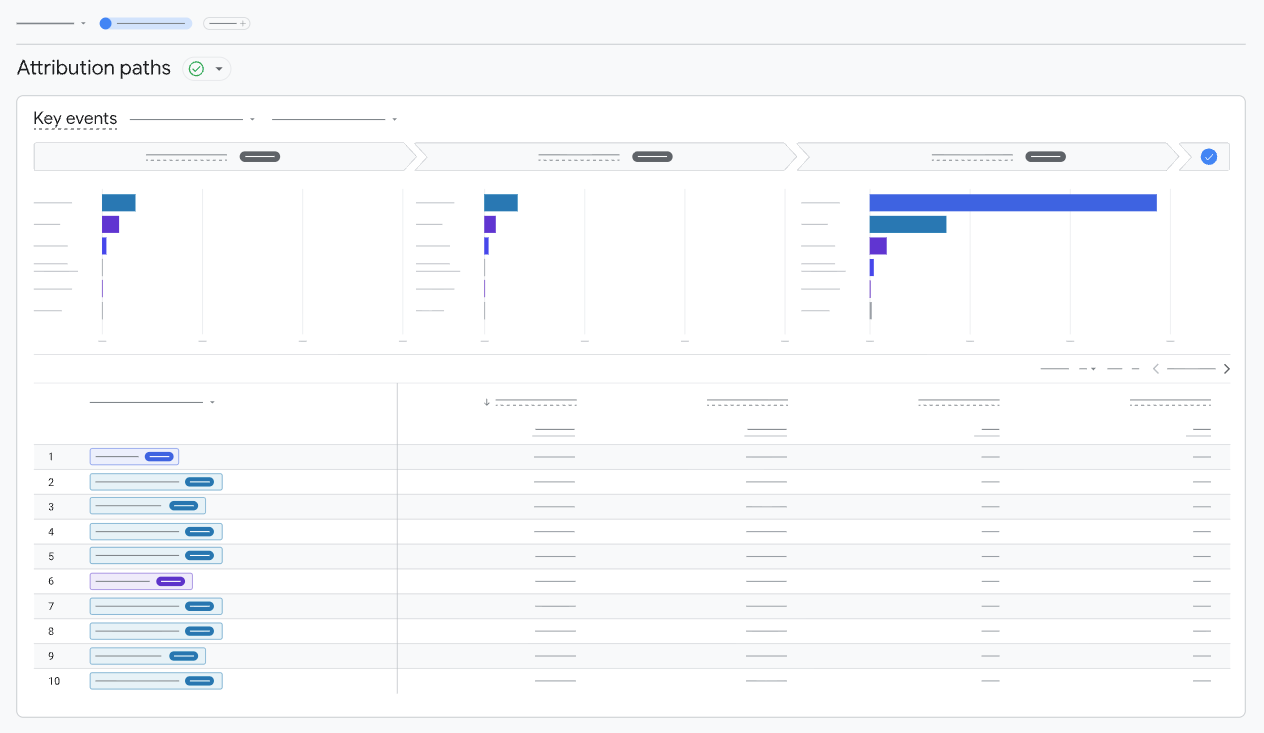
Measurement begins with an important business action. In Google Analytics, a key event records an action selected as important to the business. Test the event and the operational result. A submission with no CRM record is a measurement success and a funnel failure.
Create Nurture and Sales Follow-Up
Nurture should respond to the request, not enroll every contact in one sequence. A checklist may need usage guidance; a comparison inquiry may need a sales reply. A newsletter subscription shows topic interest, not necessarily purchase intent.
Marketing and sales should agree on three transitions:
- what makes a captured contact eligible for nurture;
- what behavior or profile makes it ready for sales review; and
- which acceptance or rejection reasons sales records.
At this point, ownership matters more than automation. Assign the sequence owner, sales reviewer, and rejected-record owner. A rejection reason should be specific enough to change a form, audience rule, claim, or qualification criterion.
Commercial-email requirements vary by location and message type. In the United States, the FTC’s CAN-SPAM compliance guide for commercial email covers sender details, subject lines, identification, addresses, and opt-outs, including B2B messages. The nurture owner should review the rules relevant to its recipients and systems.
Sales can reuse research without copying an article into email. Provide the approved claim, source, buyer question, suitable asset, and current version so outdated claims do not enter follow-up.
Track Lead Quality and Pipeline Contribution
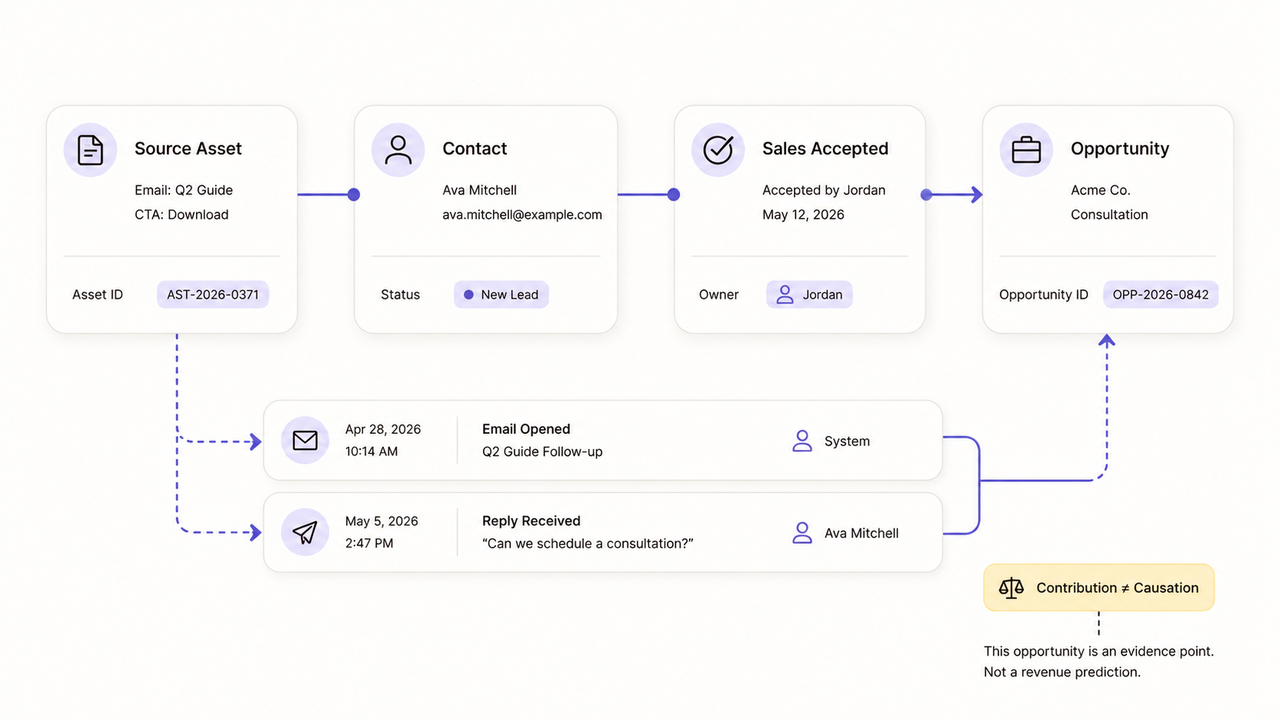
Preserve the source asset, capture action, available campaign label, contact or account record, status, owner, acceptance decision, rejection reason, opportunity reference, and timestamps. Do not overwrite the first interaction when a later form adds information.
The reporting view should answer a different question at each stage:
Measure | Question it answers | Review owner |
Relevant traffic | Did the intended audience reach and use the asset? | Content owner |
Captured contacts | Did the conversion path produce valid records? | Marketing operations |
Qualification rate | Did the records meet the agreed criteria? | Marketing and sales |
Sales acceptance | Did sales agree that follow-up was warranted? | Sales owner |
Opportunity linkage | Did an accepted lead enter a traceable opportunity? | Revenue operations |
Pipeline contribution | Which opportunities had documented content interactions? | Business owner or revenue lead |
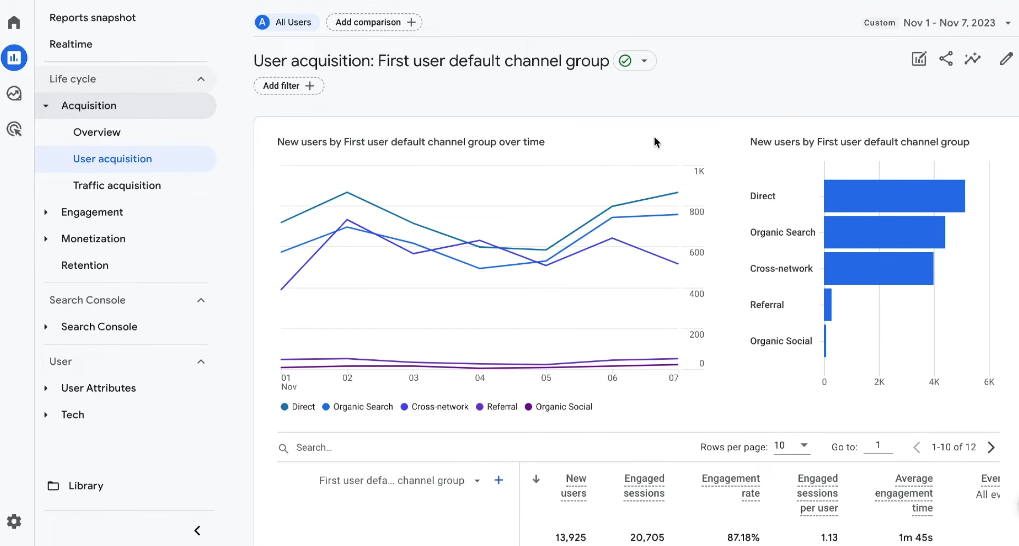
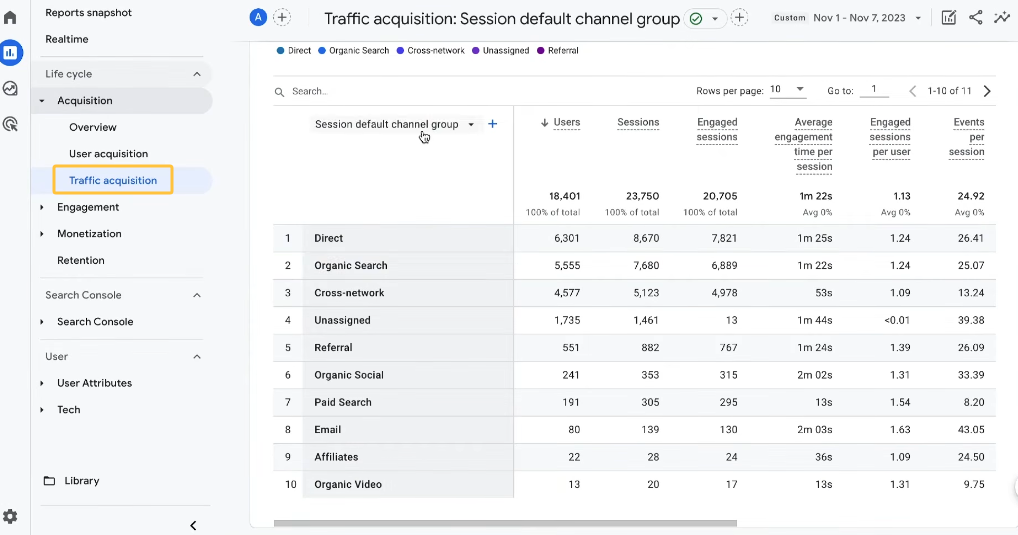
Keep reporting scopes visible. User acquisition describes first discovery, while traffic acquisition includes new and returning visitors, so similar metrics may answer different questions. Record the report, date range, event definition, and attribution setting before comparison.
Some teams return qualified calls or later sales stages to an advertising platform. Google Ads distinguishes online actions from offline conversion events such as calls, visits, and later lead progression. This is a measurement option, not proof that one article caused a sale.
Duplicate submissions need one master record without erasing interactions. Use CRM matching rules and route uncertain cases to human review. Preserve merge evidence so the team can reverse a wrong match.
When to Use Content Strategy or Writing Services
Keep the target account, qualified-lead rule, sales acceptance, offer boundaries, approved claims, and pipeline stages in-house. A provider may refine them; an internal owner approves them.
Use strategy help when the team cannot prioritize buyer questions, map assets, define conversion paths, or connect content to sales evidence. Use writing services when the plan is clear but production capacity is missing.
Before comparing services, write a brief that includes:
- the target buyer and question set;
- the funnel stage and required asset;
- approved claims and source requirements;
- the capture path and CRM destination;
- the marketing and sales handoff;
- deliverables, revisions, and approval owner; and
- the evidence required for acceptance.
Clear scope before commitment. A provider should know whether the assignment ends with approved copy, publication, form testing, nurture assets, reporting setup, or a documented handoff.
For a defined strategy or production gap, request a scoped content-service match through SpringBrand with the handoff and approval owner attached.
FAQ
When should content remain completely ungated?
Keep content ungated when the page itself must answer the searcher’s question, establish a shared definition, or help a buyer evaluate fit. Gate an additional asset only when it offers value beyond the public page and the team has a legitimate follow-up purpose. Do not hide basic conclusions or necessary context merely to increase form submissions.
How can sales teams reuse research-led content?
Turn the research into approved talk tracks, objection notes, short follow-up excerpts, and links to the full source. Keep the original citation, claim owner, publication date, and current version attached. Sales representatives can adapt the framing to a conversation, but changes to factual claims, product commitments, or offer terms should return to the appropriate approver.
What should happen when a lead magnet becomes outdated?
Assign an owner to revise, replace, or retire it. Update the landing page, form confirmation, nurture links, sales references, and internal links that still point to the asset. Preserve a version record and redirect the old URL when appropriate. Stop active promotion until the claims, examples, and next step are accurate again.
How should duplicate leads from several forms be handled?
Consolidate them under a master CRM record when the matching evidence is reliable, while preserving each form submission as a separate interaction. Do not count every submission as a new lead. Route uncertain matches for review, record why the merge was approved, and retain enough history to undo a mistaken consolidation without losing source data.
What happens when one prospect uses several email addresses?
Do not merge the records from email similarity alone. Look for reliable business evidence such as an authenticated account, confirmed company relationship, or direct clarification from the prospect. The CRM may keep several contact methods linked to one approved record. Until identity is sufficiently supported, preserve the records separately and avoid combining behavioral histories.
Conclusion
Content marketing lead gen earns pipeline credit only when an accepted lead, the source interaction, and the opportunity record remain traceable under the team’s stated reporting rules. Keep that evidence attached; otherwise, describe the result as engagement or lead activity rather than proven pipeline contribution.
Recommended Reads
- ChatGPT Sites for Small Business: What to Check
- ChatGPT Sites SEO: What Small Businesses Should Check
- LinkedIn Headline Examples That Explain What You Actually Do
- Turn Instagram Transcripts Into Marketing Content
Explore SpringBrand
Turn ideas into working workflows
Connect agents, APIs and tools in one workspace. Start with a task you want to get done.
Get started free
One account. 10,000+ APIs & capabilities
Give your agent APIs and plugins without separate keys or integrations for every provider.
Explore APIs
No tool expertise needed
Describe your GTM task. SpringBrand chooses the right APIs and plugins for your agent automatically.
Find tools for your task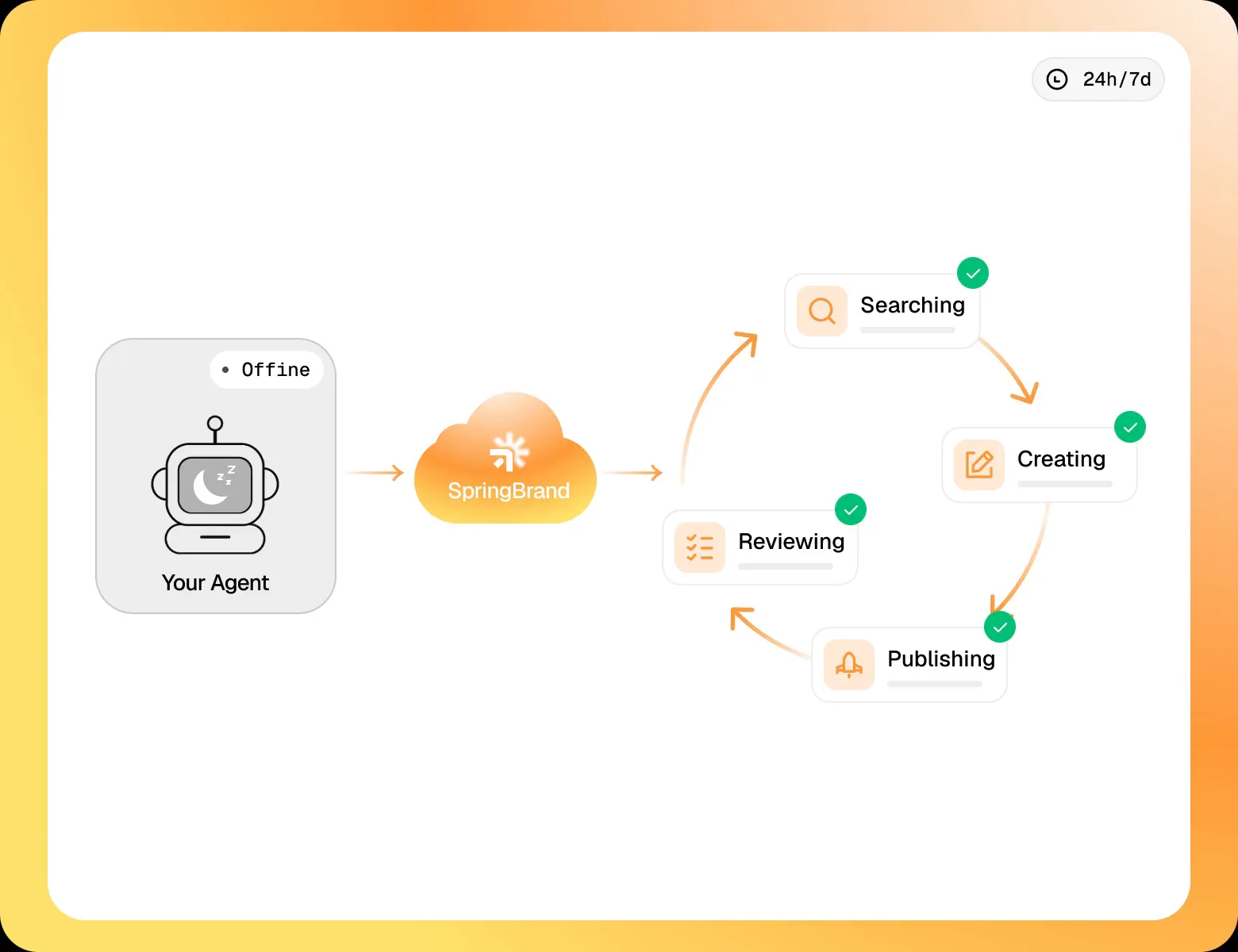
Run tasks 24/7
Connect your agent to SpringBrand to keep tasks running automatically, day and night.
Connect your agent