Hub-and-Spoke Content Marketing Workflow
Content marketing hub and spoke model amplification and repurposing can turn one core asset into coordinated search, email, and social content.
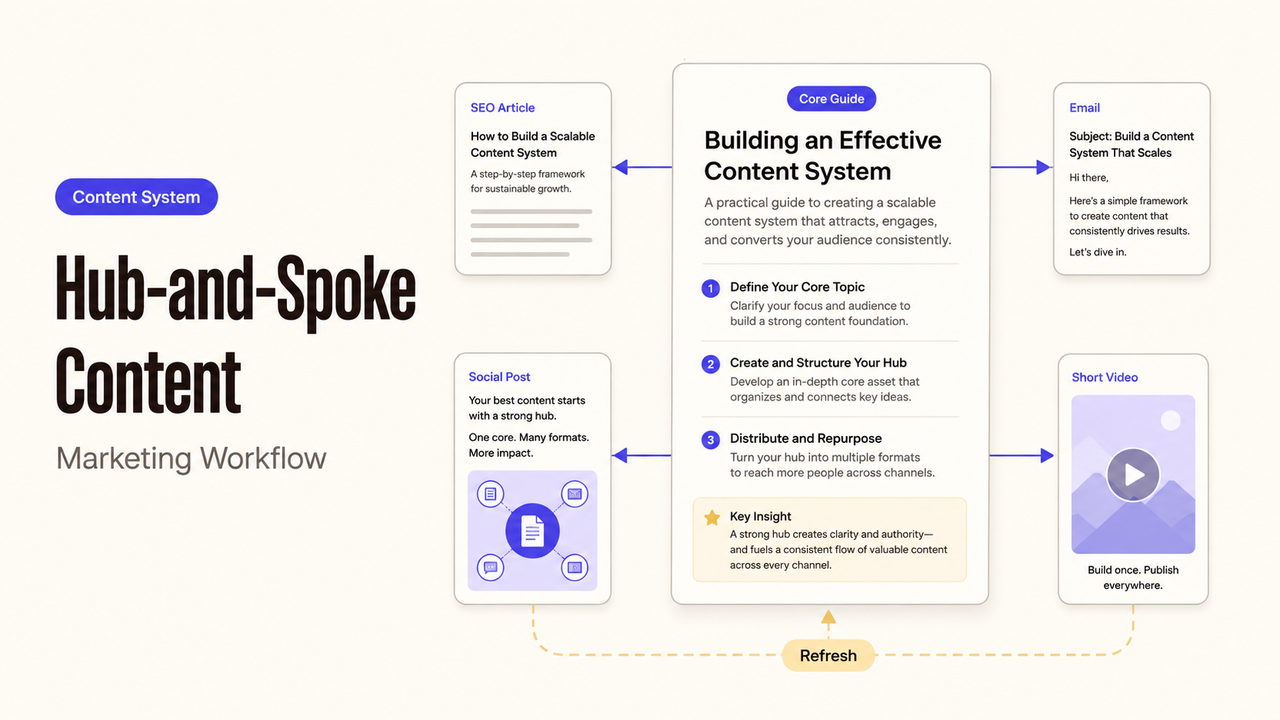
The team has finished a substantial market guide, and the next task in the calendar says only, “Turn it into posts.” Nobody has decided which customer questions deserve separate pages, which ideas belong in email, or who updates the guide when a product fact changes. A content marketing hub-and-spoke model for amplification and repurposing becomes executable only when those destinations, dependencies, and owners are mapped. For this guide, I’m Alex; follow the content from source to channel, and stop wherever the evidence or update path disappears.
How the Hub-and-Spoke Model Works
The hub is the core source on a broad topic the business can credibly own. It might be a guide, report, resource center, or service explainer. Spokes address narrower questions or channel jobs connected to that source.
The model has four working parts:
| Part | Job | Example record |
|---|---|---|
Hub | Establishes the main topic and source of truth | Core URL, expert owner, review date |
Spoke | Answers one narrower question or use case | Query, audience, format, hub section |
Amplification | Moves the useful idea into selected channels | Channel, publish date, destination |
Feedback | Returns audience and performance evidence to the system | Questions, search data, sales notes |
A hub is not simply the longest article, and a spoke is not any post that mentions it. Each spoke needs a reason to exist, an audience question, and a path back to the core asset.
The arrows run both ways. A sales question can become a spoke; repeated gaps may require a hub update. That feedback loop keeps the system alive after the initial queue ends.
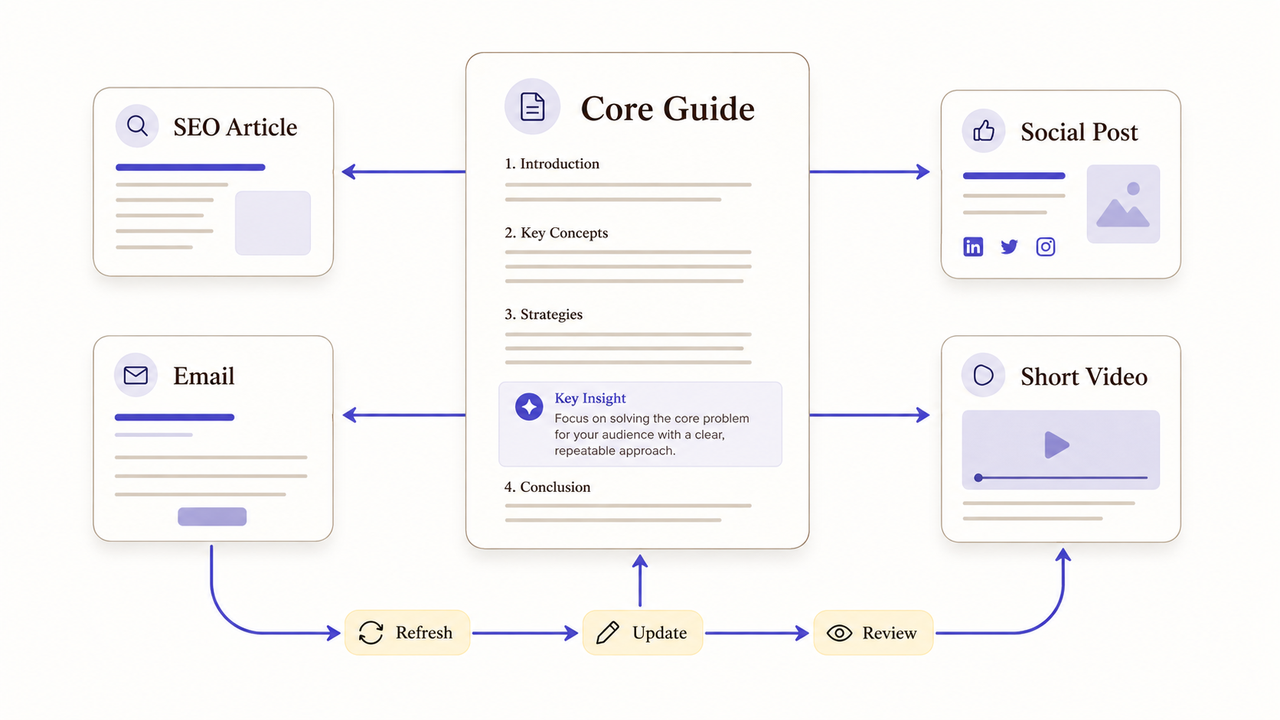
Choose a Hub Topic With Business Value
A promising hub sits where audience demand, business relevance, and available expertise overlap. Search volume cannot decide whether the company has anything useful to contribute or maintain.
Score each candidate topic against these questions:
| Criterion | Strong signal | Warning signal |
|---|---|---|
Audience need | Customers ask related questions across the buying process | The topic exists only in a keyword list |
Business fit | The topic leads naturally to a product, service, or informed next step | Interest would attract an unrelated audience |
Expertise | Internal experts can supply examples, distinctions, or original evidence | The team can only summarize other websites |
Spoke depth | The topic contains distinct questions with different purposes | Proposed spokes are keyword variations of one answer |
Maintenance | A named owner can review changing facts | Important claims have no source or update schedule |
Google’s guidance on helpful, reliable, people-first content asks whether a site has an intended audience and whether readers can achieve their goal. Apply those checks before committing to production.
Write a one-sentence boundary: “This hub helps first-time operations managers evaluate scheduling software; it does not compare enterprise workforce platforms.” This keeps the content hub SEO plan focused on a recognizable reader.
Map Spokes to Specific Questions and Channels
Start with questions, not formats. A list of articles, emails, and social posts defines volume but not purpose. A useful spoke map explains what each asset resolves.
Record these fields:
- audience and buying stage;
- exact question or objection;
- search or channel intent;
- proposed URL or destination;
- source section and evidence;
- format and channel;
- primary action;
- owner and review date.
One hub section may support several channel treatments, but not every treatment deserves a search page. Create a URL when the question, intent, and answer can stand alone. Keep shorter insights in email or social.
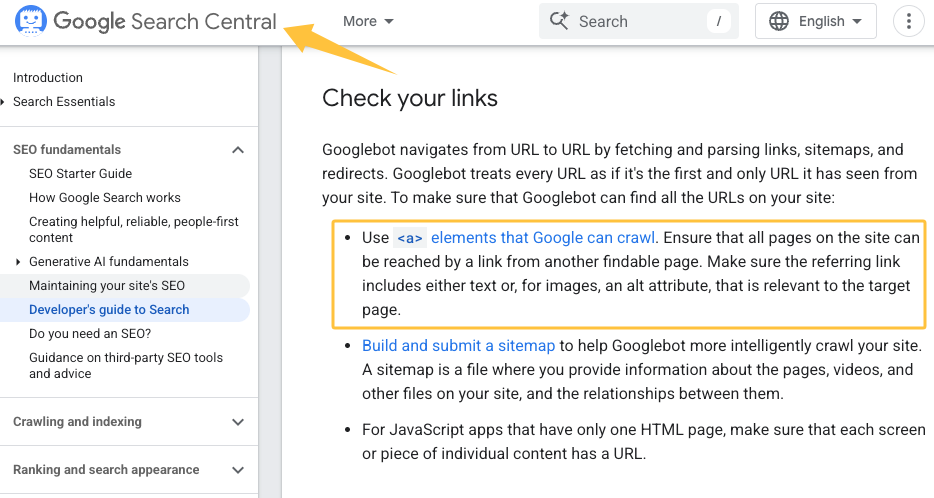
Google’s developer guidance says each page should be reachable from another findable page. Link spokes to the relevant hub section, and the hub to spokes that genuinely deepen the subject.
If two spokes use the same intent, evidence, and action, combine them or change their roles before drafting.
Repurpose Each Asset Without Duplicating It
A content repurposing workflow changes the job of the source; it does not merely shorten the same passage.
Use the source idea differently by channel:
| Source material | Spoke treatment | New job |
|---|---|---|
Detailed framework | Search article answering one implementation question | Help a reader complete a task |
Research finding | Email with interpretation and a link to the method | Re-engage a known audience |
Expert explanation | Short social sequence with one practical distinction | Create recognition and discussion |
Common objection | FAQ or sales-enablement note | Support evaluation and follow-up |
Process diagram | Webinar segment or annotated slide | Teach the relationship visually |
Keep facts, terminology, and conclusions consistent, but adapt the context, depth, opening, and action. A social post should stand alone; an email should explain why the linked section matters.
When repurposing produces substantially identical permanent pages, decide which URL is authoritative. Google explains that canonicalization selects a representative URL from duplicate or very similar pages. That safeguard is not permission to publish unnecessary copies.
Every spoke should retain approved claims, source notes, rights, data date, and hub version. Otherwise, an editor may preserve the wording but lose the condition that made it accurate.
Build an Amplification and Distribution Sequence
A content distribution strategy needs order. Publishing everything together can exhaust a small team and hide failed handoffs.
A practical sequence might be:
- Publish and review the hub.
- Add the planned internal links and verify destinations.
- Release the first search spokes around the highest-priority questions.
- Send an email that introduces the hub to a relevant segment.
- Adapt individual ideas for social, sales, and partner use.
- Revisit unanswered questions before producing the next wave.
The order can change, but each release needs a job. Email activates an existing audience, search spokes support discovery, and sales teams may surface objections the map missed.
Use one campaign naming convention. Google Analytics documents how utm_source, utm_medium, and utm_campaign identify referring campaigns and warns that inconsistent values can fragment reporting. Put approved names in the distribution record.
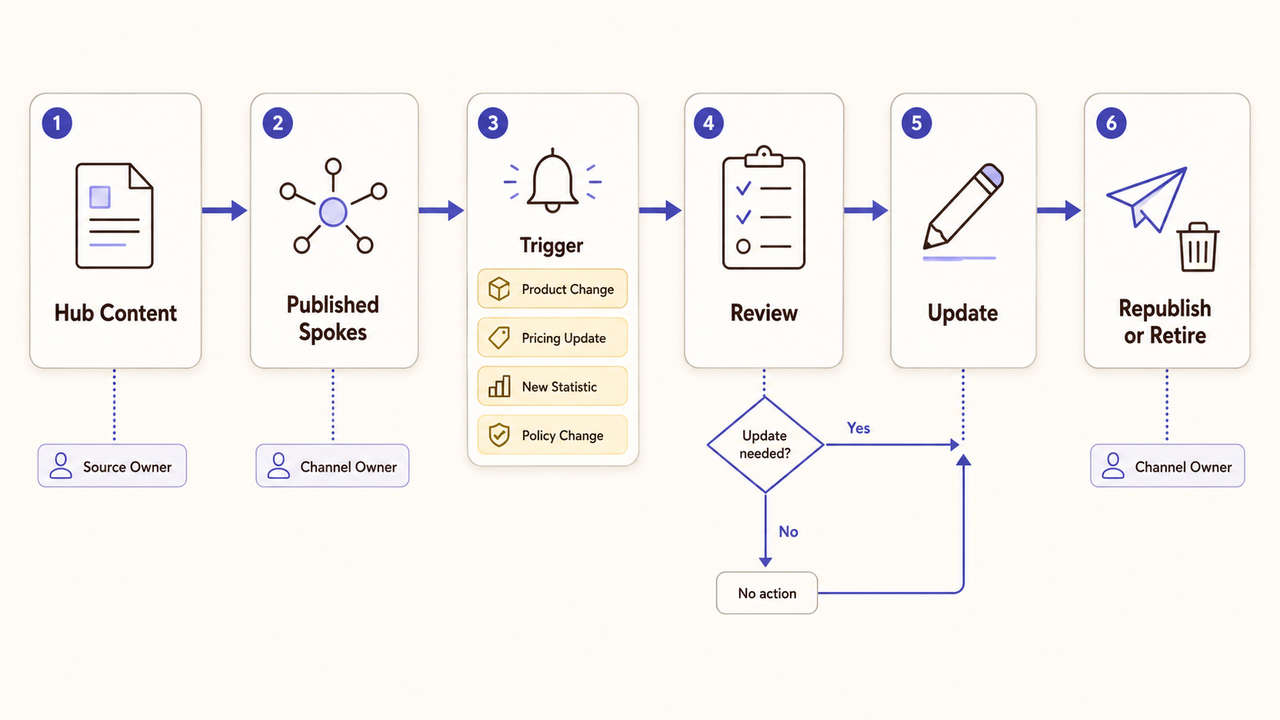
Put the exception path next to the schedule. A hub change should reveal which spokes need review; amplification should not continue after its source becomes unreliable.
Assign Owners and Maintain Content Quality
The handoff needs a named owner. “Content team” does not tell anyone who can approve a claim, pause an email, or retire an outdated spoke.
Assign responsibility by decision:
| Role | Owns |
|---|---|
Hub owner | Topic boundary, source of truth, review cycle |
Subject expert | Technical or product accuracy |
SEO editor | Search intent, URL plan, internal links |
Channel owner | Adaptation, schedule, destination, platform fit |
Approver | Final claims, offer, and publication decision |
Measurement owner | Naming, reporting, and program review |
One person may hold several roles, but decisions must remain visible. Log the affected asset, source, approver, date, and reason so a new editor can inherit the program.
Set review triggers. A pricing change, product release, policy update, expired statistic, or departing expert may require immediate action. Mark which spokes inherit hub facts.
Quality control covers more than grammar. Check accuracy, originality, search overlap, voice, accessibility, rights, links, and whether the CTA still fits. A polished spoke can still be wrong or redundant.
Measure the System as a Connected Program
Measure the hub, spokes, channels, and business response separately before judging the whole program.
| Layer | Questions to review |
|---|---|
Hub | Is the core asset being found, used, and kept current? |
Spokes | Which questions earn relevant impressions, visits, or engagement? |
Distribution | Which channels send the intended audience to the right destination? |
Business response | Are readers taking useful next steps or raising better-qualified questions? |
Operations | Are assets delayed by research, review, production, or approval? |
The Search Console Performance report can show queries, pages, impressions, clicks, and changes over time. Review related URLs together, then inspect individual pages.
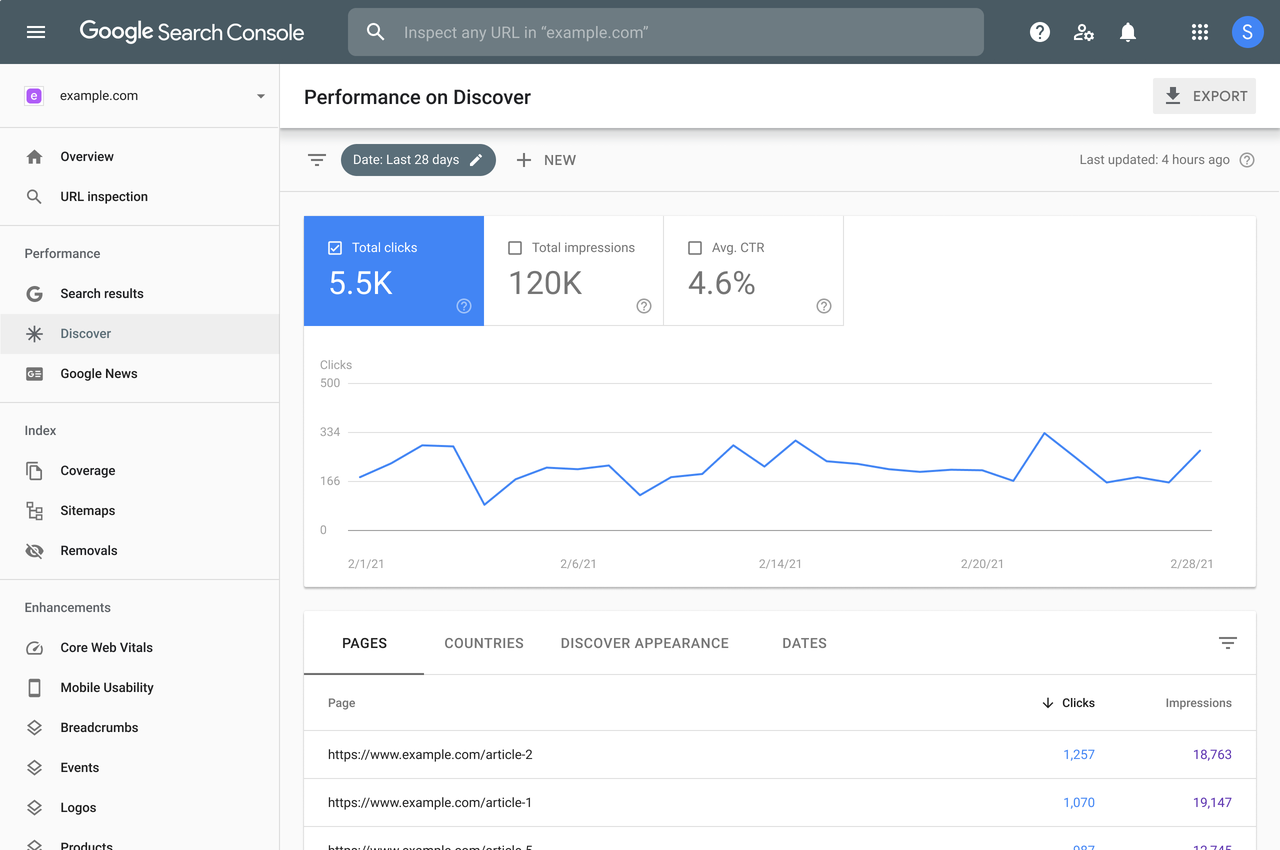
Do not force every interaction into one attribution claim. Preserve channel evidence while separating what the data shows from what the team infers.
The review should produce a decision: update the hub, expand a question, change a treatment, consolidate spokes, or stop maintaining a branch.
FAQ
Can an existing content archive become the first hub?
Yes, if the archive has a coherent topic, credible sources, and an owner. Audit existing URLs first. Identify the strongest core asset, resolve overlapping pages, repair internal links, and map gaps. Related posts do not become a hub until their relationships and update path are explicit.
What if one hub serves several audience segments?
Keep one hub when the explanation and evidence remain the same. Create segment-specific spokes when questions, examples, objections, or actions differ. If each segment needs a different promise, one hub may become too broad to maintain.
How should content be updated after an expert leaves?
Assign a new subject owner before the previous expert leaves. Preserve source notes, claim records, and approved versions. If no qualified owner can verify a claim, narrow it, replace it, or retire the affected asset.
Can gated resources function as spokes?
Yes, when the gated asset performs a distinct job and visitors can understand its value before submitting information. Explain its audience, contents, and next step outside the gate. Record its hub relationship and maintenance owner.
What happens to seasonal spokes after demand falls?
Decide whether to update the asset, redirect it to an evergreen resource, or retire it. Remove expired offers and misleading dates. Preserve the performance and source record without automatically republishing old claims.
Conclusion
A content marketing hub-and-spoke model supports amplification and repurposing when every asset has a distinct question, source relationship, channel job, and update owner.
To turn the map into a scoped production brief, review the Content Marketing services available through SpringBrand before assigning the first cycle.
Do not release the next spoke until someone owns the hub facts it inherits and the decision to change them.