Content Marketing for Startups: A Lean Growth Plan
Content marketing for startups works best with one audience, one business goal, a sustainable cadence, and deliberate make-or-buy decisions.
Every startup article uses two budgets: production time and expert attention. The content calendar usually tracks the first and quietly spends the second.
That imbalance is where content marketing for startups starts to break down. I’m Alex. We’ll build a plan around the startup’s stage, available evidence, and real review capacity, then decide what to outsource.
Start With the Startup Stage and Business Goal
Pre-launch learning, early demand, and sales support
A pre-launch team is still learning which problem matters most. It is also testing which audience responds to the offer. Content can support interviews, explain the product category, test language, or prepare a product launch marketing campaign.
At this stage, publishing more is rarely the main goal. The quality of what the team learns matters more.
After launch, content may need to create early demand or support sales. Search pages can answer questions from people already researching the problem. Product explanations and comparison pages can help prospects evaluate the offer. Founder insight can give sales a stronger way to frame the conversation.
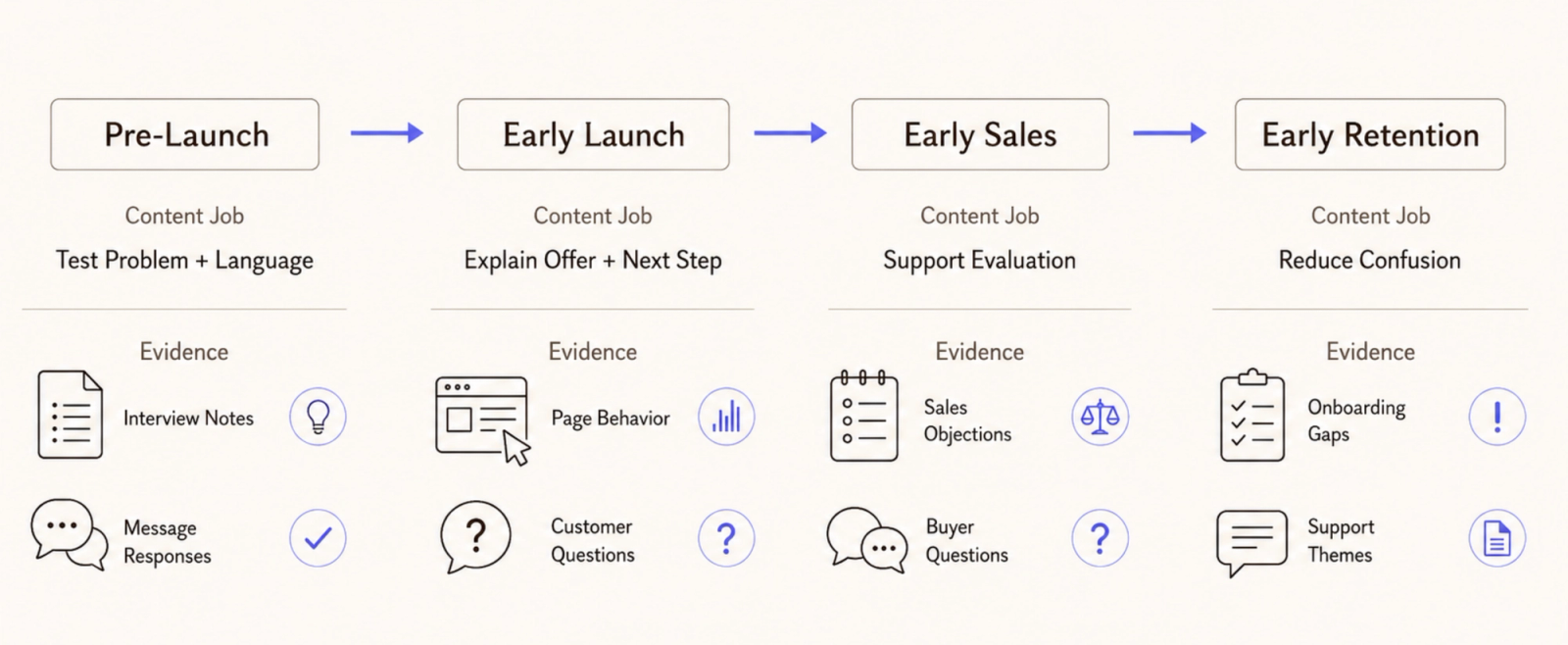
The startup stage determines the next job for content:
| Startup stage | Immediate content job | Useful evidence |
|---|---|---|
Pre-launch | Test the problem and language | Interview notes and message responses |
Early launch | Explain the offer and next step | Page behavior, questions, and objections |
Early sales | Support evaluation | Sales feedback and repeated buyer concerns |
Early retention | Reduce confusion after purchase | Onboarding gaps and support themes |
A mature company’s channel mix is a poor default for a startup. Its team, evidence, recognition, and sales process may be completely different.
Choosing one outcome before choosing channels
Choose one outcome for the next working cycle. The team might need to identify its strongest audience or explain a new category. It may need to answer a sales objection or reduce confusion during onboarding.
“Build awareness” is too broad on its own. The team needs to name the audience and the response that would indicate progress. A list containing LinkedIn, email, and a blog names channels. It does not explain why the business needs the content.
Write the outcome in this form:
For [specific audience], answer [decision or question], so the business can learn or support [observable outcome].
This statement does not promise revenue. It gives the team a reason to reject content that consumes capacity without supporting the current stage.
Build a Lean Content Foundation
Audience problem, point of view, proof, and offer
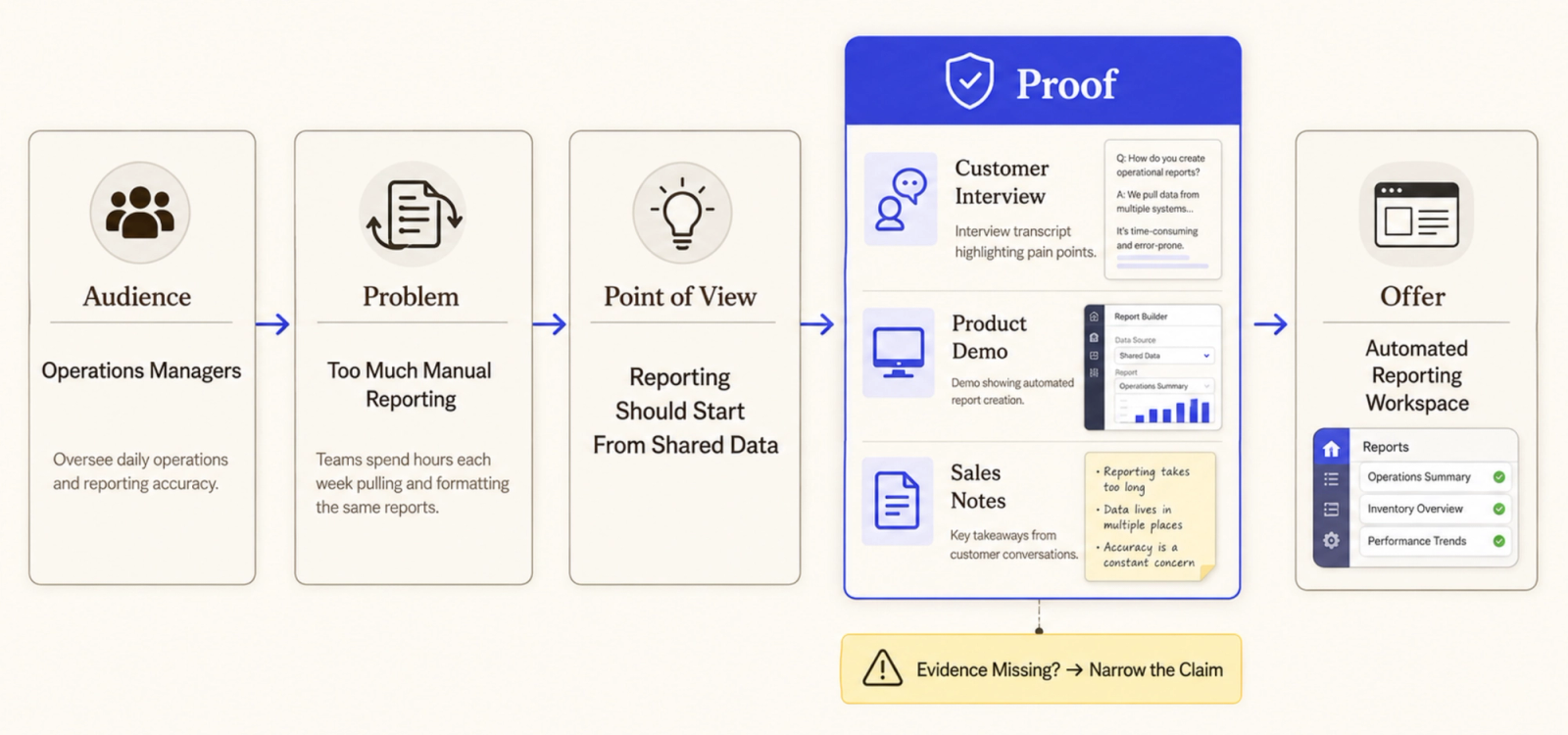
A minimum content foundation connects four decisions. Who does the startup serve? Which problem does it address? What does it believe about that problem? What can it offer today?
Start with evidence instead of inventing a persona. Useful inputs include interviews, product calls, support messages, search language, and reasons for lost deals. Early user behavior may also show how people describe the problem.
The SBA’s market research guidance covers customer behavior, interviews, surveys, and competitive analysis. Those inputs can help a startup test its business idea and audience assumptions.
The startup’s point of view should make a choice it can defend. It might challenge a familiar process or connect two problems that buyers often separate. It can also explain when the product is not a good fit. Manufactured controversy adds attention without adding useful evidence.
Match the proof to the claim. Product records, demonstrations, founder expertise, customer evidence, and documented research support different statements. When proof is limited, narrow the claim instead of writing with more confidence.
Minimum viable messaging and reusable source material
A lean messaging sheet can fit on one page. Record the audience, problem, point of view, offer, approved proof, common objection, prohibited claim, and next action.
The source library can stay small:
- product and offer facts;
- founder or expert interviews;
- approved customer language;
- frequently asked questions;
- sales and support observations; and
- current brand and claim guidance.
More production will not resolve a disagreement about the audience, promise, or evidence. Settle those questions before commissioning a large content calendar. The startup may first need positioning or suitable branding services for startups.
Limit access to unreleased product notes and early-user material. The FTC’s Start with Security guidance recommends collecting only necessary information and limiting access. It also advises businesses to set expectations for providers and dispose of data they no longer need.
Choose Topics and Formats a Small Team Can Sustain
Startup questions—not a lead-gen funnel or hub-and-spoke workflow
Choose topics from questions the startup needs to answer now. Those questions may come from buyers, users, partners, sales calls, onboarding, or the product team.
This plan stops before funnel design and distribution architecture. The content marketing lead-generation guide covers capture, nurture, and sales follow-up. The hub-and-spoke workflow covers coordinated production and distribution.
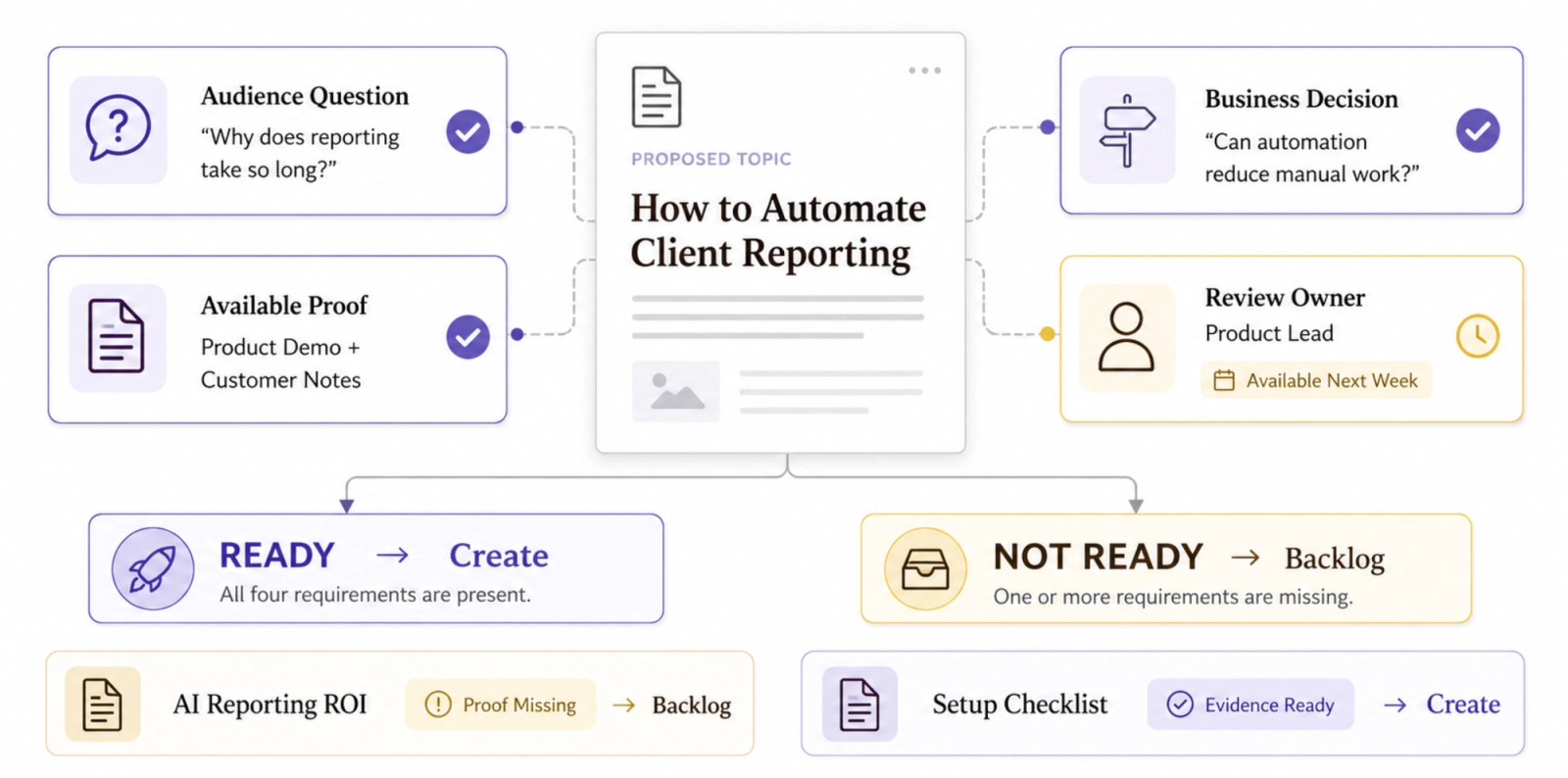
Evaluate each topic with four questions:
- Which audience question does it answer?
- Which business decision does it support?
- What proof or expertise is available?
- Who can review it during this cycle?
A topic without evidence or an owner stays in the backlog. A competitor’s new article does not automatically make that topic urgent.
Matching format complexity to available expertise
Use the simplest format that answers the question well. A short product note may be enough to explain one release. A comparison page may require product review, legal input, and structured evidence. A customer story needs consent, interviews, editing, and approval.
SaaS content marketing often draws on product managers, engineers, salespeople, and customer-success specialists. Their availability is part of the production capacity. That remains true when an outside writer prepares the draft.
Count the review burden as well as the writing time. A technical article may take two hours to draft and three weeks to approve. In that case, the expert handoff limits the cadence.
Create a Repeatable Operating Cadence
Research, creation, review, distribution, and learning
Give every content item a clear state and owner:
- Research ready: The question and source material exist.
- In creation: One person owns the draft or asset.
- In review: Named reviewers have a deadline.
- Approved: Claims, links, and the next action are cleared.
- Published: The final location and date are recorded.
- Learning: The team is collecting the agreed signals.
Keep distribution proportional to the team’s capacity. One primary channel and one supporting channel may be enough. Five versions of every asset can create more work than the original production plan.
Paid, sponsored, or partner-created content may need a disclosure. The FTC’s native advertising guidance says commercial content should not mislead people about its nature. Any required disclosure should be clear and prominent.
Hold a regular review meeting with a narrow purpose. Decide what proceeds, what remains blocked, and what the team learned. Do not use the meeting to add more requests than the team can finish.
Founder input without making the founder the bottleneck
Founder insight can sharpen positioning and explain an unusual view of the market. It can also provide details that an outside writer cannot infer. Capture that input through a planned interview, voice note, annotated outline, or short review window.
The founder should not need to approve every sentence. Let the relevant expert check facts and the content owner manage brand consistency. Send high-risk claims to the appropriate qualified reviewer.
A practical routine might include one monthly interview and one outline checkpoint. Add one final founder review limited to strategic questions. The content lead should combine questions and record decisions before sending the next batch.
Repeated founder rewrites often point to missing messaging rather than weak writing. Pause the queue and identify the disputed decision. Update the source guidance before producing another round of content.
Measure, Learn, and Decide What to Outsource
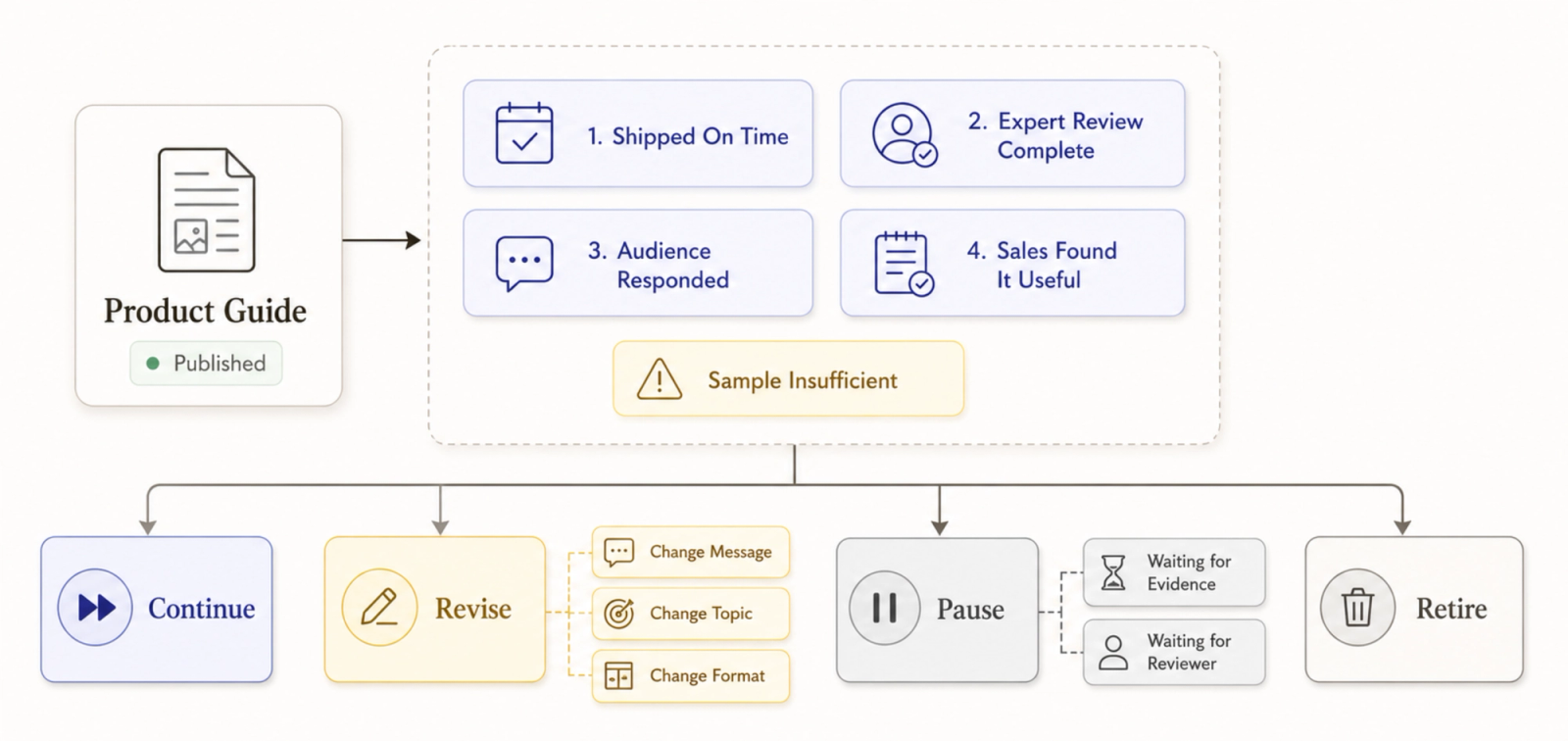
Leading indicators and business-relevant signals
Early measurement should help the team make a decision. Start with basic operating signals. Did the content ship on time? Did expert reviews arrive? Did the intended audience respond? Which questions still appear after publication?
Business signals might include qualified replies, recurring search queries, demo questions, or use of an asset in sales conversations. Onboarding confusion and customer feedback may also reveal a gap. These observations do not prove that content caused a sale or retention result.
Record the baseline, observation period, tracking gaps, and interpretation owner. If the sample is too small, label it sample insufficient. A handful of responses should not become a startup benchmark.
At the end of the cycle, choose one action: continue, revise, pause, or retire. A sustainable content system stops low-value work as deliberately as it starts new work.
When specialist execution is more practical than another tool
Outsource when the work requires skills or capacity the team cannot maintain. Common examples include research, interviewing, technical writing, editing, design, video, SEO, and production management.
Another tool cannot replace missing expertise, unavailable reviewers, or unclear approval rights. Define the outcome and format before hiring. Also document the sources, internal owner, review process, delivery files, revision boundary, and confidentiality needs.
Keep decisions based on company truth inside the business. The startup should own its audience choice, product claims, roadmap, brand position, and final approval. A provider can organize the evidence and produce the work without taking over those responsibilities.
The final handoff should include editable files, source records, approvals, usage permissions, and unresolved issues. A folder of finished assets is hard to maintain without that context.
How SpringBrand Fits This Workflow
SpringBrand can help a startup clarify its request and match it with independent providers. It does not run the content strategy or guarantee growth results.
Turn the next content gap into a scoped service request when outside execution becomes the practical constraint.
FAQ
These answers provide general workflow information, not legal advice. Rights, privacy duties, disclosures, and contractual outcomes depend on the agreement, jurisdiction, and publishing platform.
What consent is needed before using an early customer’s quote?
Permission to conduct an interview may not cover public promotional use. Confirm the exact quote, attribution, edits, channels, duration, and commercial context. The FTC’s consumer reviews and testimonials guidance distinguishes testimonials from ordinary reviews. Keep the customer’s approval with the published wording.
How should embargoed roadmap details be handled by a content provider?
Share only the details needed for the assignment. Use an approved system and name each recipient. The contract should cover confidentiality, subcontractors, permitted tools, publication timing, incident reporting, and deletion or return. Use controlled placeholders when the provider does not need the underlying information.
Who owns ghostwritten founder content after a contractor leaves?
The contract should address drafts, final copy, research, recordings, and unused concepts. Payment alone does not settle every ownership question. The U.S. Copyright Office’s Works Made for Hire circular explains that commissioned work must meet specific conditions. Obtain qualified advice for the actual arrangement.
When must sponsored partner content be disclosed?
A material relationship can include payment, free access, reciprocal promotion, or affiliate compensation. Confirm the applicable law and platform policy before publication. Place any required disclosure where readers can notice and understand it, rather than on a distant legal page.
Can early-access user data be shared with a content vendor?
First confirm the purpose, authority, data fields, security controls, retention period, and provider duties. Share the smallest useful dataset and remove direct identifiers when appropriate. Anonymization does not remove every privacy risk. Use approved accounts and revoke access after the assignment.
Conclusion
A workable plan for content marketing for startups is smaller than the list of available channels. It gives one audience question a clear purpose and relies on evidence the team can verify. It also fits the review capacity the startup actually has.
Before the next cycle begins, assign one person to the outcome and another to the content queue. Then agree on the evidence that will justify continuing the work.