UX Designer Audit for One Core Product Flow

Core-flow UX auditUX Designer Audit for One Core Product FlowClear scope · defined handoff · provider matched after request

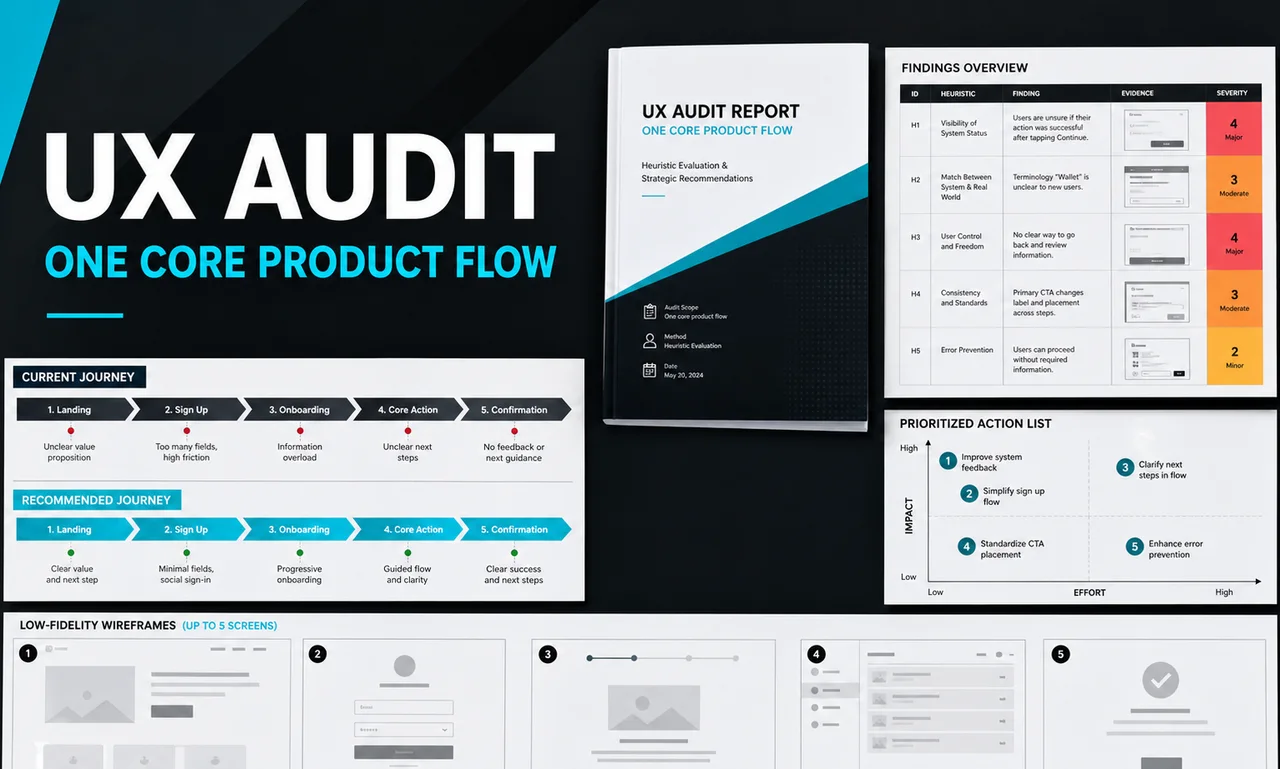
This UX designer package audits one existing core product flow when the team needs an expert diagnosis before commissioning polished UI or development. The provider reviews supplied screens or a working product, documents heuristic findings with evidence and severity, maps the user flow or journey, proposes up to five low-fidelity wireframes, and organizes recommendations into a prioritized report. One consolidated revision round is included. Visual UI design, design systems, code, implementation, recruited testing, interviews, and a formal usability study are excluded. Recommendations are hypotheses based on expert review and buyer-supplied evidence; they do not guarantee conversion, retention, task completion, accessibility compliance, or revenue.

Who it's for

product managersstartup foundersSaaS teamse-commerce product teamsin-house designers

Relevant platforms

FigmaFigJamweb applicationsiOSAndroid
Core-flow UX audit
Upload-ready

What you'll get

  • Core-flow heuristic audit report
  • Finding list with evidence, heuristic, and severity
  • Current-state user flow or journey map
  • Recommended flow or journey adjustments
  • Up to five low-fidelity wireframes
  • Prioritized action list with impact and effort notes
  • Open research and validation questions

Buyer requirements

  • Product URL, prototype, or complete screenshots of the flow
  • Definition of the target user and the task being reviewed
  • Known business rules, edge cases, and technical constraints
  • Existing analytics, research, support tickets, or feedback if available
  • Current product goals and any suspected friction points
  • Access credentials for a test environment when the flow is not public
  • One decision-maker who can consolidate factual corrections and feedback

Work process

  1. 1
    Define the audit boundary

    Confirm the target user, start and end points, reviewed screens, available evidence, business rules, and known constraints.

  2. 2
    Review the current experience

    Walk through the flow and document clarity, consistency, feedback, error prevention, cognitive load, and accessibility concerns.

  3. 3
    Map and prioritize findings

    Connect findings to the journey, assign severity, distinguish evidence from assumptions, and order recommendations by likely value and effort.

  4. 4
    Wireframe priority fixes

    Create up to five low-fidelity frames that make the highest-priority recommendations easier to discuss and implement.

  5. 5
    Revise and hand off

    Apply one consolidated clarification round and deliver the final report, maps, wireframes, and open validation questions.

Who this service is for

Best-fit buyer

Graphics & Design Services teams that need Core-flow UX audit without building the workflow from scratch.

Inputs needed

Operators who can provide Product URL, prototype, or complete screenshots of the flow, Definition of the target user and the task being reviewed and Known business rules, edge cases, and technical constraints and want a polished, implementation-ready output.

Decision context

Buyers comparing packaged help for Core-flow heuristic audit report, Finding list with evidence, heuristic, and severity and Current-state user flow or journey map with clear scope, price, and turnaround.

How the deliverables are used

DeliverableFormatPractical use
Core-flow heuristic audit reportReportUse it to prioritize fixes, explain next steps, and align stakeholders around the work.
Finding list with evidence, heuristic, and severitySpreadsheetUse it as a practical Core-flow UX audit asset that can be edited, shared, and implemented after delivery.
Current-state user flow or journey mapEditable assetUse it as a practical Core-flow UX audit asset that can be edited, shared, and implemented after delivery.
Recommended flow or journey adjustmentsEditable assetUse it as a practical Core-flow UX audit asset that can be edited, shared, and implemented after delivery.
Up to five low-fidelity wireframesEditable assetUse it as a practical Core-flow UX audit asset that can be edited, shared, and implemented after delivery.
Prioritized action list with impact and effort notesSpreadsheetUse it as a practical Core-flow UX audit asset that can be edited, shared, and implemented after delivery.

Scope and handoff

What shapes the final work

The strongest results come from a specific brief: Product URL, prototype, or complete screenshots of the flow, Definition of the target user and the task being reviewed, Known business rules, edge cases, and technical constraints, Existing analytics, research, support tickets, or feedback if available and Current product goals and any suspected friction points. The provider uses those inputs to tune the deliverables to your market, channel, and operating style.

What happens after delivery

You receive editable assets from SpringBrand Product Design Network that can be reviewed, revised, and moved into your own tools. If the work needs platform setup, publishing, or ongoing management, treat that as a follow-on scope.

Examples and delivery notes

Concrete examples, scope boundaries, and notes on how buyer inputs become usable assets.

Sample output — Core-flow UX finding

Finding: checkout loses context after plan selection

  • Observed issue: The selected plan is not visible on the account step, so users must rely on memory before payment.
  • Heuristic: Visibility of system status and error prevention.
  • Severity: High because the uncertainty occurs immediately before commitment.
  • Recommendation: Preserve the selected plan, price, billing interval, and edit option in a persistent order summary.
  • Wireframe response: A revised account step showing the order summary and a clear back-to-plans action.

Before & after — From opinions to a prioritized UX direction

  • Before: The team knows a flow feels confusing but has no shared issue list, journey map, or order of operations.
  • After: Findings are tied to the reviewed screens, ranked by severity, mapped across the journey, and translated into up to five low-fidelity wireframes.
  • What changes: Product and design teams can separate immediate friction fixes from later research questions.

Scope boundaries

  • Covers one existing core flow, a heuristic review, one user flow or journey, up to five low-fidelity wireframes, a priority report, and one consolidated revision round.
  • Does not include visual UI design, a design system, code, implementation, participant recruitment, interviews, analytics instrumentation, or a formal usability study.
  • Findings are expert-review recommendations based on supplied evidence, not validated user-research conclusions.
  • No guarantee is made for conversion, retention, task completion, accessibility compliance, or business results.

Why this provider model

SpringBrand Product Design Network provides a bounded expert review for teams that need diagnostic UX work before committing to a full redesign. The fixed flow and wireframe limits keep the service comparable to common freelance marketplace offers while separating evaluation from unperformed research. The service is delivered independently through SpringBrand with scope and accountability stated directly on this page.

FAQ

What counts as one core product flow?

It is one connected start-to-finish task, such as sign-up, checkout, booking, creating an item, or completing a request. Separate roles, unrelated journeys, or multiple funnels require additional scope.

Is this a redesign or a UX audit?

It is an expert UX audit with a flow or journey map, prioritized findings, and up to five low-fidelity wireframes. Polished visual UI, brand styling, and a complete redesign are not included.

Does the audit include user interviews or usability testing?

No. Participant recruitment, interviews, moderated tests, surveys, and a formal usability study are excluded. Existing research or analytics can be reviewed when the buyer supplies it.

What does the one revision round cover?

One consolidated feedback round can clarify findings, correct factual assumptions, or refine the included wireframes. Adding a new flow, new screens, or new research inputs after delivery requires a separate scope.

Will the recommended changes guarantee improved conversion or retention?

No. The report prioritizes likely friction based on expert review and supplied evidence, but outcomes depend on implementation, product-market fit, traffic, user behavior, and later validation.

Explore adjacent services that solve the next step in this workflow.

View all services