AI Agent Architecture for Business Workflows
AI agent architecture connects task logic, context, memory, tools, execution state, and human review into one inspectable system.
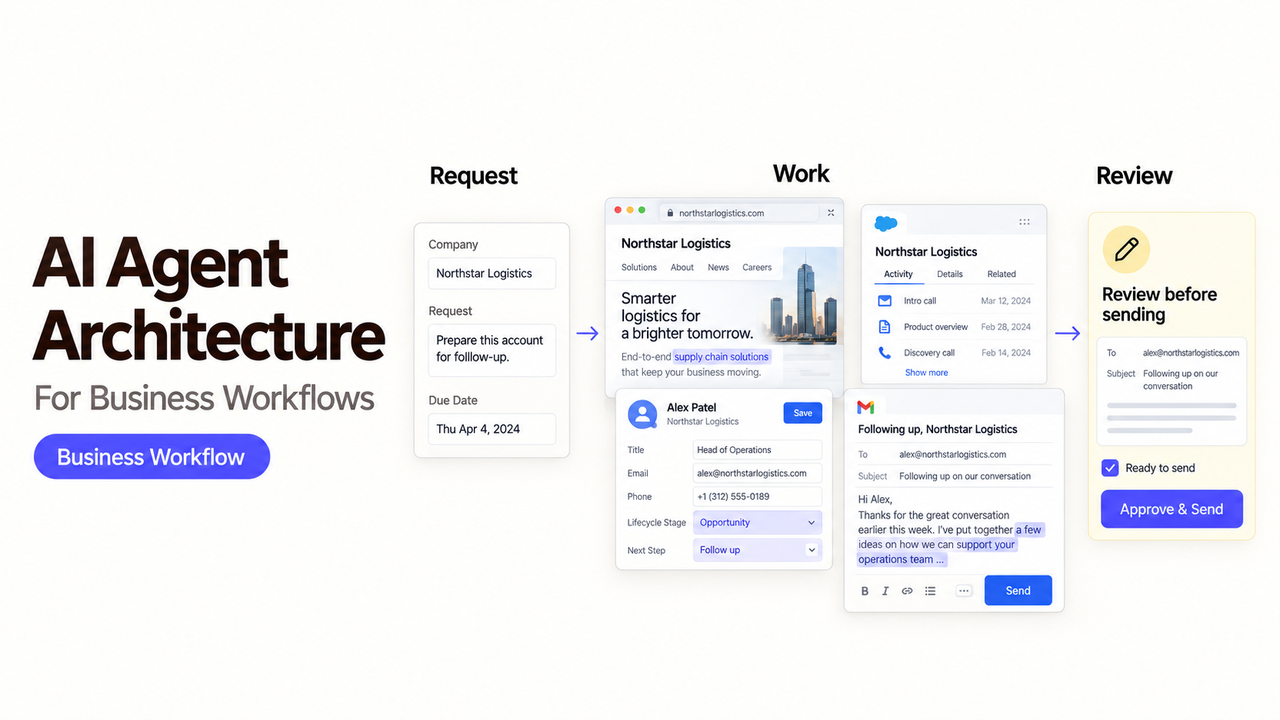
A prospect brief reaches sales with the wrong region. The team now has several places to look: the request, working context, memory, data tool, decision step, or final mapping.
A useful AI agent architecture makes that path traceable. I’m Alex, and I’ll follow one prospect-research task from validated input to a reviewed result. We will stay at the component level rather than turn this into a framework tutorial.
The Core Layers of AI Agent Architecture
IBM’s conceptual agentic AI pattern separates input, execution, planning, tools, and memory. Operational management and security controls can sit around them.
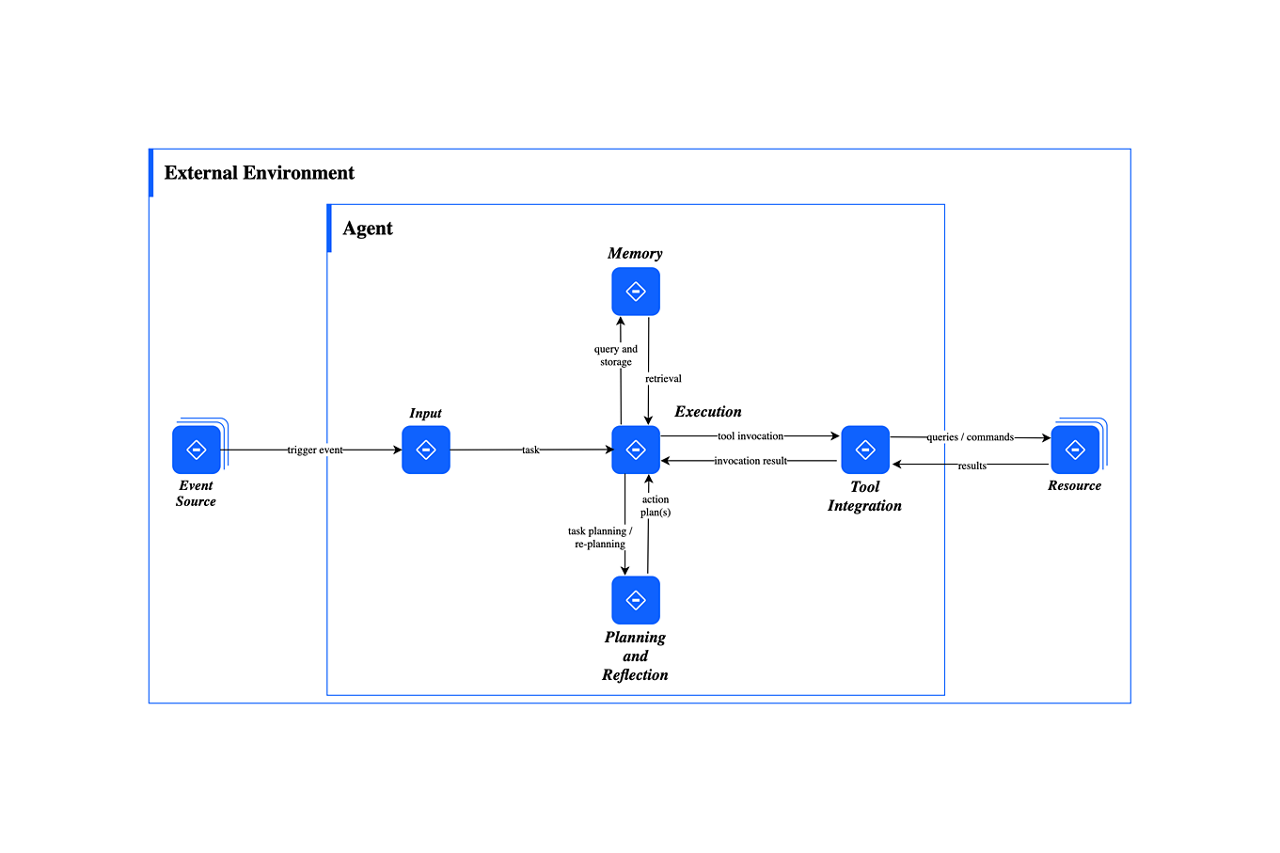
For a business review, group the system into four layers with defined inputs, outputs, and failure routes.
Task Definition and Decision Logic
The task definition says what the agent is trying to finish. It also states what falls outside the assignment.
For our example, the task is: prepare a cited prospect brief for a sales representative. It must not assign territory, change a CRM record, or contact the prospect.
Decision logic controls how the task moves. A missing domain can trigger a fixed return rule. Choosing which approved source to query may allow bounded model judgment.
The important question is not whether the system “reasons.” Ask which decisions it can make and what happens when the evidence conflicts.
Context, Memory, and State
- Context is the material available for the current model call: the request, tool descriptions, instructions, and selected results.
- Memory retains chosen information beyond one call or task. Examples include an approved company alias or a user preference that should apply later.
- State records where this run is now, including completed steps and pending review.
Do not place everything in long-term agent memory. A source result can become stale, while a rejected territory guess could contaminate the next run.
Give stored items a purpose, owner, retention rule, and update path. Keep the original request and run state available even when the model receives a shorter working context.
Tools and Capability Interfaces
Tools let the agent search, calculate, retrieve records, or change another system. The interface should describe the action more precisely than its display name does.
For a company-research tool, define inputs, returned fields, sources, timestamps, and error states. The current Model Context Protocol tools specification uses input and optional output schemas for this contract. It also calls for validation, access controls, timeouts, and logging.
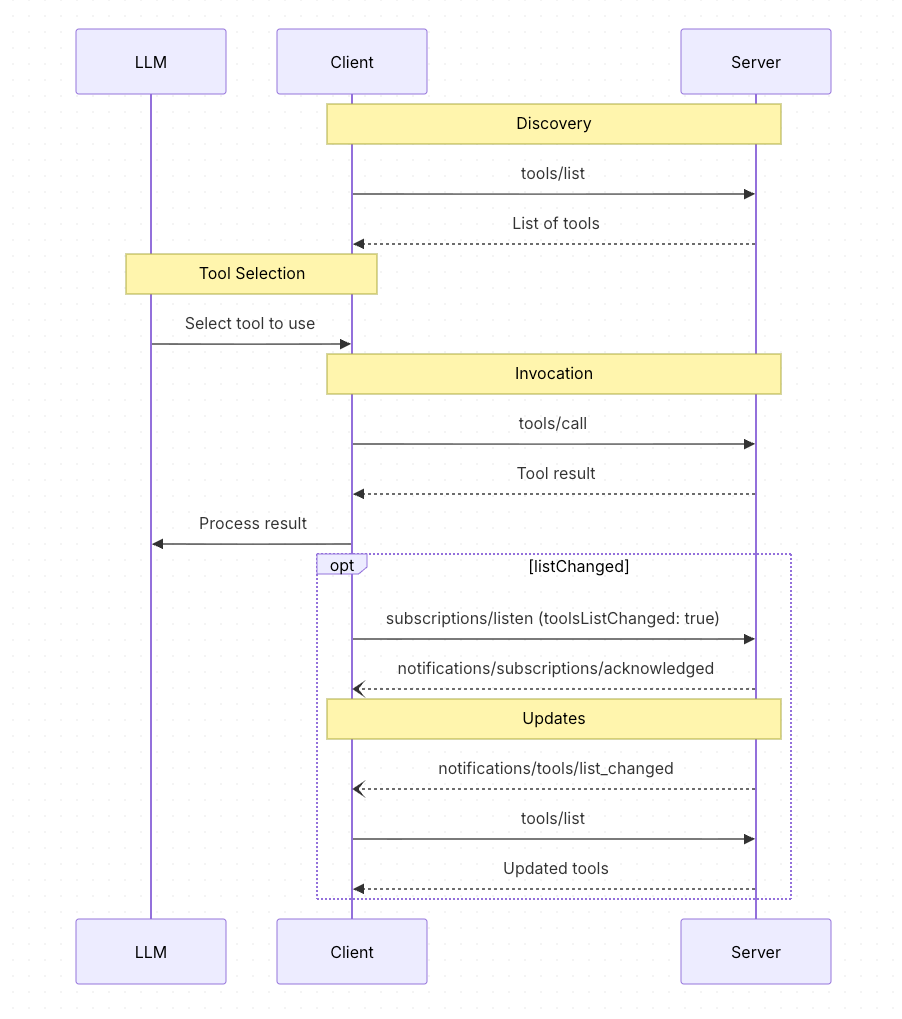
The model proposes a call; the surrounding application validates and executes it. This separation keeps agent tools from becoming vague permissions hidden inside a prompt.
Execution, Review, and Observability
The execution layer sends validated calls, handles timeouts, records responses, and applies the retry policy.
Review is a separate state. The sales representative needs the draft, cited fields, unresolved conflicts, and tool failures before giving an explicit response.
Observability gives the team a usable trail. Record the run ID, architecture version, model, tool outcomes, reviewer decision, and destination. Exclude secrets and unnecessary personal data.
Trace a Task Through the Architecture
Turn Validated Input Into Working Context
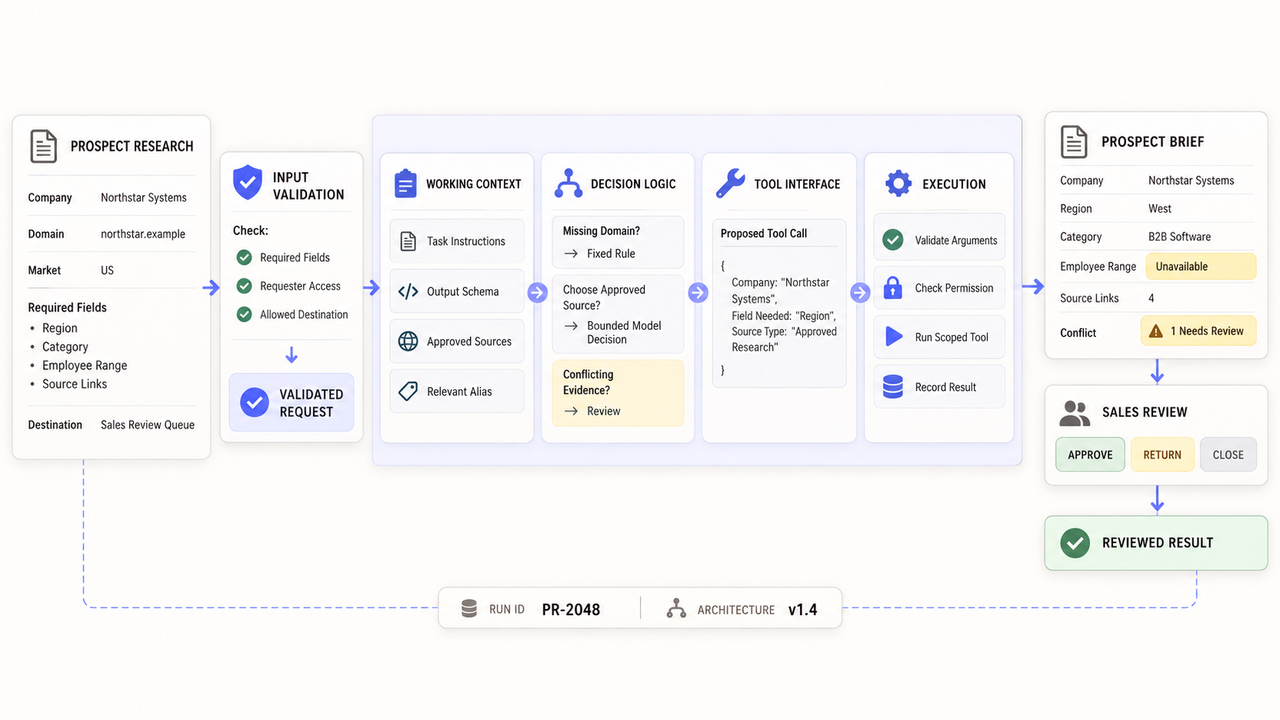
The request enters with a company name, domain, market, required fields, and destination. Validation checks completeness and the requester’s access.
The context builder adds the research policy, output schema, read-only tools, and relevant aliases. It should not load an entire CRM export for one record.
State begins before the first model call. Mark the request as received, validated, or rejected. Attach a configuration version so the team can reconstruct which instructions and interfaces applied.
Convert a Decision Into a Bounded Tool Call
Suppose the agent needs a current company description. It proposes structured arguments for an approved research capability. The application validates the arguments and permission.
The tool runs under its own scoped identity. Its result returns with source details or a defined error. A timeout should move the task to retry or review; it should not invite the model to fill the gap from memory.
An architecture diagram should give model choice, policy validation, credentialed execution, and result storage separate boxes. One “tool call” arrow hides those responsibilities.
Return the Result for Review and Recordkeeping
The agent assembles the brief and links consequential statements to their sources. Conflicts remain visible, and missing fields stay missing.
The sales representative can approve the brief, return it with a reason, or close it without use. Only an approved result moves to the stated destination. If CRM writing is later added, treat that as a new action with its own permission and test cases.
Store the final status beside the run trail. The business record shows what was accepted; operational logs show how it got there.
Separate Model Behavior From Business Authority
A model can suggest an action without receiving authority to perform it. That distinction belongs in the architecture, not only in training material.
Keep Credentials and Permissions Outside the Prompt
Prompts can describe allowed behavior, but authentication belongs in the execution environment or a managed connection. Microsoft’s current agent development guidance recommends least privilege and managed secret stores instead of embedding keys in code, configuration, or prompts.
Read and write permissions should be separate. A prospect-research agent may read approved public sources without receiving permission to edit CRM ownership or launch outreach.
Put Irreversible Actions Behind Explicit Controls
Classify actions by consequence. Reading a public company page is easier to reverse than sending an email, deleting a record, or changing account access.
High-impact actions need a fixed policy gate, human approval, or both. The reviewer should see the proposed action and its important arguments. Microsoft Agent Framework documents approval-required function tools that pause and return the request to the caller.
Approval is only one of the necessary agent guardrails. Also define rejection, timeout, credential revocation, duplicate-call handling, and recovery after a partial result.
Choose a Single-Agent or Multi-Agent Design
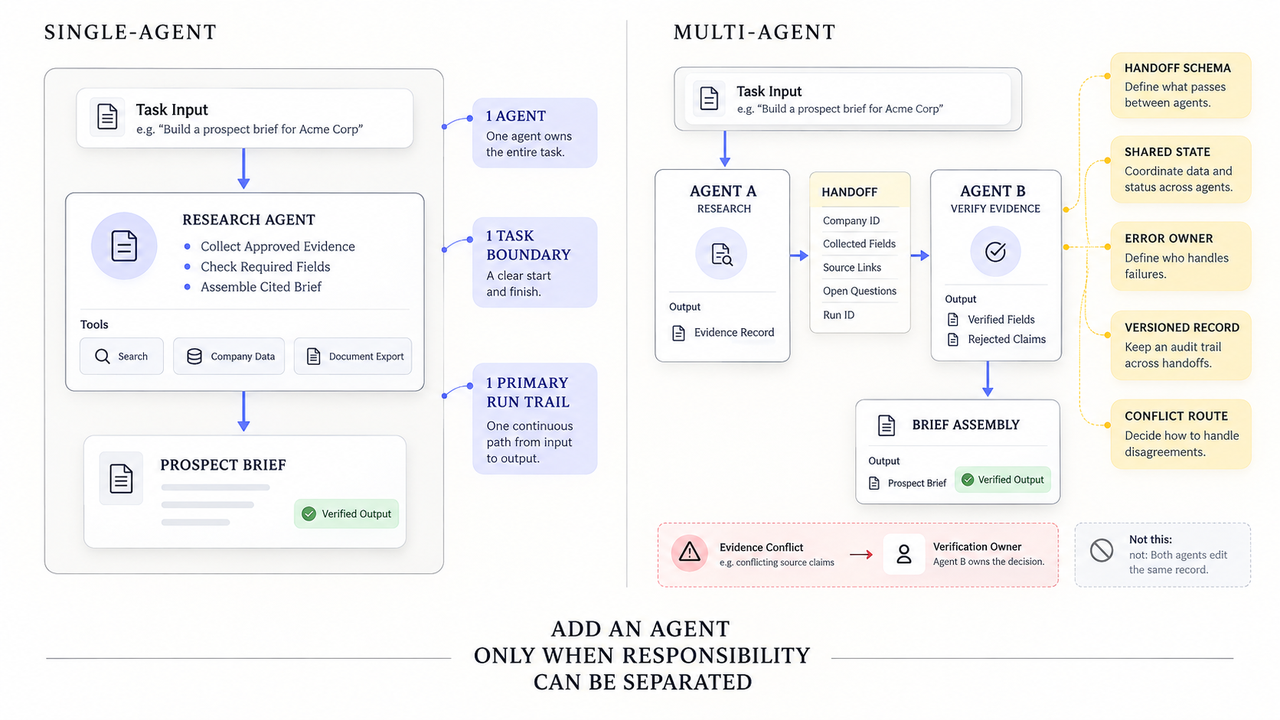
More agents create more interfaces and failure paths. Add them only for a clear separation of responsibility.
Prefer One Agent for a Bounded Responsibility
One agent can call approved read-only tools and assemble the cited brief. A single run trail makes failures easier to locate.
IBM’s current agentic architecture overview describes single-agent systems as easier to design, deploy, debug, and monitor than multi-agent systems. That is a useful default, not a universal rule.
Keep deterministic controls outside the agent where possible. Input validation, access checks, schema validation, and final release do not need another agent persona.
Add Agents Only When Responsibilities Can Be Separated
A second agent may help when the responsibility and evaluation method differ. One could gather evidence while another checks whether each field has support.
Define their handoff as carefully as a tool interface. State which fields move, which agent owns an error, and whether the receiving agent may request another search. Avoid several agents editing one unversioned record.
Different models can serve different roles, but the architecture must still produce one traceable result.
Review the Architecture Before Production
Before granting production access, review the task path with business and technical owners:
- What does each layer receive and return?
- Which decisions use fixed rules, and which allow model judgment?
- Which component holds state, memory, credentials, and the source record?
- What can change an external system, and who approves that change?
- Can one run be reconstructed from its versions, sources, tool outcomes, and review decision?
Walk through a normal request, missing input, conflicting source, tool timeout, rejected approval, and repeated call. The review is incomplete if the team cannot name where each case stops.
SpringBrand publishes this guide. Its API catalog presents search, web, social, lead, and creation capabilities for an existing AI assistant. Those categories reflect the page checked on September 16, 2026. Treat a selected API as one capability interface in the larger diagram. The catalog does not establish your memory design, execution state, permissions, approval path, or observability plan.
FAQ
Can a memory store be replaced without redeploying the agent?
Sometimes. Replacement is practical when memory sits behind a stable provider interface and its schema remains compatible. Microsoft Agent Framework’s context-provider documentation lists several external integrations, but does not promise interchangeability.
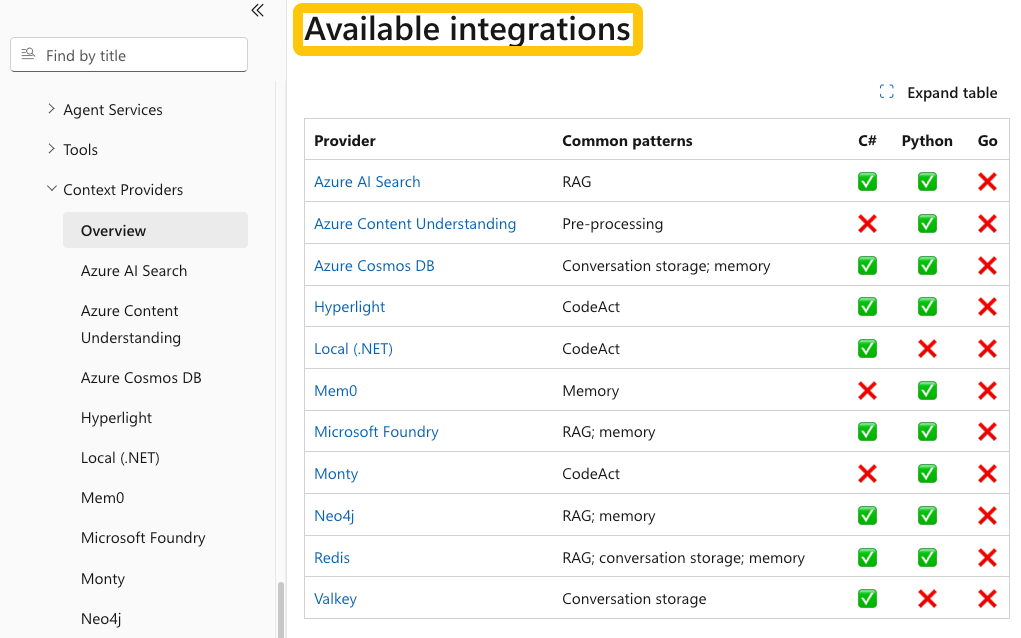
Test retrieval, writes, tenant separation, and migration first. An embedded store client or data model may still require a new release.
How should tool schema changes be versioned across the architecture?
Treat the schema as a contract. Additive optional fields may remain compatible; renamed fields, changed types, or new required inputs should receive a new version or an adapter.
The MCP specification defines tool input and output with JSON Schema. Keep the schema version with traces, then test every caller before retiring it.
Can one agent use different model providers for separate steps?
Yes, if the runtime supports routing or assigns provider-specific agents to separate steps. Microsoft Agent Framework documents multiple model providers, while its agents-as-tools guide allows specialized agents to use different models.
Check tool support, structured outputs, context handling, and fallback behavior for each provider. A shared agent interface does not make those capabilities identical.
What happens to in-flight tasks during an architecture upgrade?
The platform and deployment design decide. Pin each run to a configuration version, then document whether old runs finish, stop, or migrate.
Microsoft Agent Framework can resume checkpoints, but its checkpoint guidance requires compatible topology and executor identities. Test the upgrade path or start a new run with a recorded handoff.
Can tool calls run in a separate execution environment from the model?
Yes. The model can request a tool while application code, a provider runtime, a container, or an MCP server performs the action. Microsoft’s tools overview distinguishes custom functions, hosted tools, local MCP tools, and containerized execution options.
That separation helps isolate credentials and dependencies. It does not remove the need for authentication, network limits, validated arguments, timeouts, and result checks.
Conclusion
A useful AI agent architecture explains the full task path. It connects validated input, working context, memory, decision logic, tools, execution state, review, and records without treating the model as the whole system.
Start with one bounded agent and one inspectable result. Add memory, write authority, or more agents only when their responsibility and recovery path are clear. If the team can trace an error to one component, name who owns it, and replay the relevant evidence, the architecture is ready for a serious pilot.