AI Agent Employees: What Brands Need to Know

Written by
Springbrand Editor Team
Editorial team
Springbrand Editor Team creates and maintains blog guides on AI tools, automation, marketing, and agent workflows.

Reviewed by
Springbrand Audit Team
Editorial review team
Springbrand Audit Team supports editorial quality through source checking, clarity, and consistency across the blog.
Updated
Published
AI agent employees are changing how brands think about roles, workflows, oversight, and outsourced growth services.
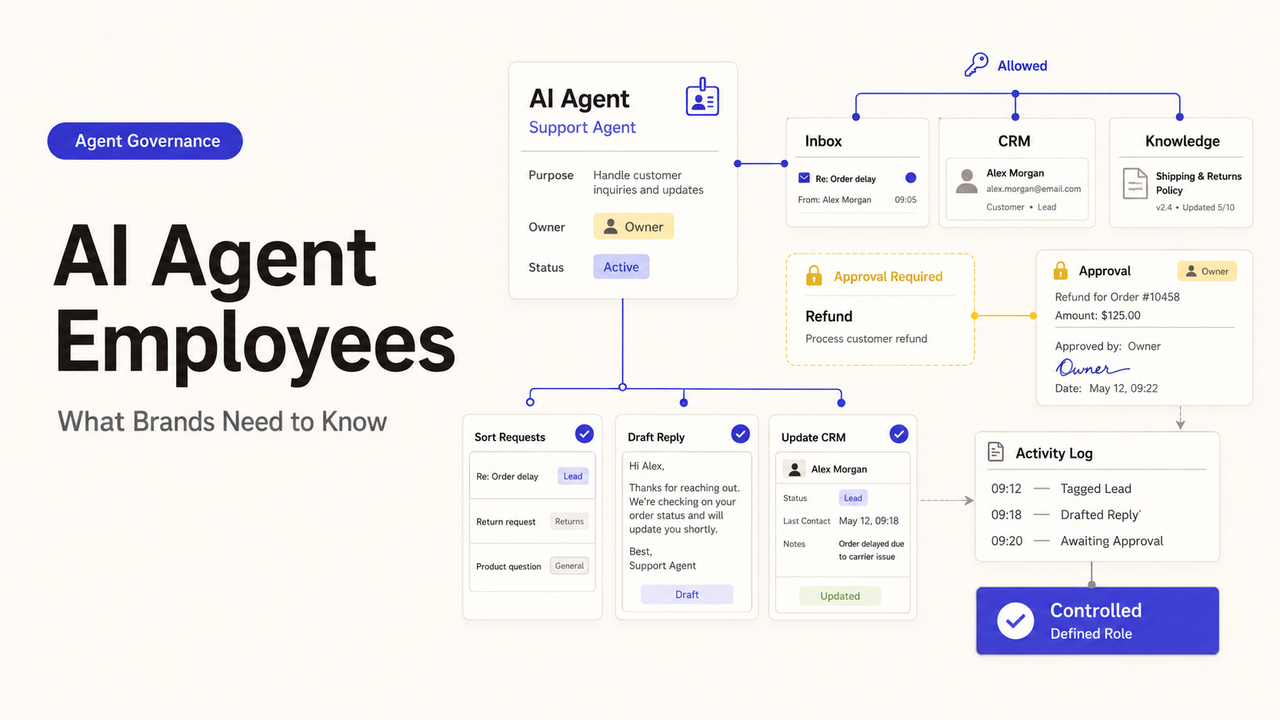
A campaign board lists an “AI content coordinator” beside a real editor. The label looks tidy until the agent schedules the wrong draft and nobody knows who can stop it.
That is the useful question behind AI agent employees. The phrase can help a brand describe a recurring role. It does not turn software into a colleague, manager, or legal employee.
What AI Agent Employees Really Means
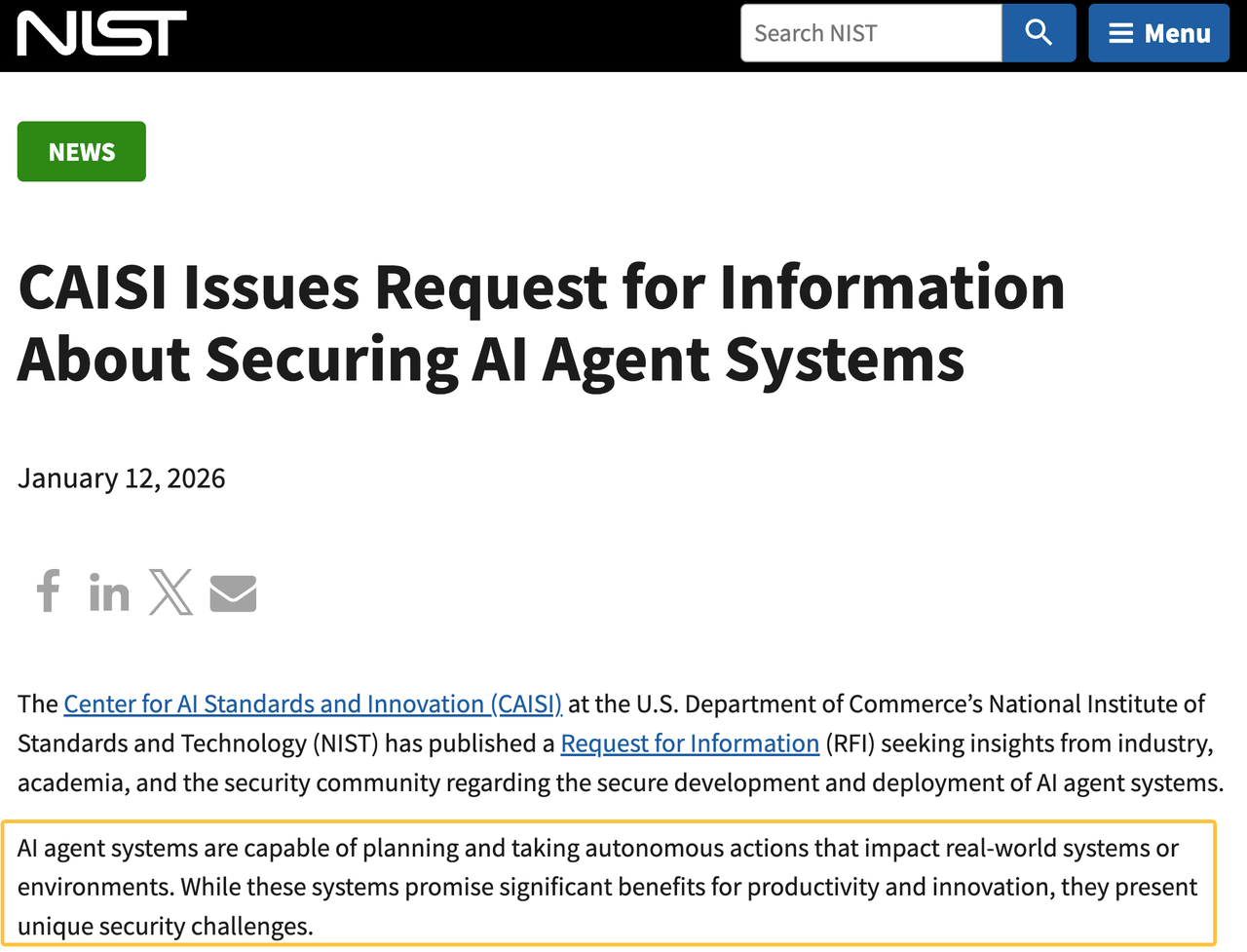
AI agents can receive a goal, work through steps, use approved tools, and take limited actions. NIST describes agent systems as capable of planning and acting in real-world systems or environments. Its current agent-security work also notes that those capabilities create distinct security concerns.
“AI agent employee” and “digital employee” are business labels, not one settled technical category. Vendors may use them for very different products. One system may only draft work. Another may read a CRM, update records, and send messages.
Treat the label as a prompt to define a role. What starts the work? Which systems may the agent open? Which actions need approval? Who takes over when the request falls outside the rules?
How Digital Employees Differ From Chatbots
A chatbot usually waits for a message and returns a response inside a conversation. A digital employee may carry a task across tools and over time. It might read a form, create a draft, route it for approval, and record the decision.
The difference is operational, not a guarantee of intelligence or independence. Some chatbots call tools. Some products marketed as agents do little beyond generating text. Buyers need to inspect the actual workflow rather than trust the category name.
Authority is the more useful dividing line. A system that only recommends an action has one risk profile. A system that can publish, spend, delete, or contact a customer has another.
Map Agent Roles Before Tool Selection
Start with work the team already understands. A stable, repeated task is easier to bound than a broad request to “help the brand grow.”
Workflows that look like staff augmentation
An agent-assisted role might sort campaign requests, prepare weekly reporting notes, draft catalog updates, or flag unanswered customer messages. These jobs resemble staff augmentation because the system handles recurring steps inside an existing process.
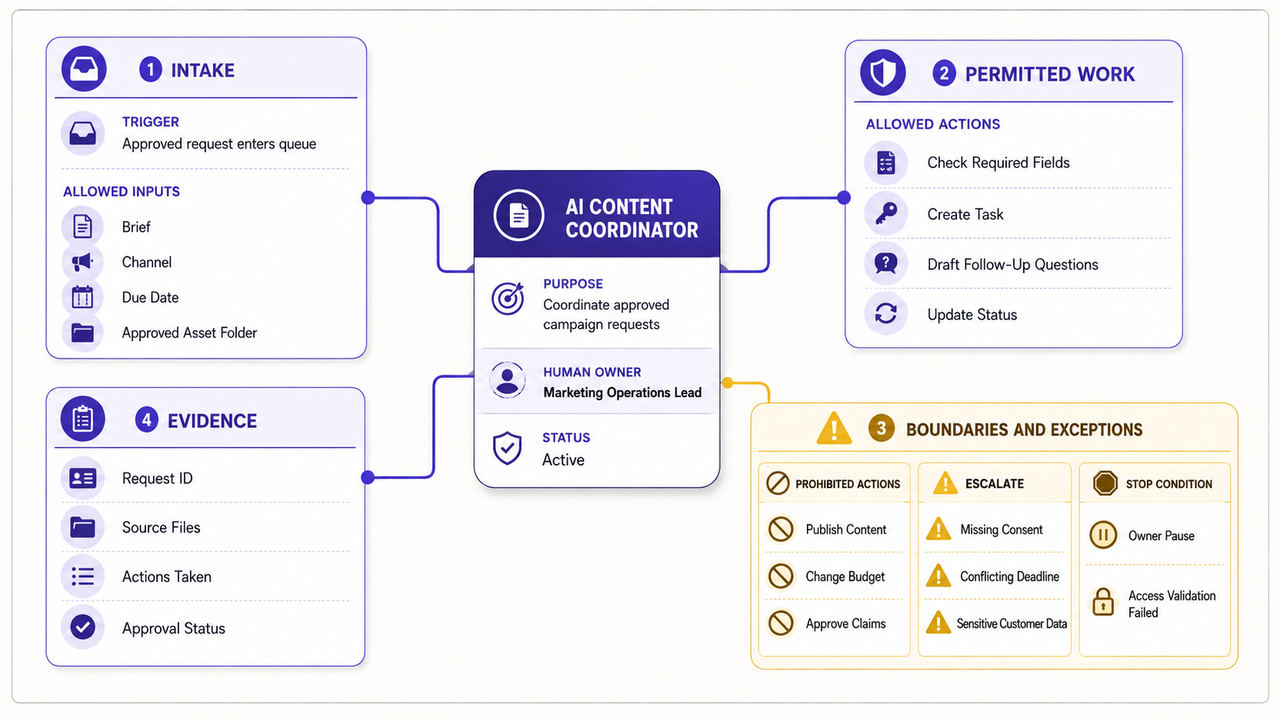
Do not copy a human job description. Convert one part of the work into a role card:
Role-card field | Example: campaign intake coordinator |
Trigger | An approved request enters the campaign queue |
Allowed inputs | Brief, channel, due date, approved asset folder |
Allowed actions | Check required fields, create task, draft follow-up questions |
Prohibited actions | Publish content, change budget, approve claims |
Human owner | Marketing operations lead |
Escalation | Missing consent, conflicting deadlines, sensitive customer data |
Evidence | Request ID, source files, actions taken, approval status |
Stop condition | Owner pauses the workflow or access validation fails |
This role card is a SpringBrand editorial framework, not an official employment or technical standard.
Human owners for every agent role
Each role needs one named owner with authority to change access, review exceptions, and stop the workflow. “The marketing team” is too vague when an account has been changed or a customer needs a correction.
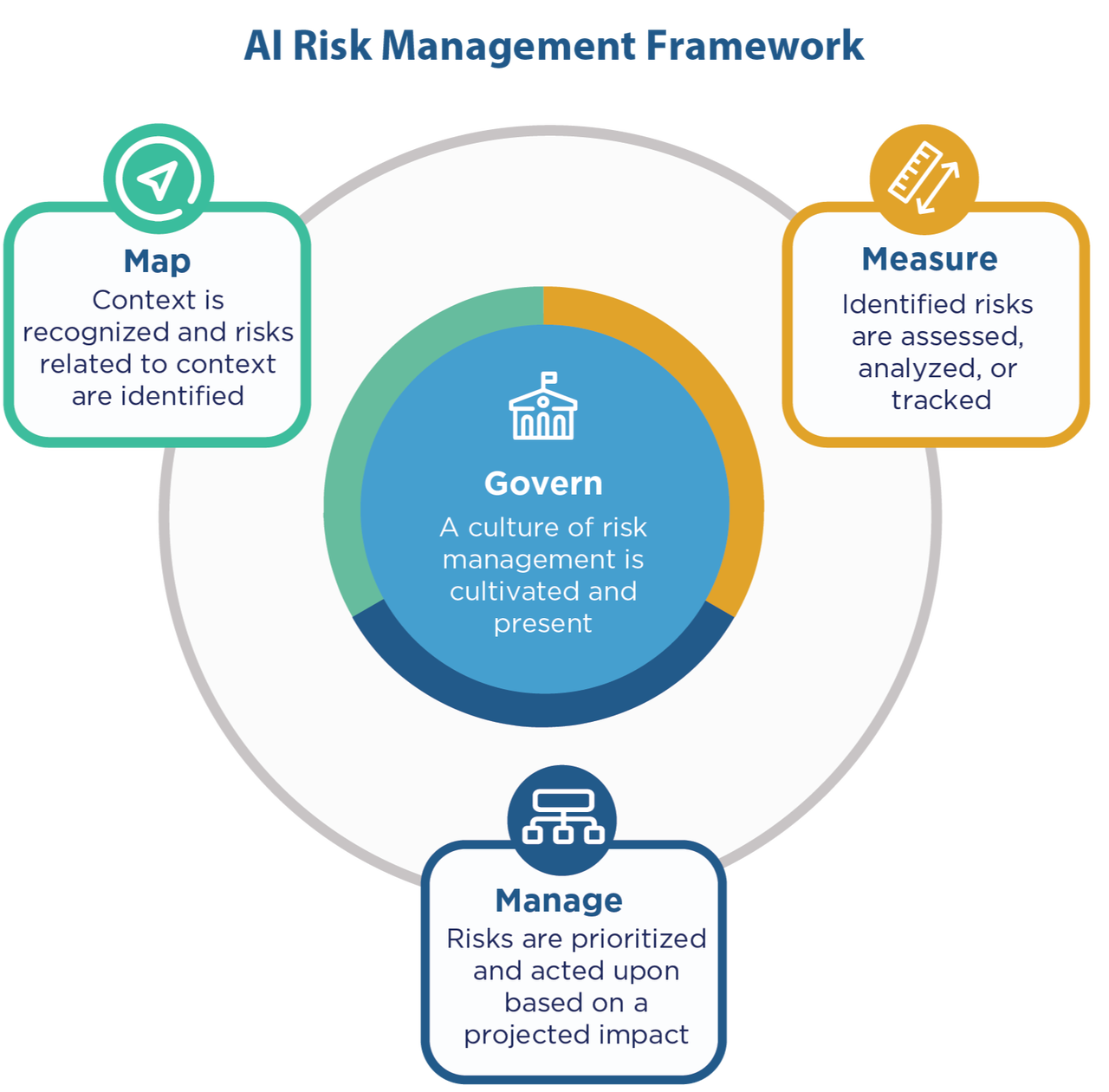
NIST’s AI Risk Management Framework Core calls for organizations to define human-AI roles and oversight responsibilities. It also treats third-party software and data as part of the risk map.
Run a negative test before expanding the role. Give the agent a request with a missing approval, an expired asset, or an unauthorized destination. A useful pilot should show that the workflow stops or escalates, not merely that the normal path works.
What Still Needs Human Ownership
People should retain decisions about brand position, policy, sensitive claims, customer remedies, and unusual exceptions. An agent can prepare evidence or suggest an option. It should not become the unnamed owner of a consequential decision.
Keep hiring, pay, promotion, discipline, and termination decisions outside a casual agent workflow. The EEOC identifies AI-assisted employment decisions as activities still covered by federal employment discrimination protections.
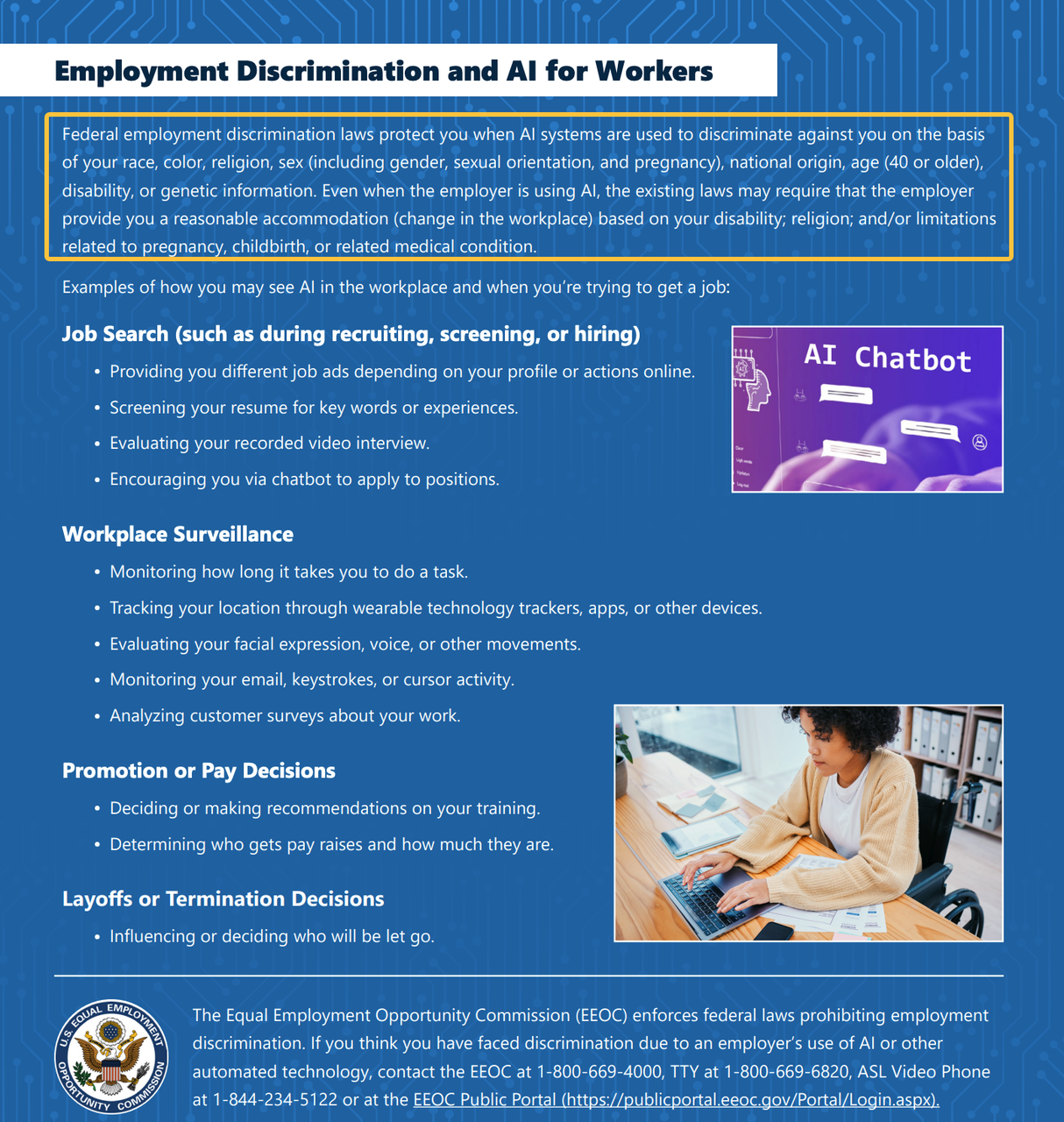
This article provides general business information, not legal or employment advice. Apply the current rules for every jurisdiction where the affected people work.
Access also needs a human owner. NIST’s 2026 agent identity and authorization concept highlights least privilege, delegated authority, revocation, and auditable action records as open design concerns.
How to Brief a Vendor for Agent-Assisted Work
Give every vendor the role card, current workflow, systems involved, data restrictions, and expected volume. Then define the deliverable. A prototype, configured workflow, integration, operating guide, and ongoing managed service are different scopes.
Ask the vendor to identify every model, connector, subcontractor, account, and human review point involved. The brief should say who owns configurations, who pays usage fees, where logs are stored, and how access ends.
Acceptance tests should cover both success and failure. Test an approved task, an incomplete request, a forbidden action, a disconnected tool, and a human takeover. Record the result and the owner of each unresolved issue.
How SpringBrand Fits This Workflow
SpringBrand publishes this article and operates the service marketplace linked here. It does not supply the agent or guarantee a provider’s work.
When the role card is ready, compare relevant third-party services for the defined implementation scope.
FAQ
Could an AI agent create employment classification questions?
The software label alone does not classify a person. Questions may arise when a business changes the duties or control of employees and contractors around the workflow. The IRS says worker status depends on the actual relationship, not its label. Review the current classification guidance and obtain qualified advice for the relevant jurisdiction.
How long should agent activity records be retained?
There is no universal period for every workflow. Set a schedule around operational evidence, security needs, contracts, and applicable law. The FTC advises businesses to keep sensitive data only while there is a business reason and to document retention and disposal. Its business data guide provides a practical starting point.
Can a former contractor reuse an agent workflow?
Do not assume either party may reuse it. The answer can depend on the contract, ownership of configurations and prompts, third-party licenses, and confidential inputs. Record reusable components separately from client-specific material. Have a qualified professional review disputed ownership or reuse rights.
What happens when a tool account outlives the project?
Transfer the account to an approved owner or close it under the agreed exit plan. Export required records first. Then revoke users, rotate keys, cancel scheduled actions, and check connected tools. A vendor account should never remain the only route to the workflow after handoff.
Should agent-created drafts be labeled in internal files?
An internal label can help reviewers identify the draft stage, responsible owner, model or workflow version, and required checks. It should support review rather than imply that every output received the same process. Customer-facing disclosure is a separate decision based on context, policy, contract, and applicable requirements.
Conclusion
AI agent employees are most useful as a role-design idea. The label becomes risky when it hides permissions, exceptions, or the person accountable for the result.
Define one bounded role before choosing a tool. Give it a human owner, test how it refuses unsafe work, and keep an exit path that does not depend on the original vendor.
Recommended Reads
Explore SpringBrand
Turn ideas into working workflows
Connect agents, APIs and tools in one workspace. Start with a task you want to get done.
Get started free
One account. 10,000+ APIs & capabilities
Give your agent APIs and plugins without separate keys or integrations for every provider.
Explore APIs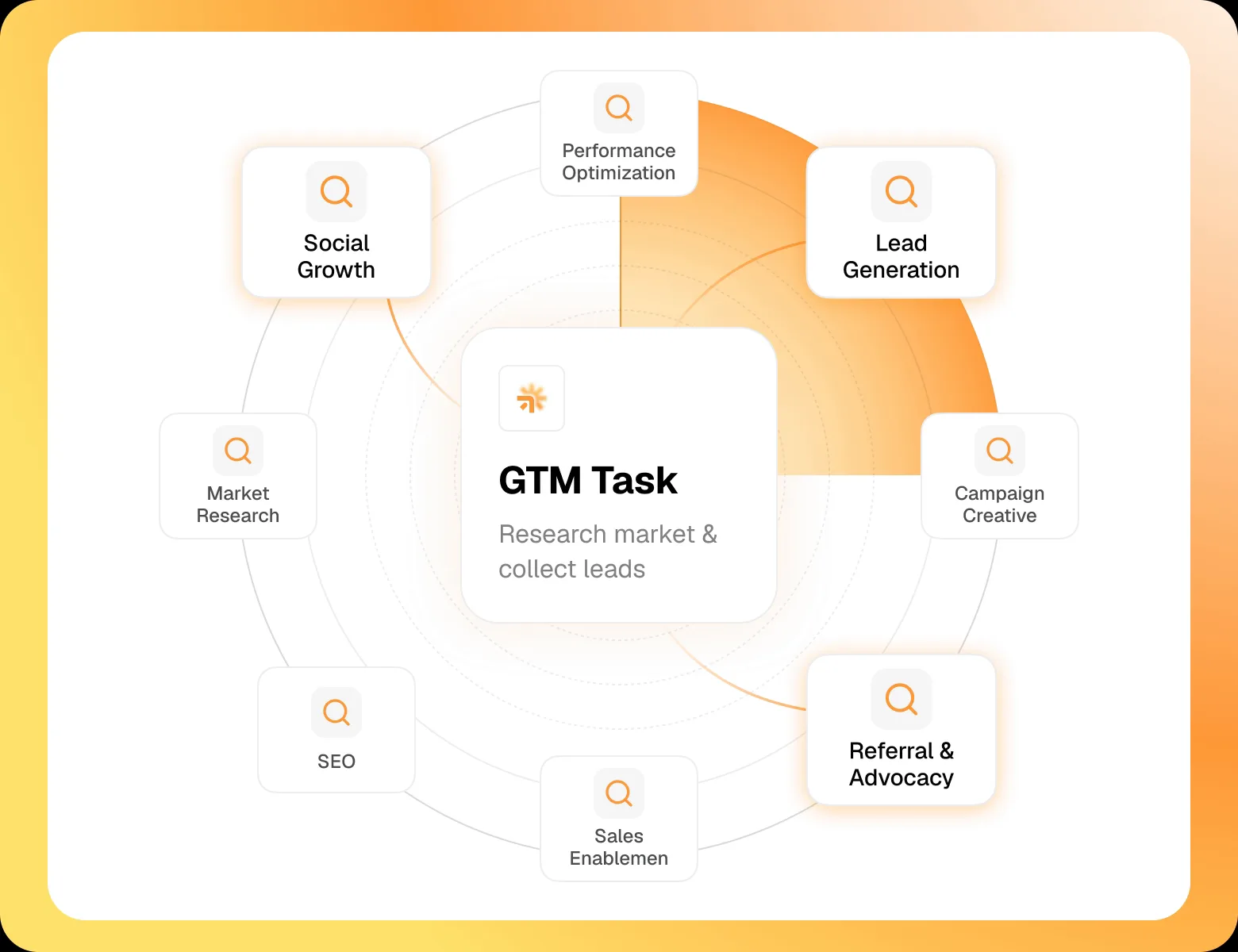
No tool expertise needed
Describe your GTM task. SpringBrand chooses the right APIs and plugins for your agent automatically.
Find tools for your task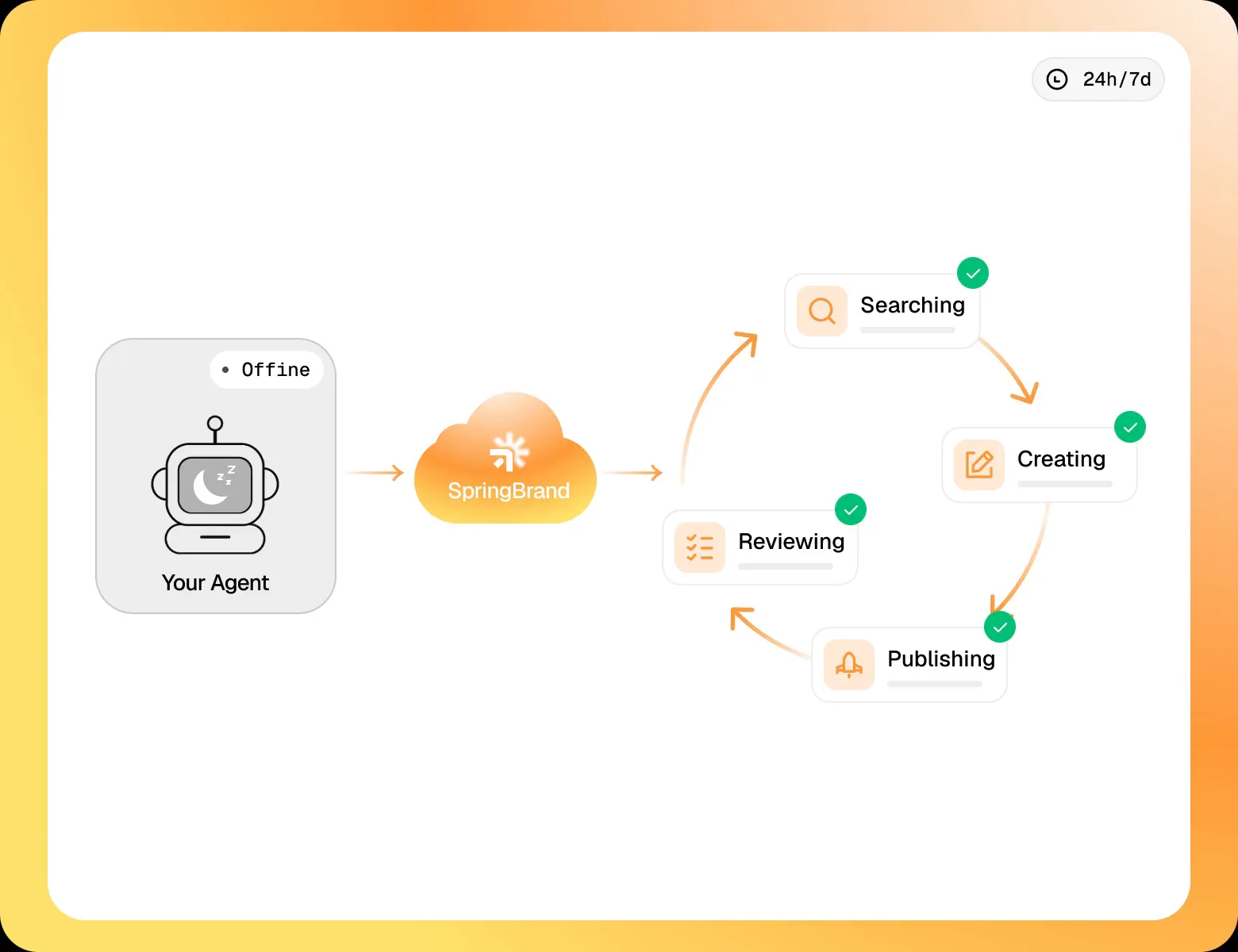
Run tasks 24/7
Connect your agent to SpringBrand to keep tasks running automatically, day and night.
Connect your agent