AI Agent Use Cases: Rank Value Against Review Risk
AI agent use cases should be ranked by business value, task repeatability, review burden, action risk, and the cost of handling exceptions.
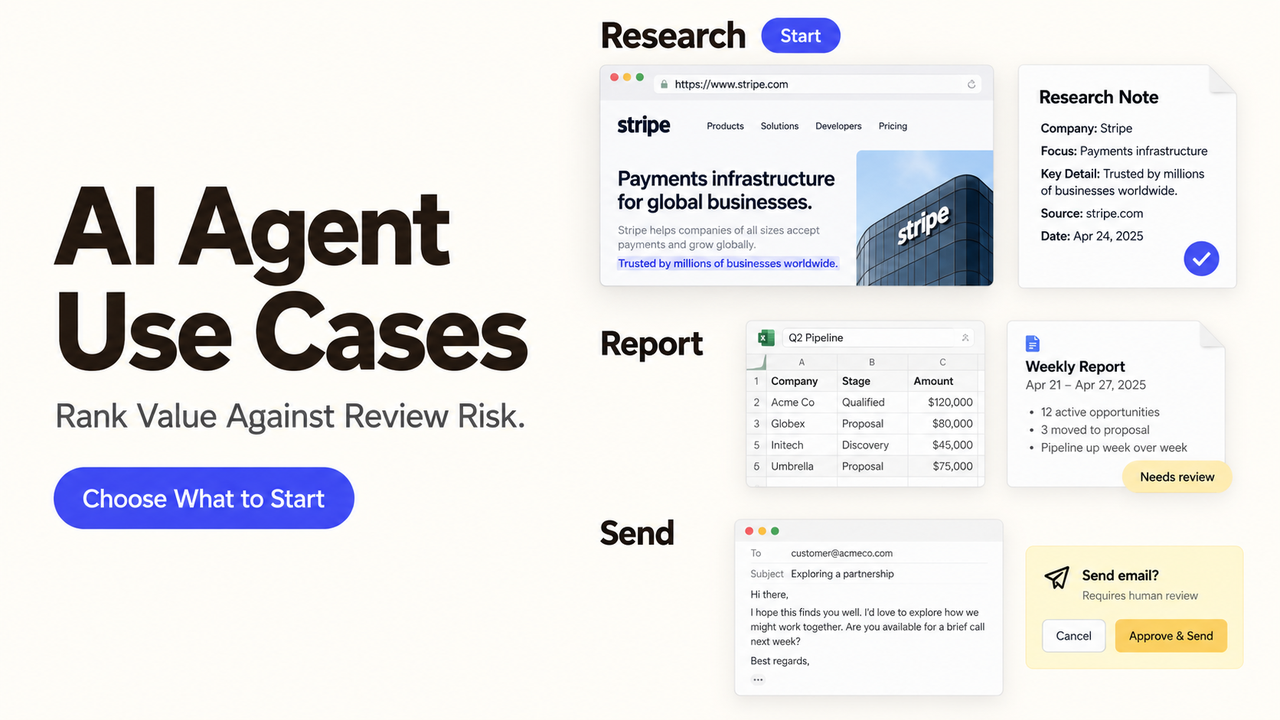
Compare four proposals: prepare a competitor brief, route support messages, assemble a weekly report, and send customer follow-ups. All four can be described as AI agent use cases, but they should not enter the same queue.
My first choice would be the research brief. I’m Alex, and the scorecard below explains why visible output and reversible action matter more than novelty.
What Makes an AI Agent Use Case Worth Building
A worthwhile use case addresses work that repeats often enough to measure. It also produces an outcome that someone can inspect without recreating the whole task.
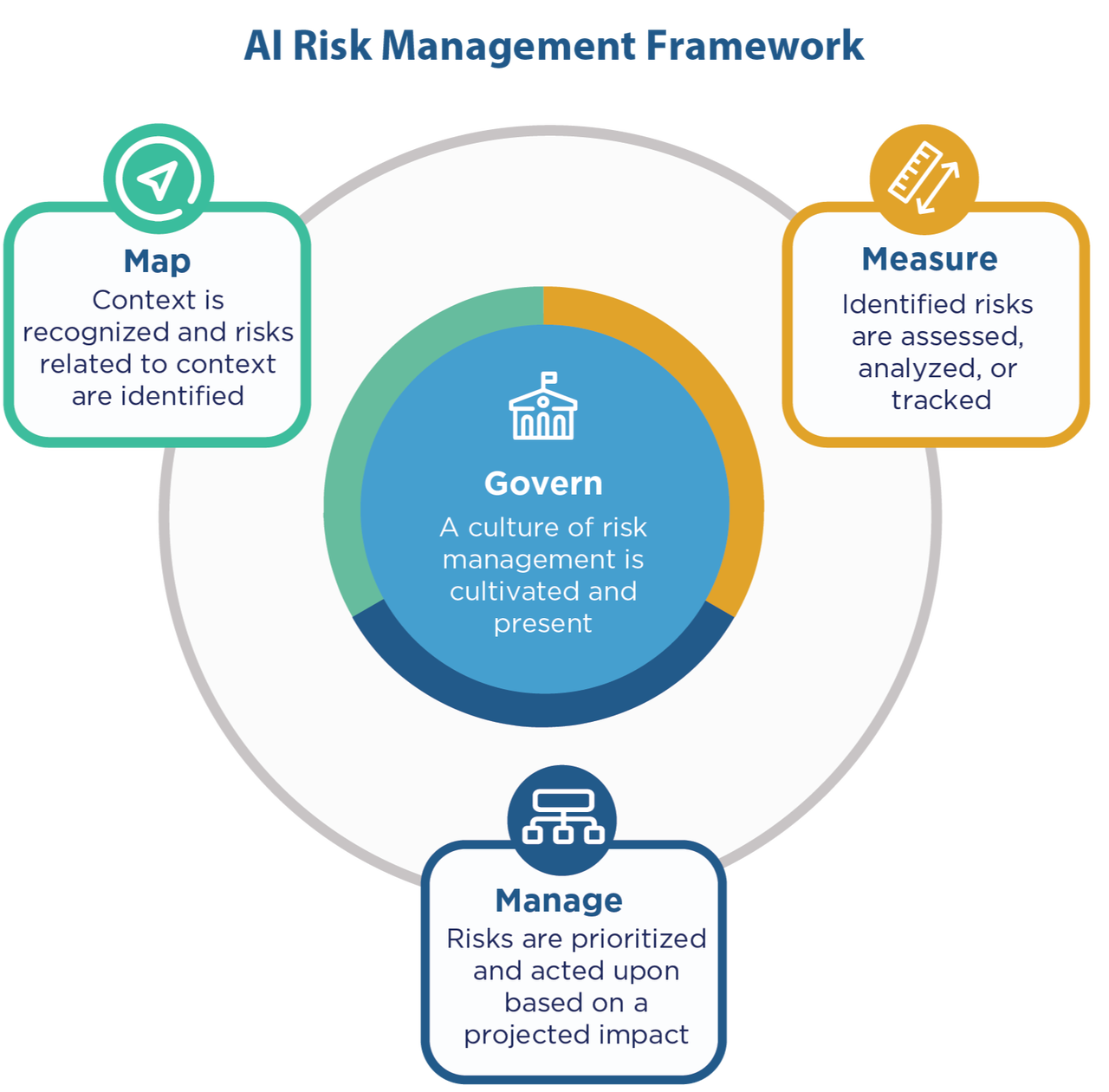
The voluntary NIST AI Risk Management Framework places risk management across design, use, and evaluation. That work starts before an agent is built.
A Repeatable Input, Outcome, and Owner
Start with a task that has a recognizable beginning. A competitor brief may begin with a market, product category, source policy, and research date. Its outcome is a cited document for a named marketing lead.
Repeatability does not require identical inputs. The team must still describe what arrives, the expected work, and the finish line. “Help with growth” names none of them.
Name the person responsible for accepting the result. An agent can prepare work, but the business still needs someone who decides whether it is complete.
Decisions That Can Be Reviewed and Reversed
The easiest first task ends before an external action. A person can reject a research brief, correct a report, or reroute a ticket. The team has not yet emailed a customer or changed a financial record.
Reversibility changes the cost of a mistake. Editing a draft is cheaper than recalling a message or repairing a large CRM update.
Look at the review itself. If reviewers cannot see the sources, proposed action, and unresolved exceptions, the use case is not ready just because its output reads well.
High-Value AI Agent Use Cases
These patterns can create value when inputs are stable, a reviewer is clear, and the action stays narrow.
Research and Data Preparation
Research is often the strongest first candidate because the result can remain internal. Examples include competitor briefs, account research, and structured data preparation.
Require links, dates, and missing-data flags. The agent may assemble evidence, while a person decides what that evidence means for strategy. A polished summary without traceable sources only moves the review burden downstream.
Triage, Routing, and Follow-Up
An agent can label an inbound request, suggest a destination, and prepare a follow-up task when categories already exist.
Keep unusual or sensitive messages out of automatic routing. For the first version, let the agent recommend a queue while a person confirms the move. Separate preparing a follow-up from sending it.
Recurring Reports and Document Handoffs
Recurring reports fit when the same sources and fields appear each cycle. The agent can collect figures and flag missing inputs.
The useful outcome is not a confident narrative. It is a report that shows where each number came from and which sections still need judgment. If the source system changes, the run should stop instead of silently substituting another field.
Controlled Drafting and Distribution
Product descriptions, campaign variations, and internal summaries can be bounded with approved claims, audiences, formats, and prohibited promises.
Distribution carries a different risk. A draft can wait in a review folder; a published page or sent message reaches people outside the team. Score those as separate use cases even when one workflow may eventually connect them.
Rank Business Value Against Review Risk
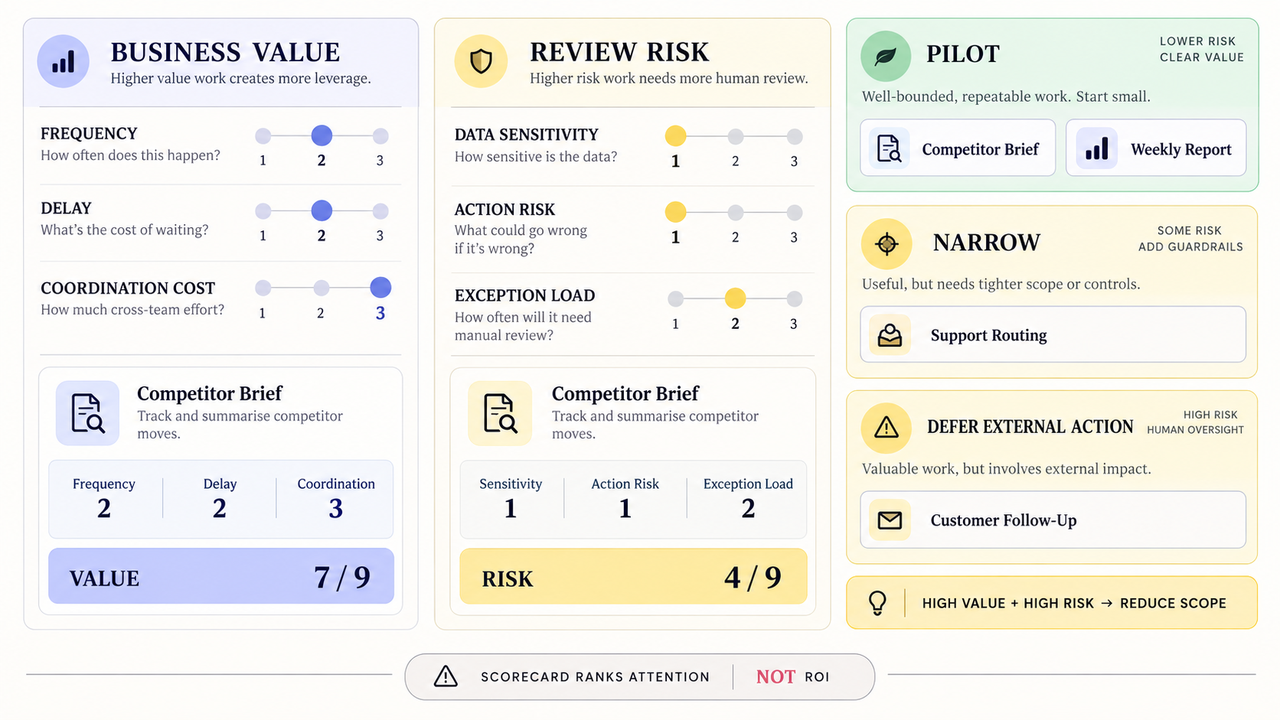
Use two scores. Business value reflects delay and coordination, while review risk reflects the cost of catching and correcting a bad result.
The scorecard below is an editorial planning tool, not an industry standard or ROI model. Rate each factor from 1 to 3, using your own recent cases.
Dimension | 1 | 2 | 3 |
Frequency | Occasional | Regular | Constant or scheduled |
Delay | Little waiting | Noticeable queue | Blocks another team or customer |
Coordination cost | One person and system | Several handoffs | Repeated chasing across tools |
Data sensitivity | Public or low sensitivity | Internal | Restricted or customer-sensitive |
Action risk | Draft only | Reversible record change | External, financial, or hard to reverse |
Exception load | Rare and obvious | Regular but defined | Frequent or judgment-heavy |
Add the first three rows for value and the last three for review risk. Favor high value with lower risk. Narrow high-value, high-risk work; defer low-value, high-risk work.
Score Frequency, Delay, and Coordination Cost
Use actual work, not enthusiasm, to score value. Count how often the task appears and where it waits. Note how many people or systems become involved before the result is usable.
A weekly report may score well because reminders, missing files, and version conflicts create delay. A rare strategy exercise offers less repetition.
Do not turn the score into a savings forecast. It ranks attention; it does not prove future efficiency or revenue.
Score Data Sensitivity, Action Risk, and Exception Load
Review risk rises with restricted data, important system changes, and unusual cases. One difficult exception can outweigh several ordinary runs.
Score the action the agent can actually take. A lead-research draft and an outreach message may use the same data, but the message has an external consequence. The second score should therefore be higher.
If the team disagrees about a score, inspect recent cases. The disagreement often reveals an undefined exception or a hidden approval step.
Choose a Bounded Pilot
Choose the smallest version that still proves business value. For research, that might be one competitor brief for one product line. For routing, it might be recommendations for one low-risk queue.
Do not combine collection, decision, writing, and external action merely because one agent could attempt them. A narrow pilot reveals where review grows.
Lock One Input, Output, Owner, and Review Point
Write four items before configuration begins:
- the eligible input and its source;
- the expected output and acceptance check;
- the person who owns the result;
- the point where the agent stops for review.
Add the most likely exception. A missing source, unknown category, or conflicting record needs a visible destination. Otherwise, the pilot hides later work.
Measure the Use Case Before Expanding It
Measure whether the task finishes as defined. Output volume means little when reviewers reject or redo the work.
Track Completion, Intervention, Errors, and Rework
Track four practical outcomes:
- Completion: eligible tasks that reached an accepted result.
- Intervention: runs that needed a person before the planned review point.
- Errors: missing, wrong, duplicated, or unauthorized results.
- Rework: time or steps needed to make the result usable.
Read the measures together. A faster report with more correction is not an obvious improvement. A triage agent that asks for help on difficult cases may be working as designed.
Expand only after ordinary runs and expected exceptions remain understandable. The goal is not zero human involvement. It is a review load the team deliberately accepted.
Use Cases That Should Not Be the First Pilot
Avoid first versions that combine unclear judgment with hard-to-reverse action. Examples include customer promises, unrestricted record cleanup, final financial posting, or licensed professional judgment.
Also defer broad assignments such as “run marketing” or “manage sales.” They hide several decisions, data sources, and consequences inside one label. Split them into research, preparation, recommendation, approval, and action before scoring each part.
A low-frequency executive decision is another weak pilot. Keep it human-led until a repeatable supporting task becomes visible.
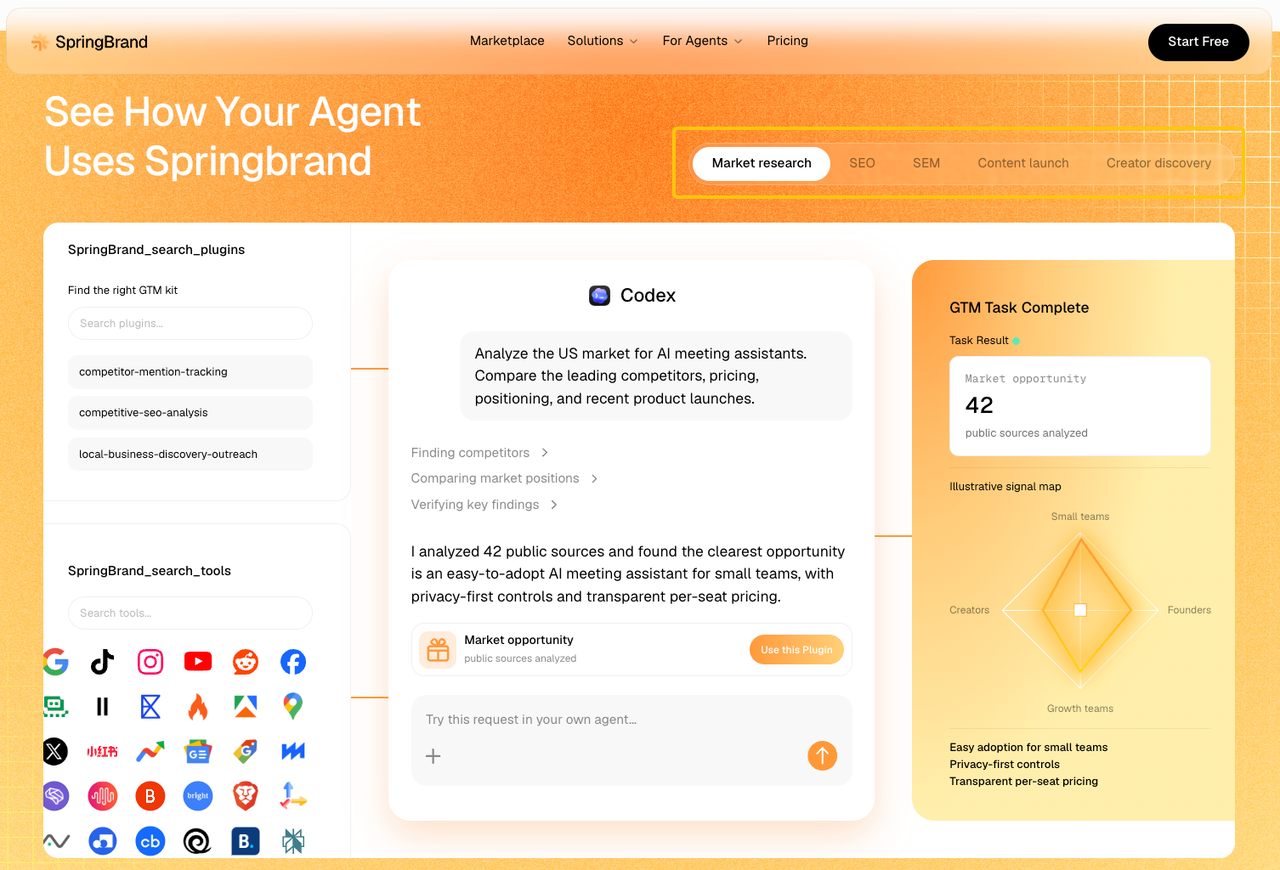
SpringBrand publishes this guide. Its homepage, checked September 16, 2026, presents an AI-native plugin marketplace for existing agents and shows GTM tasks across research, SEO, content, creators, and leads. It does not prove that any proposed use case has the controls or economics to run unattended.
Once your GTM task has a bounded score, explore SpringBrand’s current plugin marketplace for research, SEO, content, creator, or lead capabilities.
FAQ
Can one use case share prompts across departments without sharing data?
Yes. Teams can version a common prompt while resolving data, credentials, and retrieval permissions separately at run time. Treat the prompt as instructions, not authorization.
Test each department with an account that lacks access to the other department’s records. If the prompt or shared memory contains copied data, the separation has already failed.
Can a pilot be limited to a percentage of eligible tasks?
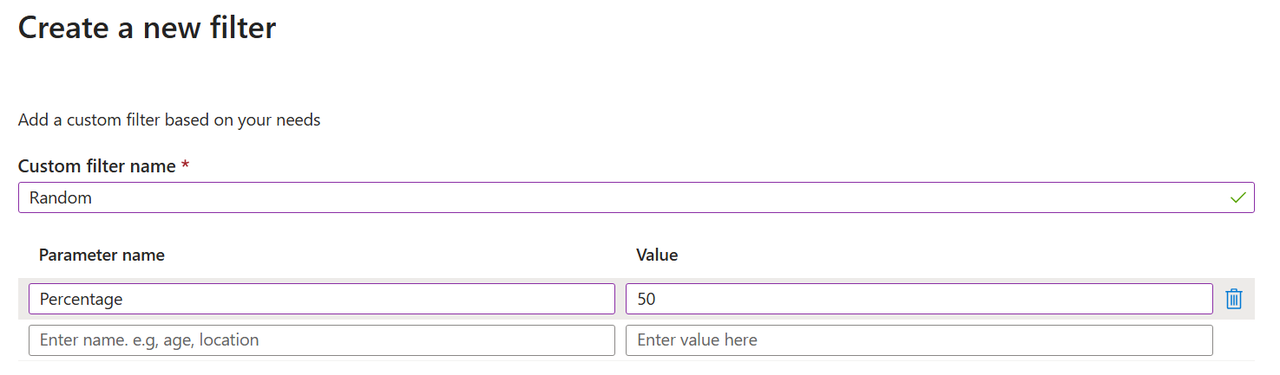
Yes, when the routing layer supports stable percentage or audience rules. Keep the comparison group and eligibility definition unchanged during the review window.
Microsoft’s current feature-filter guidance shows conditional flags for subsets of users and percentage-based custom filters. That is one implementation example, not a feature every agent platform provides.
How should seasonal agent use cases be paused and restarted?
Pause the trigger without deleting the configuration, then review credentials, sources, owners, and pending work before restart. Run one controlled case before restoring the normal schedule.
Google Cloud Scheduler, for example, documents pausing and resuming scheduled jobs. Other platforms may treat missed runs or backlogs differently, so confirm that behavior before the season begins.
Can masked data test integration behavior accurately?
It can test schemas, routing, permissions, and many error paths when the masked values preserve the shapes and edge cases the integration expects. It cannot prove real-data quality or every privacy property.
NIST SP 800-188 warns that merely masking personal information may not provide sufficient de-identification. Define the test purpose and have the appropriate data owner approve the dataset. This is operational guidance, not a privacy or compliance determination.
How should a retired use case preserve its run history?
Disable new runs, then retain the approved configuration, version history, decisions, errors, and output references for the period your organization requires. Remove live credentials separately.
NIST’s log-management guidance treats generation, storage, access, and disposal as one planning problem. Your retention period still depends on internal policy, contracts, and applicable requirements.
Conclusion
The best first AI agent use cases create visible value without demanding heroic review. Rank the work that already exists, then narrow the action until errors remain easy to catch and reverse.
Choose the task whose score your team can defend with recent cases. Keep final action with a named person until completion, intervention, errors, and rework show that a broader boundary is justified.