Digital Marketing for Financial Advisors: Trust-First Plan
Digital marketing for financial advisors should build trust across search, content, email, and referrals while respecting current compliance requirements.
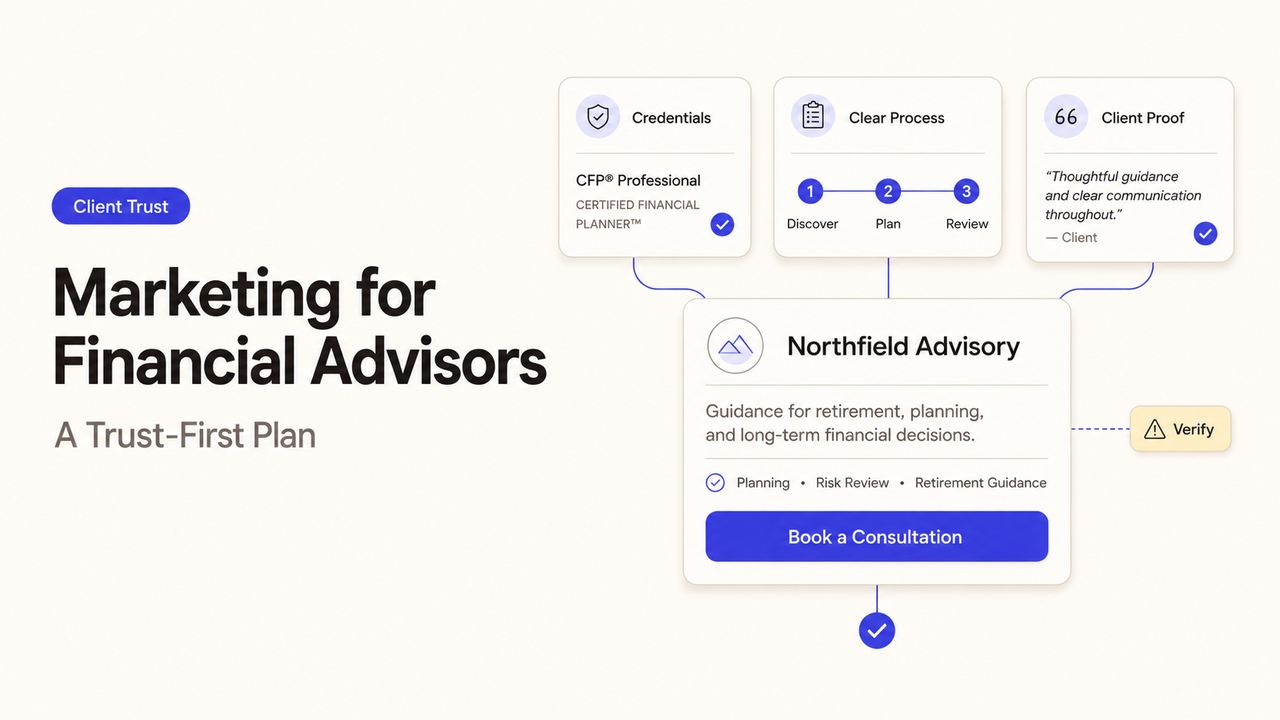
A financial advisor has a retirement-planning article, an email invitation, and a webinar page ready to publish. The three assets make similar promises, but they were written by different people, use different disclosures, and have no shared approval record. More distribution would magnify the inconsistency rather than build trust. My name is Alex, and this digital marketing for financial advisors plan starts by defining who may publish each claim, what supports it, and when a prospect must move from marketing into a qualified human conversation.
Start With Audience, Service Model, and Trust Requirements
“People who need financial advice” is not a usable audience definition. An independent advisor may serve business owners nearing an exit, young families planning around several goals, retirees managing income decisions, or professionals receiving equity compensation. These groups ask different questions and move at different speeds.
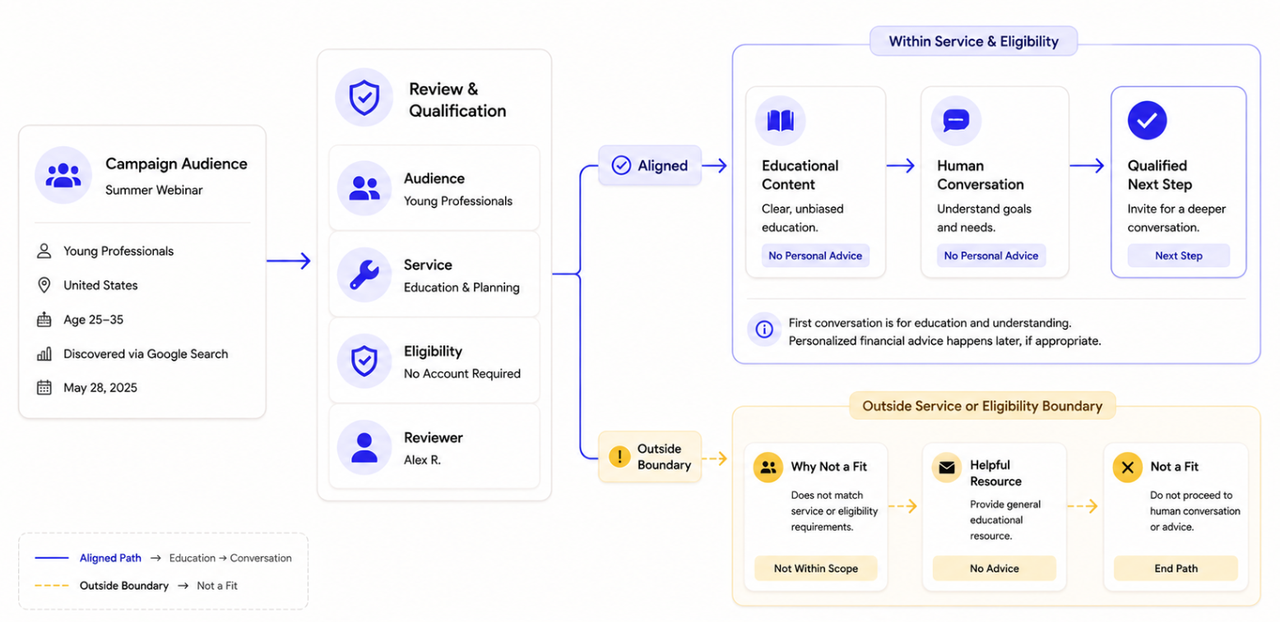
Choose one primary audience for each campaign, then document:
- the problem the audience is trying to solve;
- the service the firm actually provides;
- geographic, registration, or eligibility boundaries;
- the appropriate first conversation;
- claims the firm can substantiate;
- required review and disclosure steps;
- information marketing may collect;
- information that must go directly to a qualified representative.
The service model matters because “financial advisor” can describe firms and professionals operating under different registration, licensing, supervisory, and contractual structures. A registered investment adviser, broker-dealer representative, insurance professional, or dual registrant may not follow an identical review process.
Confirm the rules that apply to the firm before borrowing another advisor’s marketing workflow. This article provides a planning framework, not investment, legal, or compliance advice.
Trust begins with accuracy rather than polished branding. A prospect should be able to understand who the firm serves, what kind of relationship it offers, how to verify relevant credentials, and what will happen after an inquiry.
Build a Clear Website and Search Foundation
A useful advisor website answers practical questions before asking for a meeting.
The homepage and service pages should clarify:
- the people or organizations served;
- the problems the firm helps them evaluate;
- the services offered;
- the nature of the initial conversation;
- relevant geographic or client restrictions;
- who will respond to an inquiry;
- where official disclosures or firm information can be found.
Avoid broad statements such as “We secure your financial future” or “Our proven approach protects your wealth.” These phrases may imply certainty that the firm cannot support. Replace them with specific descriptions of the planning or advisory process.
The site also needs a coherent search structure. Advisor SEO may include pages for retirement planning, business-owner planning, investment management, tax-aware coordination, or other services the firm genuinely provides. Educational pages can address the questions people ask before they are ready to contact an advisor.
Do not create pages for every city, profession, or financial concern simply because a keyword tool shows demand. Each page should represent a real audience, service, location, or expertise boundary.
Trust signals may include:
- accurate names and professional titles;
- current registration or licensing information where applicable;
- links to relevant public records;
- clearly described services;
- an accessible privacy notice;
- current contact details;
- review dates on time-sensitive content;
- disclosures placed where readers can understand the relevant claim.
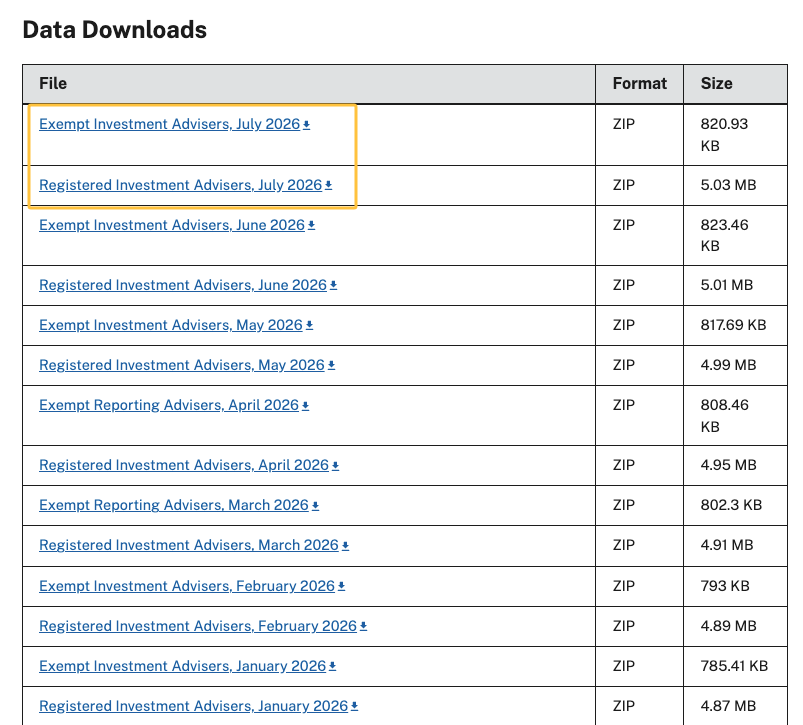
In the United States, the SEC explains that the Investment Adviser Public Disclosure database provides access to recent Form ADV filings for SEC-registered, exempt-reporting, and state-registered investment advisers. A firm can direct readers to the appropriate public adviser information without implying that registration is an endorsement.
Test the inquiry path. Submit the form. Confirm where the record goes. Check who can see the submitted information and who is responsible for responding. A page is not complete because a calendar opens.
Use Educational Content to Support Long Decisions
People may read financial content for months before requesting a conversation. The purpose of financial services content marketing is therefore not to force every visitor into an immediate booking. It is to help the right reader understand the firm’s subject area, approach, and boundaries.
Organize content around stages of understanding:
| Reader stage | Content job | Possible format | Appropriate next step |
|---|---|---|---|
Recognizing a problem | Define the issue without prescribing an individual solution | Article, guide, short video | Read a related explanation |
Comparing approaches | Explain variables, trade-offs, and questions to ask | Checklist, webinar, FAQ | Review service information |
Evaluating the firm | Clarify process, audience fit, and working relationship | Service page, team page | Request an introductory conversation |
Preparing to talk | Collect limited scheduling and fit information | Form or booking page | Qualified human follow-up |
Educational content should distinguish general information from individualized advice. A retirement-income article can explain planning variables. It should not tell an unknown reader which securities to buy, how to allocate a portfolio, or what action is suitable for their personal circumstances.
For every material claim, preserve:
- the source;
- the source date;
- the draft version;
- the reviewer;
- the approval date;
- the disclosure used;
- the scheduled review date.
This matters when content mentions tax limits, regulatory changes, performance, fees, ratings, testimonials, or market conditions.
For U.S. SEC-registered investment advisers, the SEC’s marketing rule includes general prohibitions against materially misleading advertisements and establishes conditions around testimonials, endorsements, third-party ratings, and performance information. The SEC’s investment adviser marketing guide summarizes these provisions. Other firms and jurisdictions may be subject to different requirements.
A disclaimer does not repair an unsupported headline. Review the claim first; then determine which disclosure and context it needs.
Coordinate Email, Events, and Referral Channels
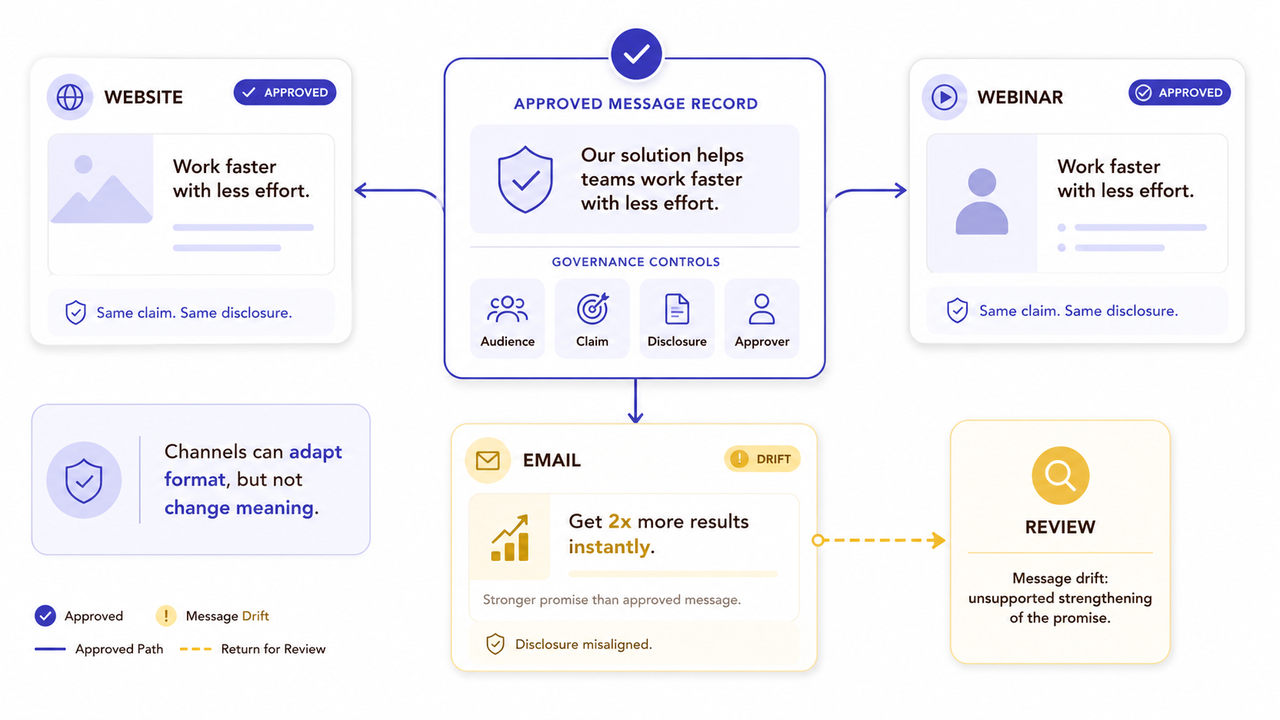
Email, webinars, local events, professional partnerships, and referrals can support a long advisor decision cycle. They should use the same audience definition and service promise as the website.
Segment email by a meaningful relationship:
- prospect who requested educational material;
- event registrant;
- professional referral source;
- existing client eligible for a particular communication;
- inactive contact whose status requires review.
Do not move contacts between segments merely because a new campaign needs a larger audience. Record the collection source, permitted use, applicable preferences, and opt-out status.
In the United States, the FTC’s CAN-SPAM business guide explains requirements for commercial email, including accurate sender information, non-deceptive subject lines, a physical address, and an opt-out process. It also notes that a company cannot transfer away its responsibilities simply by hiring an email provider. Additional rules may apply to other regions, channels, or firm types.
Events need one shared brief:
- intended audience;
- educational purpose;
- speakers;
- promotional claims;
- slides and handouts;
- registration fields;
- disclosures;
- recording decision;
- follow-up message;
- owner of live questions that move toward personal advice.
Referral language also needs review. “Introduced by a client” and “endorsed by a compensated promoter” may create different facts and obligations. Do not describe a referral arrangement until the firm has confirmed how it should be disclosed, supervised, and recorded.
FINRA-member firms must also consider rules governing communications with the public. FINRA Rule 2210 classifies written communications and applies content, supervision, recordkeeping, and, in some cases, filing requirements. The current FINRA communications rule should be read with the firm’s registration status and written supervisory procedures in mind.
Measure Qualified Conversations Without Overclaiming Attribution
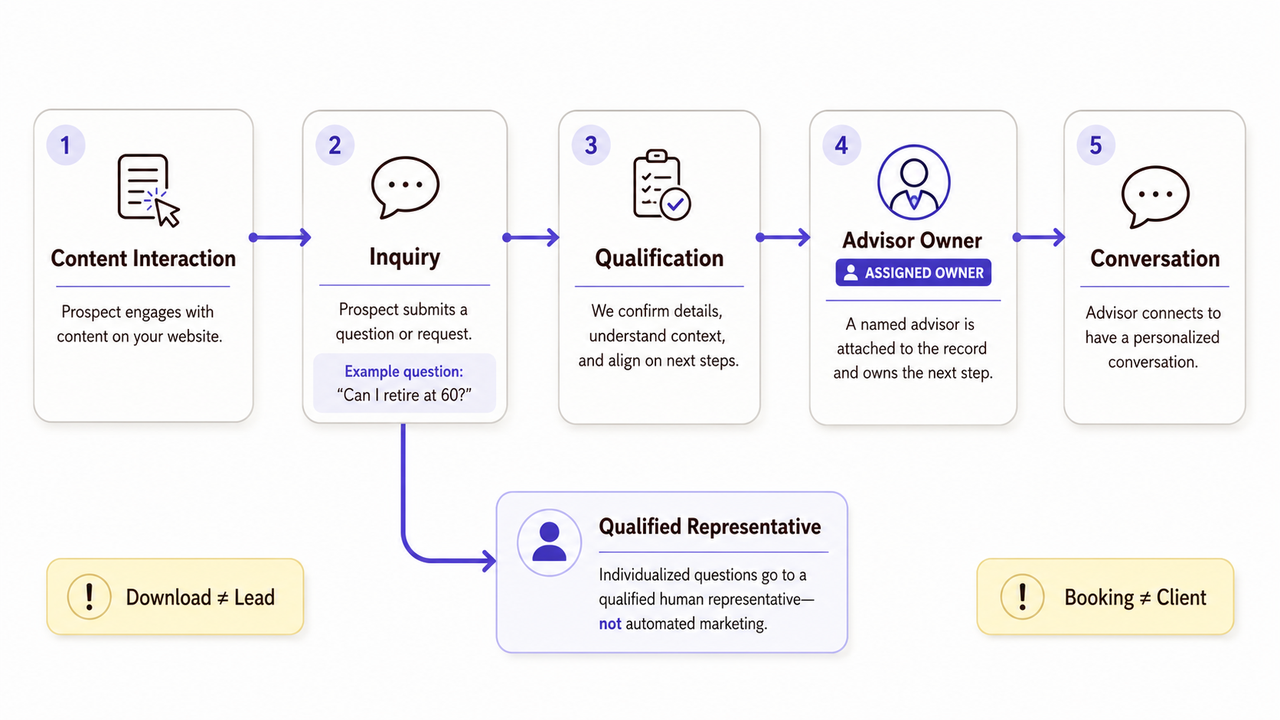
An advisor may receive few immediate conversions from a single article. A prospect might find the firm through search, attend an event several weeks later, receive an email, and finally request a conversation after speaking with an accountant.
That makes exact channel attribution difficult. Do not force a single-source story when the available evidence shows several interactions.
Use a simple lead record:
| Field | Purpose |
|---|---|
First known source | Shows where the firm initially recorded the prospect |
Recent source | Identifies the interaction nearest the inquiry |
Topic or service interest | Routes the request appropriately |
Audience-fit status | Separates relevant inquiries from general traffic |
Assigned representative | Names the follow-up owner |
Response date | Shows whether the handoff occurred |
Meeting status | Records the agreed next step |
Disqualification reason | Reveals targeting or messaging problems |
Notes on attribution limits | Prevents false reporting certainty |
Define an advisor lead generation outcome conservatively. A downloaded guide is a content interaction. A submitted form is an inquiry. A qualified conversation requires an appropriate person, a relevant need, and a follow-up the firm can accept.
Avoid reporting every booking as an acquired client. Likewise, do not attribute assets, revenue, or a client relationship to marketing unless the firm has a supportable method for doing so.
The form should request only what the next step needs. Sensitive account, tax, health, identity, or portfolio information generally does not belong in a general marketing form. When more information becomes necessary, move the conversation into the firm’s approved process.
Plan Review Boundaries Before Publishing
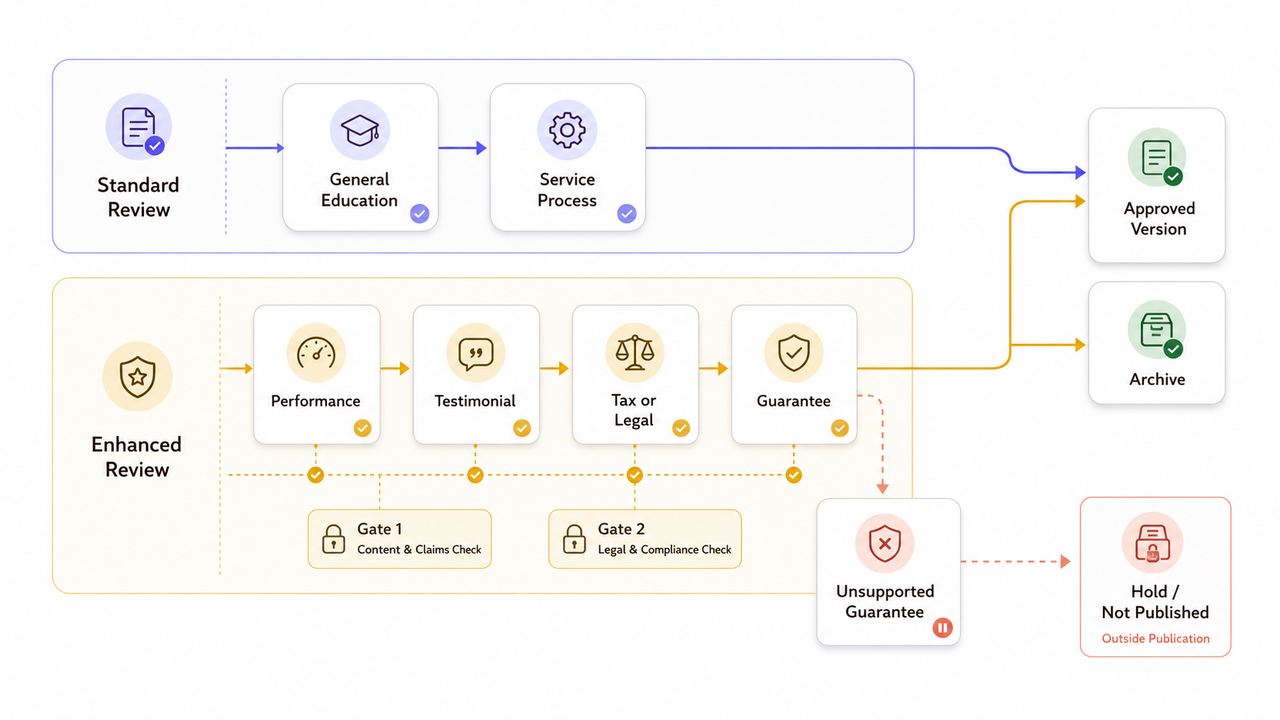
Compliance review should not begin after a campaign is already scheduled.
Build a review matrix for the firm’s actual channels:
| Asset | Marketing owner | Subject reviewer | Compliance or supervisory review | Record retained |
|---|---|---|---|---|
Website service page | Marketing | Service owner | According to firm policy | Approved page and disclosure |
Educational article | Writer or editor | Qualified subject expert | Based on content and applicable rules | Sources, draft, approval |
Email campaign | Marketing operations | Campaign owner | Before send when required | Audience, email, approval |
Webinar promotion | Events lead | Speaker | Before publication | Page, invitation, disclosures |
Webinar slides | Speaker or editor | Subject expert | Before presentation when required | Final deck and approval |
Social post | Approved publisher | Topic owner | According to communication type | Post and review record |
The exact reviewer and timing depend on the firm. The important point is that writers should know the boundary before drafting.
The process should identify content that always receives enhanced review, such as:
- performance information;
- testimonials or endorsements;
- third-party ratings;
- specific investment references;
- tax or legal interpretations;
- comparative or “best” claims;
- guarantees or statements suggesting certainty;
- promotions involving compensation or referral arrangements.
Archive the approved version as it appeared, not merely the editable source file. Keep the relevant disclosures, evidence, reviewer, approval date, publication period, and later corrections attached to it.
For FINRA-member firms, recordkeeping follows the substance of business communications rather than the device used. FINRA’s social-media guidance warns that business-related communications may need to be retained even when they occur through social platforms or personal devices.
Choose Internal or External Marketing Support
Keep decisions involving professional scope, regulatory classification, disclosures, suitability boundaries, and final approval inside the firm or with its qualified reviewers.
External support may help with:
- search research and site structure;
- technical website work;
- editorial planning;
- design and production;
- email operations;
- event assets;
- analytics setup;
- content inventory and archiving.
The provider needs a written operating boundary. Define:
- channels included;
- audiences and services covered;
- claims it may draft;
- subjects requiring internal expertise;
- disclosures supplied by the firm;
- approval stages;
- publishing permissions;
- record-retention responsibility;
- access to prospect data;
- escalation path;
- acceptance criteria.
Do not let an agency publish from an advisor’s personal account without a record or approval route. Do not assume a provider’s generic “financial compliance” checklist reflects the firm’s registration, jurisdiction, products, or supervisory procedures.
The firm should retain its domain, website, email platform, analytics, social accounts, event records, and content archive. Outside specialists can work through named access without becoming the owner of the evidence.
A useful engagement improves the review and delivery process. It does not claim to replace qualified compliance, legal, tax, or investment professionals.
FAQ
Can advisors reuse educational content supplied by custodians?
Possibly, but permission to access material is not automatically permission to republish or modify it. Confirm the licensing terms, intended audience, required attribution, update date, and mandatory disclosures.
The firm should still review whether the content is accurate for its services and approved channels. “Supplied by a custodian” does not mean “approved for every advisor’s campaign.”
What if a prospect requests personalized advice through a form?
Acknowledge the request without turning an automated message or marketing reply into individualized advice. Route it to an appropriately qualified person through the firm’s approved process.
Avoid requesting additional sensitive information through an unsecured marketing form. The responsible professional should decide what information is needed, which communication channel is appropriate, and whether the firm can assist.
How should archived disclosures be preserved after content updates?
Keep the disclosure that accompanied each published version. Attach it to the content, publication period, source evidence, reviewer, and approval record rather than overwriting the old file.
Retention periods and required formats depend on the firm and applicable rules. Confirm them through current official requirements and the firm’s qualified legal or compliance reviewers.
Can several advisor representatives share one campaign under one brand?
Yes, when the firm has defined which services, locations, registrations, and representatives the campaign covers. The landing page and follow-up should not imply that every representative offers the same service or holds the same qualifications unless that is accurate.
Assign one owner for the campaign and preserve representative-level routing, approvals, and required disclosures.
When should compliance review occur for live-event promotion?
Review should begin before the invitation or registration page is published. The promotional promise, audience, speakers, event description, disclosures, and follow-up plan may all affect the review.
Slides and prepared remarks should be reviewed before the event under the firm’s applicable process. The team should also decide who handles unscripted questions, last-minute slide changes, recordings, and requests for personal advice.
Conclusion
A useful financial advisor digital strategy does not ask every channel to produce an immediate client. It helps an appropriate audience understand the firm, reach the right professional, and see consistent evidence across search, content, email, events, and referrals.
Before another asset is published, name the person who can approve its central claim and retrieve the supporting record. If neither owner exists, the campaign is not ready to carry the firm’s trust.