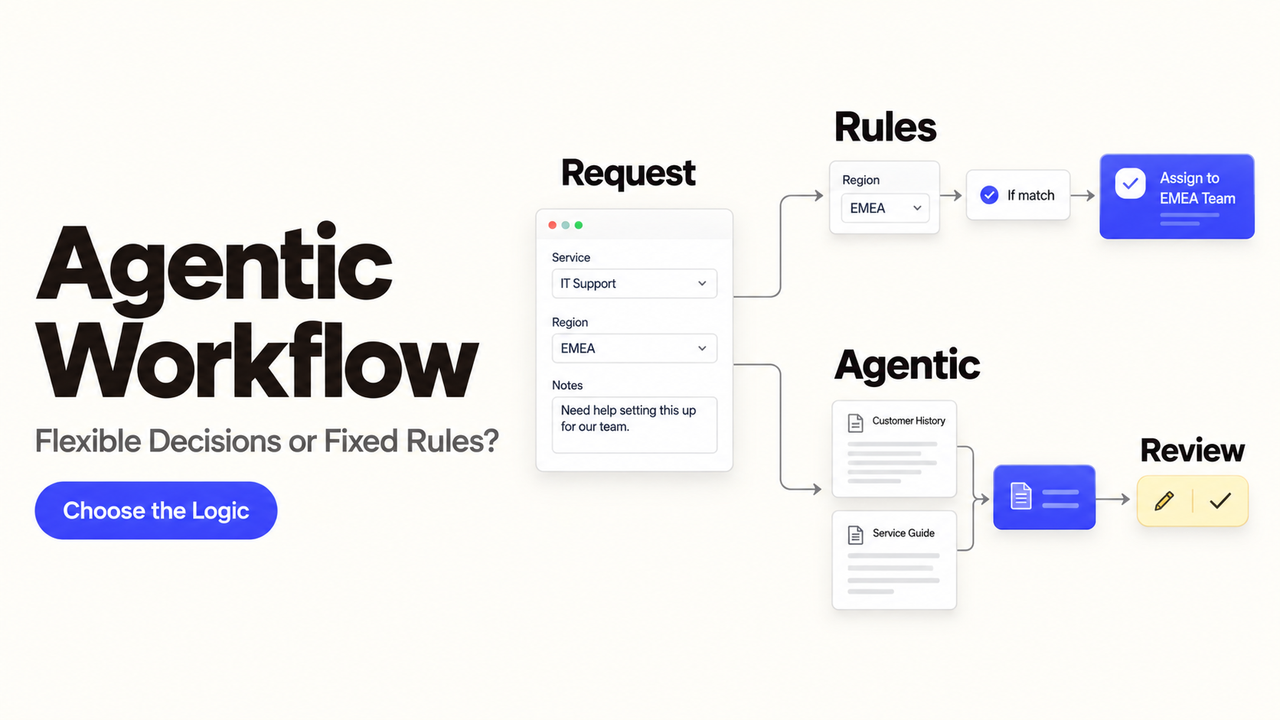
Agentic Workflow: Flexible Decisions or Fixed Rules?
An agentic workflow adds bounded decisions where fixed rules cannot handle variation, while keeping goals, tools, review, and stop conditions explicit.
An invoice above your approval limit should always take the same route. A customer message written in their own words may need interpretation before any route makes sense.
The first step needs a rule. The second may justify an agentic decision. Putting an agent around the whole process adds freedom where the business may need certainty.
An agentic workflow works best when it uses the least autonomy required for the job. The goal is not to replace every fixed path. It is to handle useful variation inside boundaries that people can inspect and change.
What Makes a Workflow Agentic
A workflow becomes agentic when a model can choose how to pursue a goal instead of following only a route defined in advance.
Anthropic defines an agent as a model that directs its own processes and tool use. It describes a loop of planning, acting, observing, adjusting, and either continuing or asking for human input.
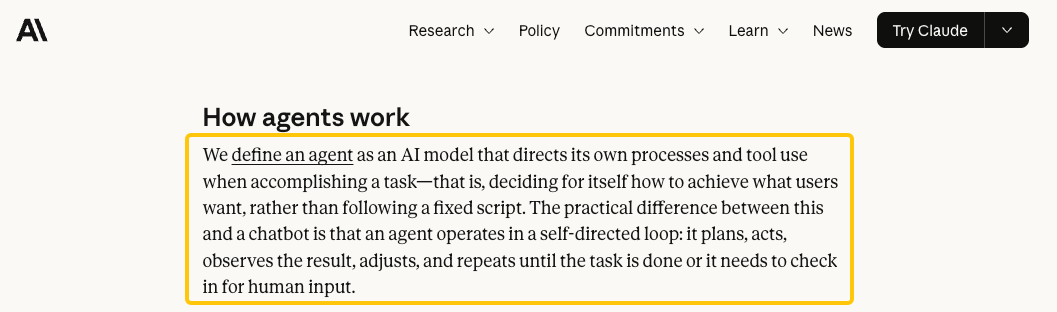
One decision can be agentic while the trigger, permissions, approval, and final write remain deterministic.
Bounded Decisions Instead of a Fixed Path
A fixed workflow can check whether an account ID exists and route a billing form to the billing queue. Those conditions are known in advance.
A free-text message is less tidy. The customer may describe two problems, omit a key detail, or use language that does not match your categories. An agentic step can examine the message, consult approved material, and propose a route.
The word “propose” matters. The agent does not need permission to refund a payment, close the case, or contact the customer. Flexible interpretation can end in a structured recommendation.
Goals, Context, Tools, and Feedback
An AI agent workflow needs a goal, permitted context, limited actions, and feedback.
For the support example, the goal could be “prepare a reviewable route for each complete request.” Context may include the message, customer tier, and approved category guide. Available tools might read the account record and search a knowledge base.
A missing record, failed search, or low-confidence category should change the next step. It should not hide behind a polished answer.
Choose Fixed Rules or Flexible Decisions
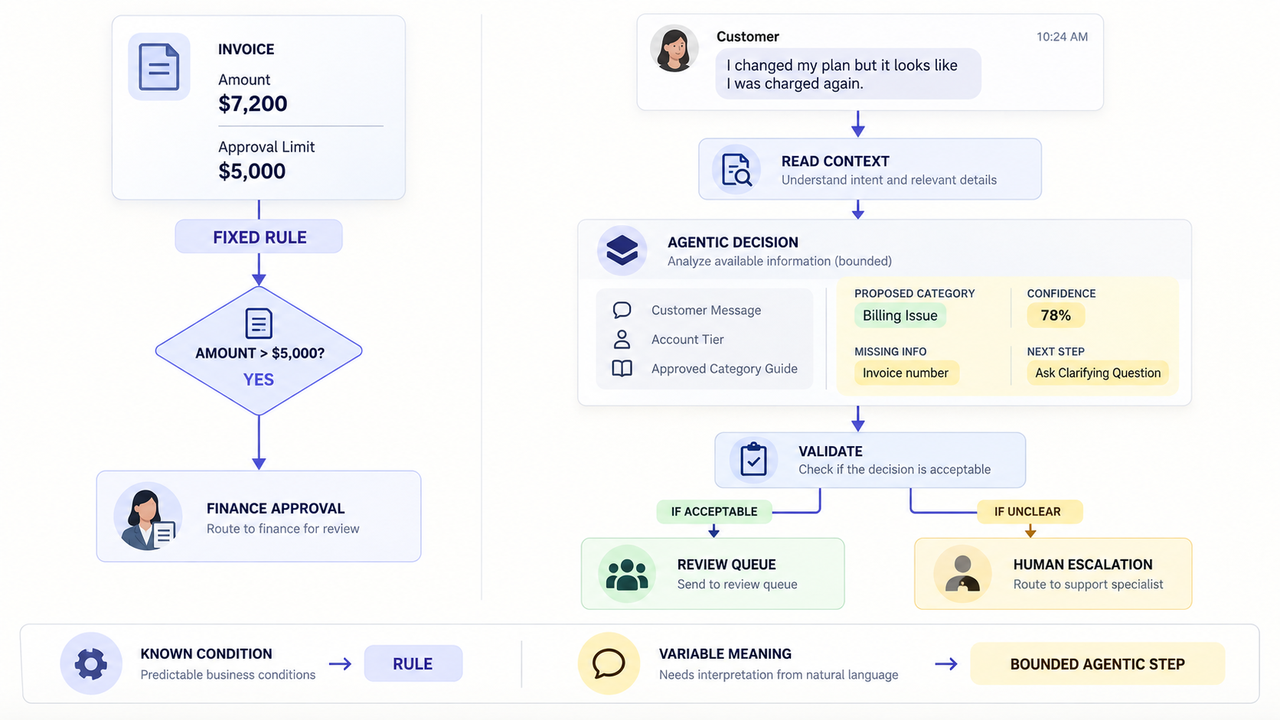
Use a fixed rule when the correct path can be written and tested before the workflow runs. Consider an agentic step when valid inputs vary enough that a prewritten branch becomes brittle.
Use Rules for Stable and Auditable Steps
Rules fit required fields, thresholds, allowlists, due dates, and exact status changes. They are easier to test because the same condition should produce the same route.
AWS Step Functions documents a Choice state that evaluates defined rules and selects the next state. It is one product example.
Keep a rule when the business needs a clear audit answer. “Invoices above $5,000 require finance approval” is easier to defend than asking a model whether an invoice feels significant.
Use Agentic Steps for Variable Inputs and Paths
Agentic process automation can help when the input is unstructured and the useful next action depends on context. Examples include classifying an unusual request, selecting relevant sources, or drafting a clarification question.
Give the agent a closed tool list, an output schema, and a route for uncertainty. If no approved category fits, escalation is a valid result.
Design a Bounded Agentic Loop
A bounded loop tells the agent what outcome to pursue and where its discretion ends. It also defines how the workflow exits when progress stops.
Define the Goal, Available Actions, and Stop Conditions
Write the goal as a result another person can verify. “Handle support” is too broad. “Recommend a queue, cite the message evidence, and identify missing information” is testable.
List each permitted action. Reading a customer record and searching an approved knowledge base are different permissions. Drafting a reply is different from sending one.
Stop after two failed searches, when an identifier is missing, when sources conflict, or before a restricted action. Send the stopped case to an owner.
Add Structured Outputs and Human Escalation
Require a proposed category, confidence, supporting text, missing information, and next step. Structured output also gives later rules something reliable to inspect.
Escalation should name a queue, owner, and response expectation. “Ask a human” is not enough if nobody receives the case. Preserve the agent’s proposal so the reviewer can see what required correction.
Combine Deterministic and Agentic Steps
The strongest design is often mixed. Rules prepare clean inputs and enforce permissions. An agent interprets the part that varies. Rules then validate its output and control what happens next.
In the support flow, rules validate the account ID and reject unknown categories. The agent recommends a category and drafts a question.
This is also the boundary with workflow orchestration. Decision design asks how one step chooses. Orchestration coordinates state, dependencies, tools, and people across the full job.
Keep High-Risk Changes Behind Explicit Controls
Refunds, record deletion, access changes, external messages, and financial commitments should not inherit authority from a classification step. Put those actions behind explicit rules or human approval.
As of September 15, 2026, SpringBrand publishes this guide and offers an agent-facing API capability layer. A verified capability could become an available action within a workflow. Its existence does not define the loop, approval policy, or business result.
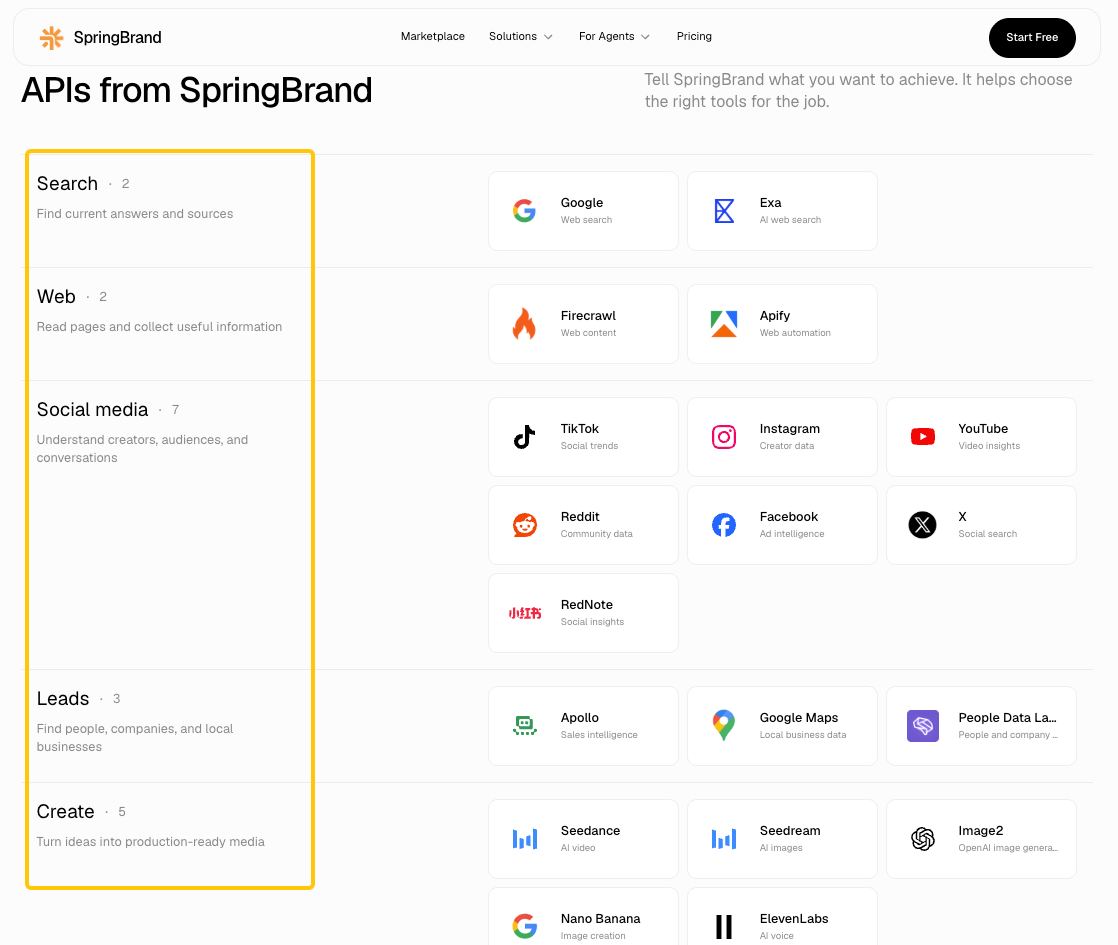
Check the current action schema, authentication, output, and failure behavior before adding any capability. A plugin or API belongs to the capability layer. An automation, template, or solution describes how capabilities are arranged for an outcome.
Evaluate the Workflow Before Expanding It
Test ordinary cases, incomplete inputs, conflicting evidence, unavailable tools, ambiguous messages, and requests that cross the approval boundary.
Measure Task Success, Intervention, and Failure Patterns
Define task success before the pilot. For support routing, measure accepted recommendations, corrections, unresolved cases, and prohibited actions attempted or blocked.
Separate useful corrections from hidden failures. Also track repeated loops, tool errors, and cases sent to the wrong owner.
Review failure patterns, not only the average. Keep, narrow, or remove the agentic step based on the evidence.
The named product behaviors below were checked against official documentation on September 15, 2026. They illustrate specific implementations and should not be treated as universal platform behavior.
FAQ
Can prompts be versioned separately from workflow logic?
Yes, some platforms support separate prompt versions. Your run record should still capture both the prompt version and the workflow version used.
For example, LangSmith gives prompts commit histories and environment tags. A tag can point to a different prompt commit without changing workflow code. Treat that move as a deployment change: test it, approve it, and retain the resolved commit identifier.
What happens when a long-running workflow's credentials expire?
The run should pause before the protected action and create a recoverable error. Do not let repeated authentication failures consume the normal retry budget.
Save a checkpoint that excludes secrets, send reauthorization to the credential owner, and resume only after access is restored. If the underlying data may have changed, read it again before completing the action.
Can completed deterministic steps be reused after an agentic step fails?
Sometimes, if the platform preserves successful state and the completed actions are safe to reuse. Do not assume every engine supports this behavior.
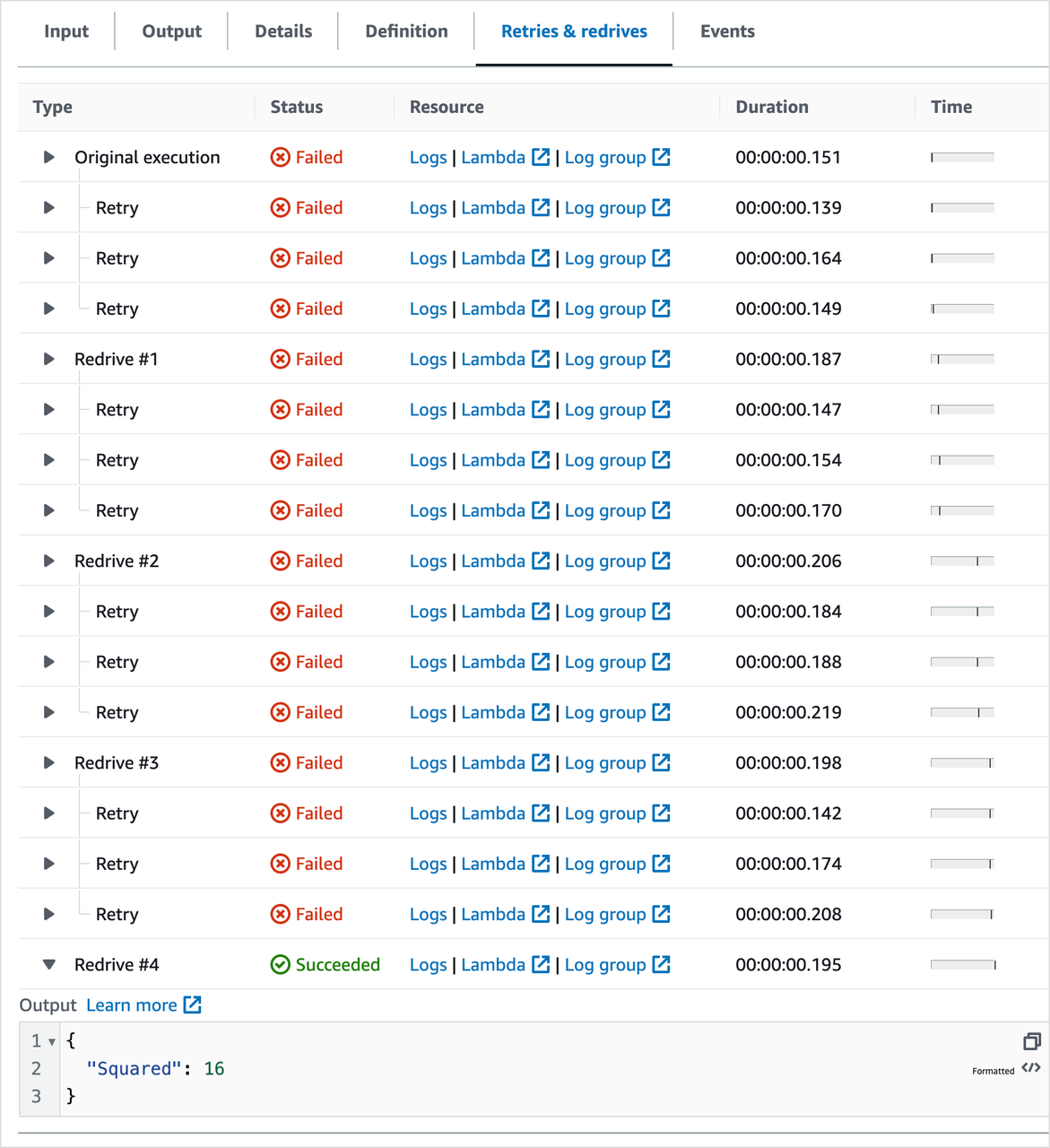
AWS Step Functions Standard Workflows provide one example. Its redrive feature preserves successful step results and resumes from the unsuccessful step under stated eligibility limits. Reused outputs still need durable storage, version context, and idempotent downstream actions.
How should concurrent agentic runs update the same business record?
Use version checks so an older run cannot silently overwrite a newer record. A conflict should trigger a fresh read, a new decision, or human review.
Microsoft Dataverse illustrates this with optimistic concurrency. Its version-matching option detects a record changed after retrieval. The losing run should not default to last-write-wins behavior.
What evidence should be retained when a human overrides an agent decision?
Keep enough evidence to reconstruct the decision without storing unrelated data. Record the run, workflow and prompt versions, relevant inputs, agent proposal, reviewer, time, reason, final action, and downstream effect.
The NIST Generative AI Profile recommends monitoring and documenting human overrides as part of risk management. Set retention and access rules according to the workflow’s business, contractual, and regulatory needs.
Conclusion
An agentic workflow is useful when a real business step needs interpretation, tool choice, or adaptation that fixed branches cannot handle well. That does not make the entire process agentic.
Keep stable checks and consequential actions deterministic. Give flexible steps narrow goals, limited tools, structured outputs, stop conditions, and a named human escalation route. Then expand only when the task evidence supports more autonomy.