AI Content Trust: In-House Review or Expert Support?
AI content can speed up publishing, but trust still needs review. Learn when brands can handle content checks in-house and when to get expert support.
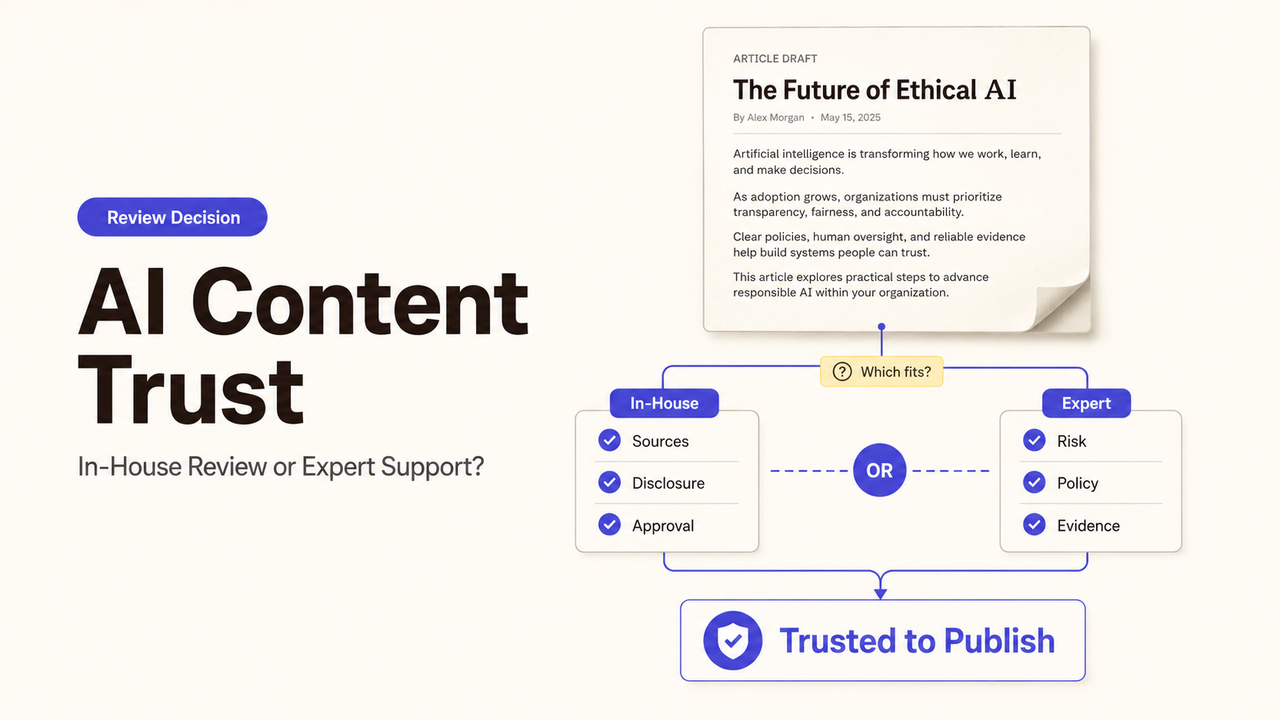
Keep AI content trust review in-house when one named editor can trace every claim, compare the copy with its source notes, and stop publication when evidence is missing. Bring in outside support when the work crosses regulated claims, several channels, unfamiliar search requirements, or a launch where one error would be expensive to correct. The dividing line is not how much AI touched the draft; it is whether the team can inspect the evidence and own the correction. I’m Alex. Use that boundary to decide how much review capacity your business actually needs.
Why AI Content Trust Is a Business Issue
Customers rarely see the prompt, model, or editing history behind a page. They see a product claim, an email recommendation, a founder’s opinion, or an answer that is supposed to help them make a decision.
A weak article can therefore create more than a writing problem. An unsupported statistic may enter a sales deck. An outdated product description may be reused in an email sequence. A fabricated quotation may be repeated on social media before anyone checks the original source.
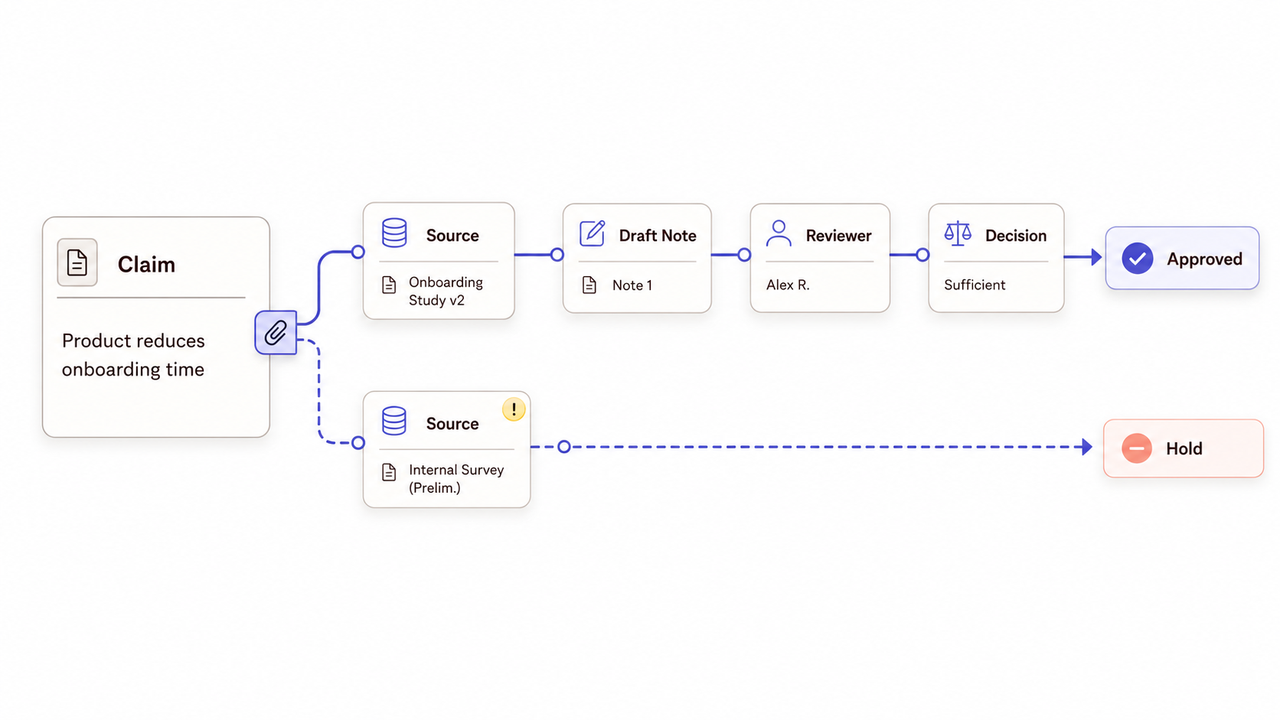
The business needs to know:
- who supplied the information;
- which source supports each material claim;
- who edited and approved the copy;
- what AI was allowed to do;
- where corrections will be recorded;
- who responds when a customer challenges the content.
These controls matter whether the first draft came from an employee, freelancer, agency, or language model. The FTC’s advertising guidance for small businesses states that advertising must be truthful, non-deceptive, and supported by evidence. AI use does not reduce the company’s responsibility for the claim it publishes.
What Makes AI-Assisted Content Feel Trustworthy
Readers cannot verify every sentence, but they notice when an article is specific, attributable, consistent, and willing to show its limits.
Trustworthy AI-assisted content usually has five qualities:
| Quality | What the reviewer should see |
|---|---|
Accuracy | Claims match current, accessible sources |
Attribution | Data, quotations, and outside ideas identify their origin |
Original contribution | The business adds analysis, experience, or a useful decision |
Brand consistency | Terms, promises, examples, and tone fit the company |
Accountability | A named person approves the work and owns corrections |
A polished draft can still fail this test. Smooth transitions and clean grammar do not prove that the source exists or that the conclusion follows from it.
Search visibility depends on similar fundamentals. Google’s current guidance for generative AI content tells site owners to focus on accuracy, quality, and relevance. It also warns that generating many pages without adding value may violate its scaled-content policies.
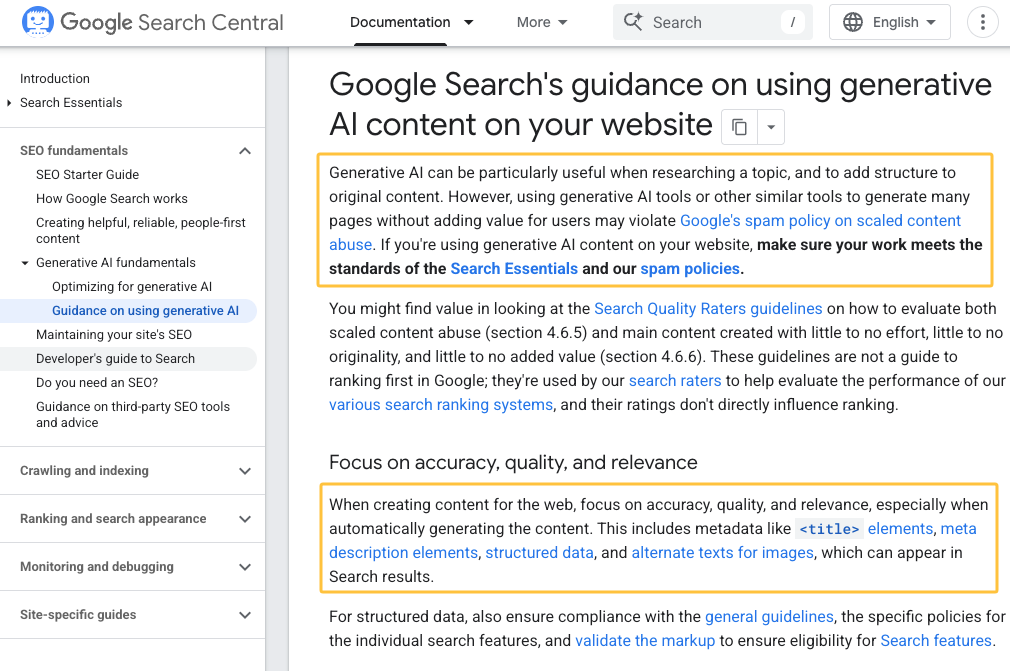
That does not mean every AI-assisted paragraph needs to be removed. The editor should ask what the page contributes and whether the business can defend it.
Build an In-House Review Process First
Even if you expect to hire help, establish a basic internal process first. An outside provider cannot reliably enforce standards the company has never defined.
Use five review stages:
- Brief the work. Record the audience, business goal, channel, required sources, prohibited claims, AI-use boundary, and final approver.
- Preserve the record. Keep the outline, sources, drafts, contributor notes, prompts when relevant, and meaningful revisions.
- Review the content. Check facts, quotations, originality, search intent, brand terminology, and the requested action.
- Escalate exceptions. Route legal, technical, financial, medical, privacy, or regulated claims to an appropriately qualified reviewer.
- Approve and archive. Save the published version, review date, approver, disclosures, and correction contact.
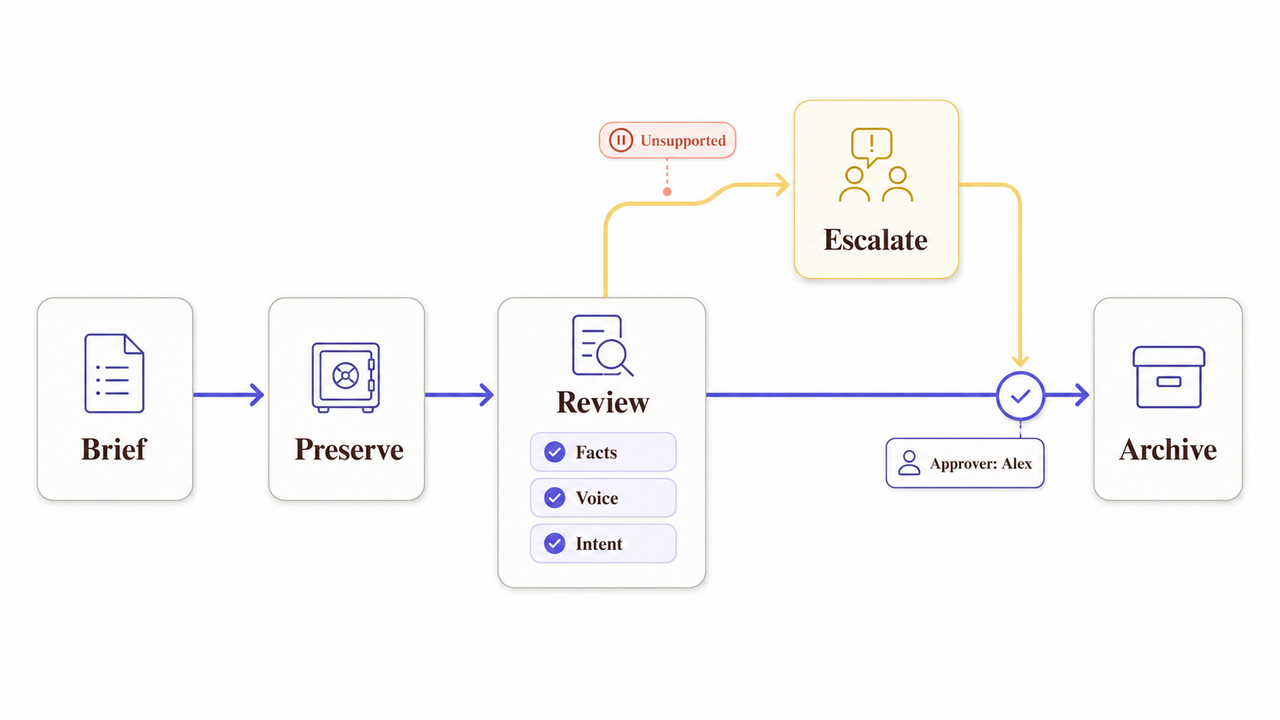
The reviewer needs authority to return the draft. If marketing is expected to publish every piece on schedule regardless of unresolved evidence, the process contains a deadline but not an approval control.
NIST’s AI Risk Management Framework provides a broader structure for managing AI risks affecting organizations and people. A small content team does not need to reproduce an enterprise governance program, but it can apply the same operating idea: identify the risk, decide who owns it, measure what can be checked, and document the response.
Use AI Detectors as One Quality Signal
AI generated content detection can help a reviewer identify passages that deserve attention. It cannot establish factual accuracy, originality, contractual compliance, or the identity of the person who typed the draft.
If your team uses a detector:
- scan the exact version under review;
- retain the tool name and date;
- inspect the highlighted passages;
- compare those passages with drafts and sources;
- ask the writer about the production process;
- record who made the final decision.
Do not create an automatic rejection threshold without considering the cost of an error. A false positive can accuse an original writer; a false negative can allow generated work to pass as human. A 2025 NBER study of automated writing detection emphasizes that decision-makers should evaluate those two error types separately and set policies according to their consequences.
A detector disagreement should keep the review open. It should not trigger repeated scans until the team receives the result it prefers.
The stronger evidence usually comes from the work itself: revision history, source files, interview notes, contributor comments, and an explanation that matches the record.
Protect Brand Voice Across Every Channel
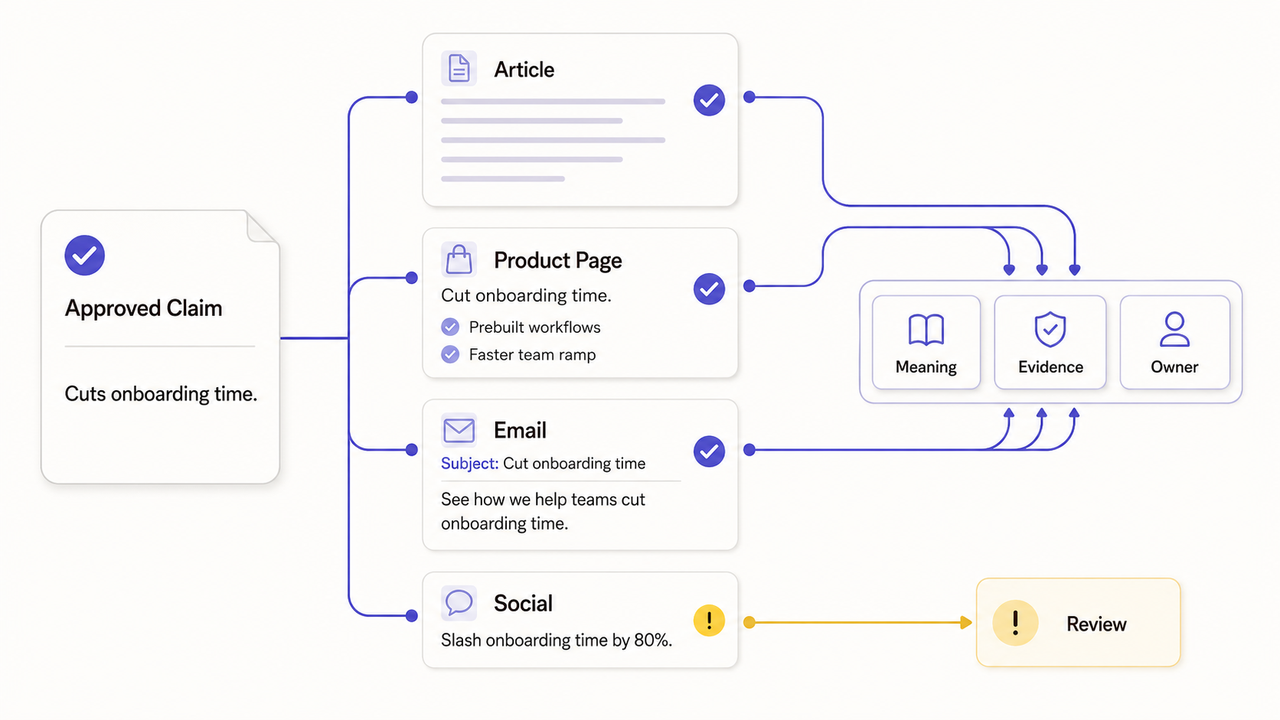
Brand authenticity is easier to maintain when the voice guide describes decisions rather than adjectives.
“Professional, helpful, and confident” gives an AI tool or freelancer little direction. A stronger brief explains:
- how directly the brand states a recommendation;
- which claims require qualification;
- how technical terms are introduced;
- whether first-person experience is permitted;
- which customer concerns deserve acknowledgment;
- which promises the brand will not make;
- how the next step should be presented.
Create an approved terminology list for product names, features, customer groups, pricing language, and sensitive claims. Attach an owner and review date so outdated wording does not remain “approved” forever.
Do not force identical copy across channels. A research article, product page, customer email, and social post may share the same claim while using different detail and pacing. The underlying commitment should remain consistent even when the presentation changes.
When a channel owner changes the claim rather than merely adapting its format, the content should return to the appropriate approver.
Decide When Expert Editorial Support Is Needed
Internal review works when the content volume is manageable, sources are accessible, and someone has enough subject knowledge and authority to challenge the draft.
External support becomes more useful as uncertainty or coordination cost rises.
| Situation | Likely support |
|---|---|
Grammar, clarity, and structural problems | Copy or substantive editor |
Search intent, internal links, metadata, or content decay | SEO specialist |
Inconsistent topics, audiences, and channel roles | Content strategist |
High publication volume with weak quality control | Editorial operations support |
Multilingual content with market-specific meaning | Qualified local editor or localization specialist |
Technical or regulated claims | Relevant subject-matter or qualified professional review |
Major rebrand or messaging change | Brand strategist plus editorial lead |
One provider may cover several areas, but the title alone proves nothing. An editor may not provide SEO strategy. An SEO consultant may identify thin content without rebuilding the brand voice system. A content strategist may design governance without line-editing every article.
Buy the missing capability, not the broadest package.
Outside support is also appropriate when the internal reviewer is too close to the claim. A founder who wrote the positioning may struggle to test whether the evidence supports it. An independent reviewer can challenge the assumptions, but final business approval should remain with the company.
What to Ask Before Hiring Content Support
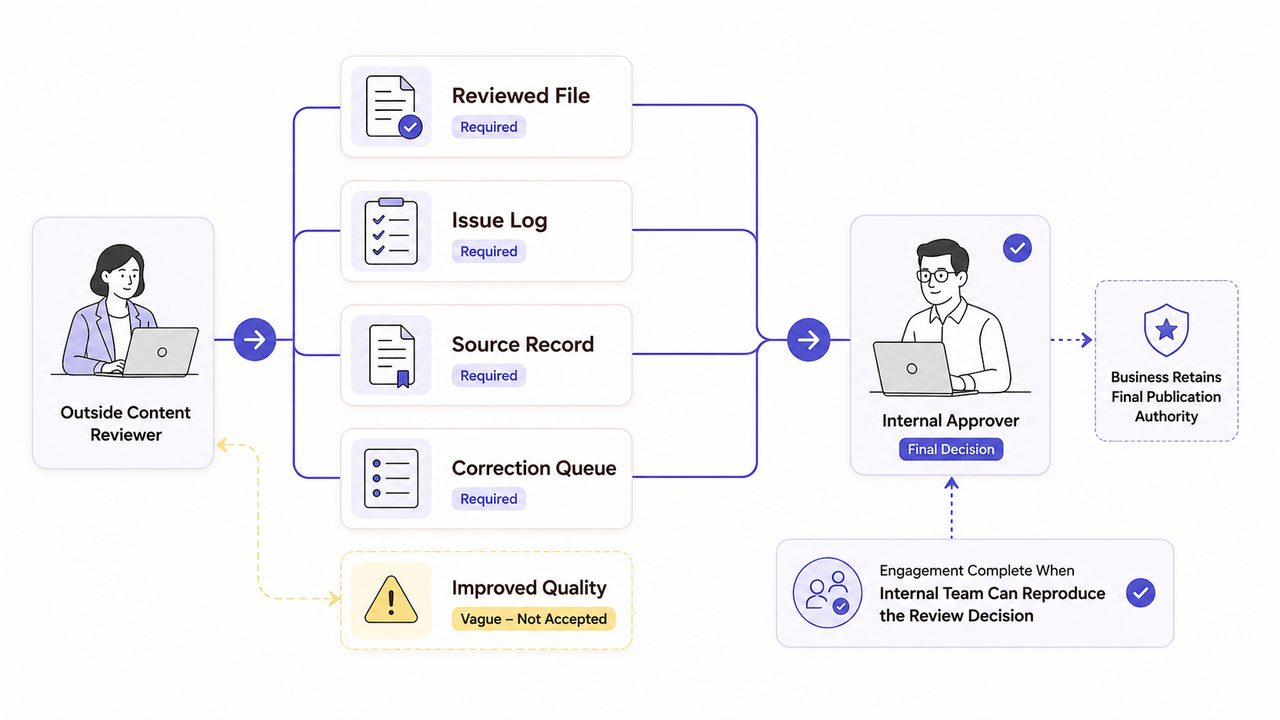
Start with a review brief that shows the provider what the business is trying to protect.
Include:
- content types and channels;
- monthly or project volume;
- primary audience;
- brand and terminology references;
- AI-use and disclosure policy;
- fact-checking expectations;
- high-risk topics;
- current workflow and bottleneck;
- required deliverables;
- approval owner;
- correction and escalation process.
Then ask each provider the same questions:
- Which parts of the review will you perform?
- What evidence will appear with each finding?
- Do you edit the copy, create tickets, or only recommend changes?
- How do you distinguish a factual error from a style preference?
- Where do AI detectors enter your process?
- How do writers respond to a disputed flag?
- Which claims require another specialist?
- What access and confidential material do you need?
- Who owns edited files, source notes, and workflow documentation?
- What proves the engagement is complete?
A useful deliverable should leave the internal team able to reproduce the decision. “Improved quality” is too vague to accept. A reviewed file, issue log, source record, approved voice guide, and correction queue can be inspected.
For sponsored or promotional content, check disclosure responsibilities separately. The FTC advises that necessary native advertising disclosures should be clear and prominent. An editorial provider can flag the issue, but the business should verify the requirements that apply to its market, industry, platform, and commercial relationship.
FAQ
Who should own AI content review inside a small business?
Assign one person with authority to delay publication, request evidence, and escalate specialist questions. This may be a marketing lead, managing editor, or founder in a very small company. Contributors can complete checklists, but shared participation should not obscure who makes the final decision.
Should AI-assisted content always be disclosed?
Not under one universal rule. The answer depends on the type of assistance, audience expectations, publication policy, platform requirements, commercial relationship, industry, and jurisdiction. Define the company standard in advance. Verify applicable requirements when AI materially generates content, affects expert claims, or could change how readers interpret authorship.
How often should older AI-assisted content be reviewed?
Review according to change risk rather than one arbitrary calendar. Pricing, product features, legal requirements, health information, software instructions, and market statistics may need frequent checks. Evergreen opinion pieces may change less often. Add an owner, last-reviewed date, and trigger for events such as a product update or policy change.
What should be included in an editorial review brief?
Include the audience, content goal, channels, source requirements, AI-use boundary, brand references, sensitive claims, expected deliverables, reviewer access, approval owner, deadline, and acceptance criteria. Also state whether the provider will edit directly, leave comments, create an issue log, or manage corrections after publication.
When is a detector score not enough to make a decision?
A score is insufficient whenever the decision affects payment, authorship credit, contributor access, reputation, or publication status. Review the highlighted passage alongside drafts, sources, revision history, permitted-use rules, and the writer’s response. If the evidence remains inconclusive, record the uncertainty instead of converting probability into proof.
Conclusion
AI content trust can stay in-house when the business has a workable standard, a named reviewer, accessible source evidence, and a correction path. External support becomes justified when volume, specialist knowledge, channel coordination, or the cost of a mistake exceeds that internal capacity.
Keep final approval inside the business until the provider’s scope, evidence, escalation duties, and handoff are explicit. If nobody can explain why the content is accurate and ready to publish, adding another tool or vendor will not close the decision.