AI Detector Accuracy: What Writers Should Know
Are AI detectors accurate? Learn why results can vary, where false positives happen, and how writers should use detection tools responsibly.
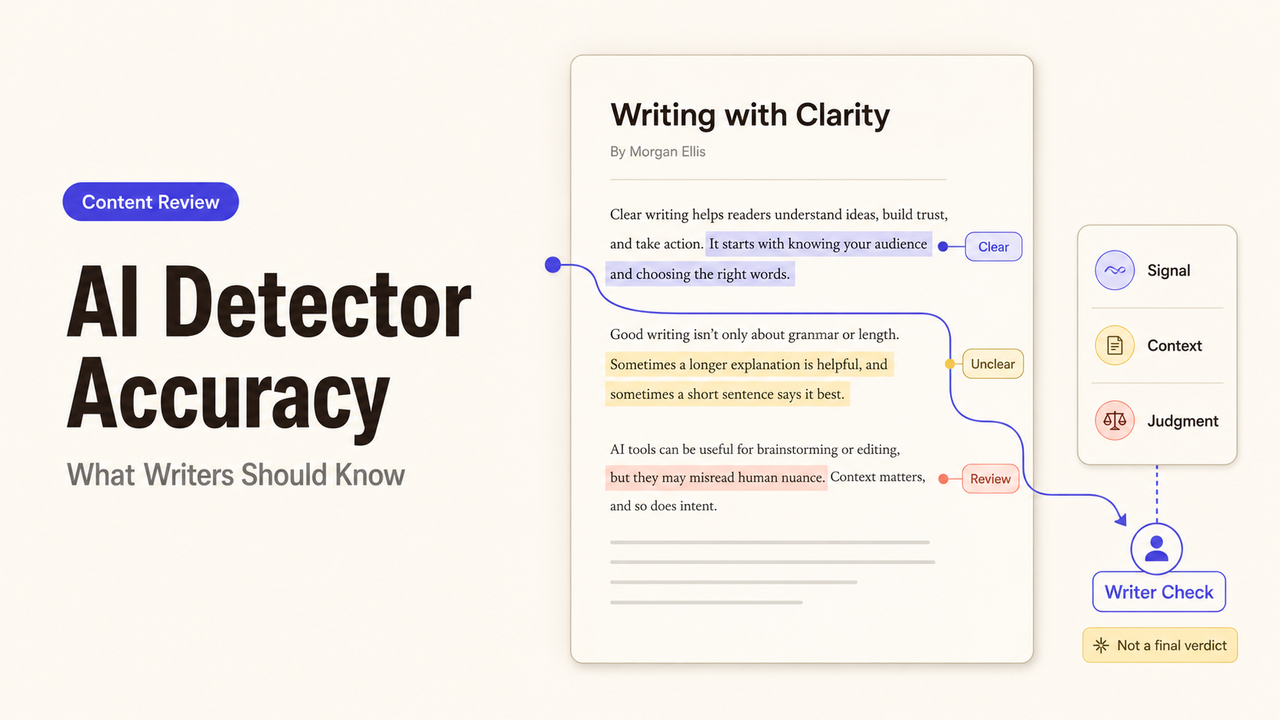
Run one draft through two AI content checkers and you may get two different stories. One highlights several passages; the other finds nothing unusual. The useful question is not simply which score is higher. An editor needs to know what text was tested, where each tool sets its threshold, and whether it is more likely to miss AI writing or flag human work by mistake. I’m Alex, and throughout this guide I’ll keep the score where it belongs: inside an evidence review, not above it.
Why AI Detector Accuracy Is Hard to Measure
“Accuracy” sounds like one clean number. In practice, it can hide several different questions.
| Measure | What it tells you | What it may conceal |
|---|---|---|
Overall accuracy | How many samples the detector classified correctly | Whether the test used a realistic mix of human and AI writing |
False-positive rate | How often human writing was flagged as AI | Which writers, languages, or genres were affected |
False-negative rate | How often AI-generated writing passed as human | Which models or editing conditions were tested |
Decision threshold | How much evidence the tool requires before flagging text | The trade-off between false positives and false negatives |
Test coverage | Which models, genres, languages, and text lengths were included | Performance on material outside the test set |
A cautious detector may produce fewer false accusations, but it may also allow more AI-generated text to pass unflagged. Raise the threshold and that trade-off changes again.
That is why a 2025 NBER paper on artificial writing and automated detection keeps the two error rates apart. False positives show how often human work is accused; false negatives show how often generated text slips through. Fold them into one number, and that difference disappears.
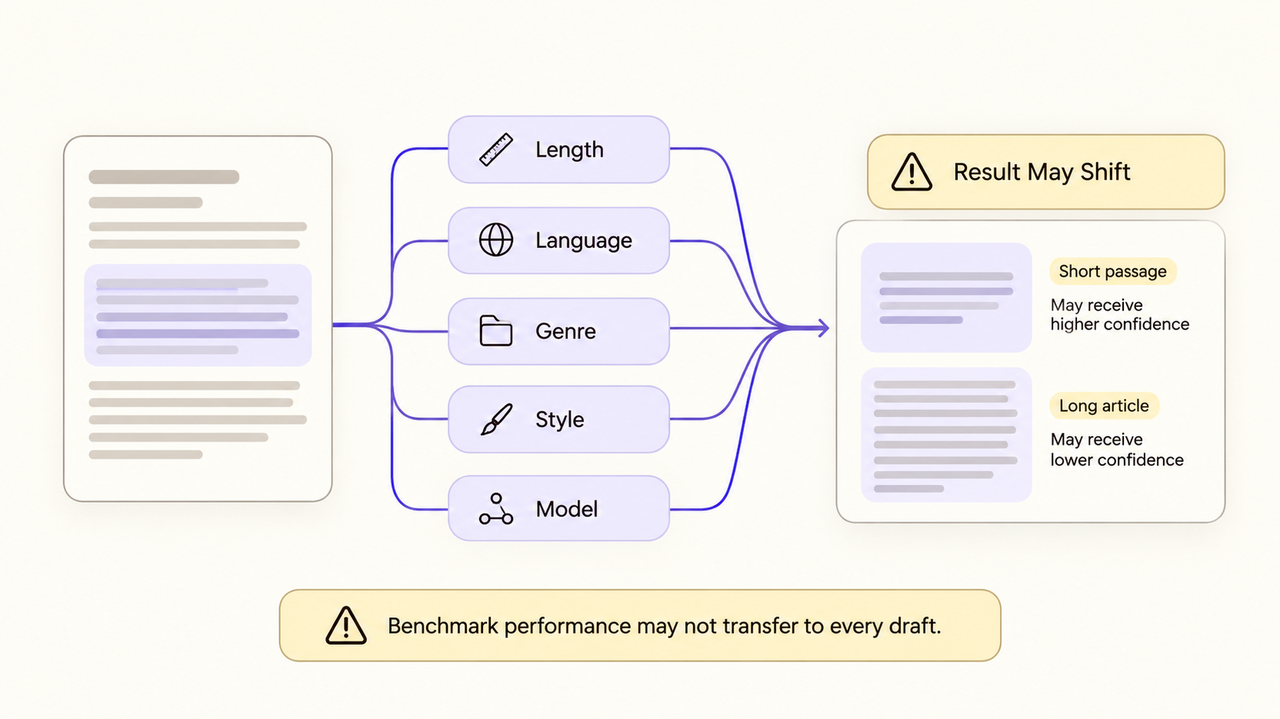
A strong benchmark result does not always travel well. Long English essays give a detector far more material than a 70-word product description, while translated newsletters and technical copy may contain patterns the original test never covered. Output from a newer model can widen the gap. Check the benchmark before deciding that its accuracy figure says anything useful about your draft.
What AI Detectors Usually Look For
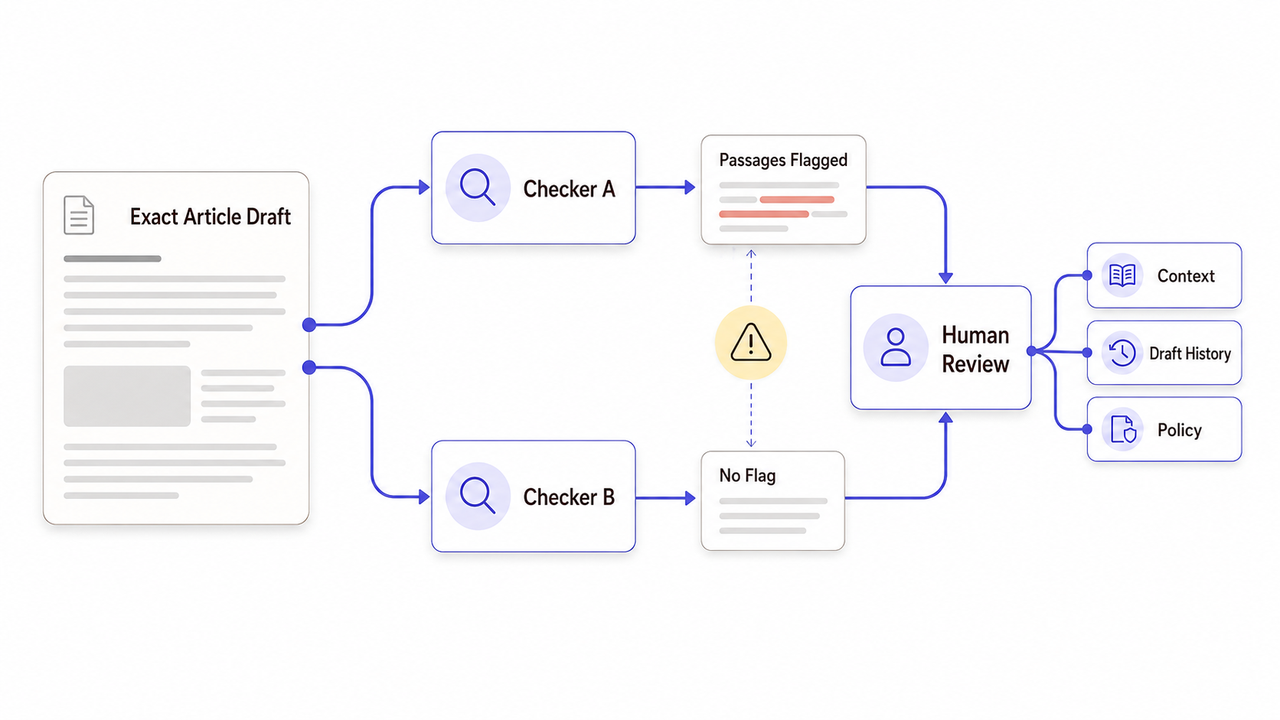
Most AI writing detectors do not uncover a hidden label showing who wrote a passage. They estimate whether patterns in the submitted text resemble material classified as human-written or machine-generated during the tool’s development.
What the software notices varies from one system to another. One detector may react to predictable word choices or repeated sentence shapes; another may pay more attention to transitions, vocabulary patterns, or the mathematical representation of a passage. Because each tool combines these clues differently, its score cannot be directly compared with a result from another AI content checker.
There is another limit that often gets overlooked: the detector sees the submitted text, not the process behind it. It cannot inspect the interview that produced a quotation, the notes that shaped an argument, or the revisions exchanged between a writer and editor. When authorship is disputed, those records may reveal more than the final score.
Why False Positives and False Negatives Happen
A false positive occurs when human writing is identified as AI-generated. A false negative occurs when generated material is classified as human. Both types of error are expected in a classification system.
Their frequency can change with the tool’s threshold, test dataset, sample length, language, genre, and the difference between the submitted material and the examples used to develop the detector.
Researchers saw that gap while conducting an evaluation of AI-generated text detectors. Several tools looked strong when measured by AUROC, a broad benchmark metric. Their practical value fell, however, once the researchers imposed a stricter limit on how often human writing could be flagged by mistake.
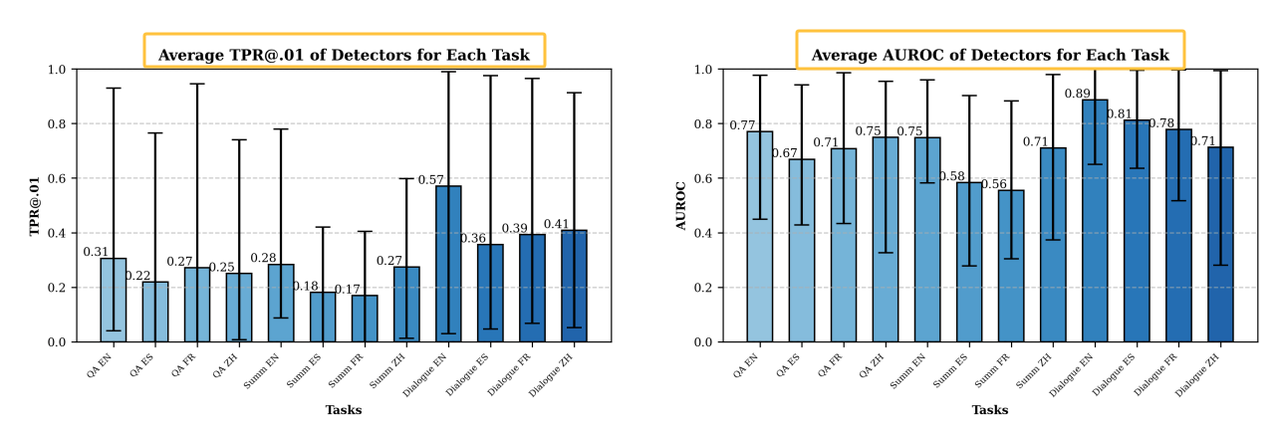
Those errors are not harmless. A false flag can lead to a rejected article, delayed payment, or an accusation that follows the writer beyond one assignment. If the process offers neither human review nor an appeal, even a relatively uncommon false positive can do real damage.
How Writing Style Can Affect Detection Results
Clear writing is not evidence of AI use. Neither are formal transitions, consistent sentence structure, limited vocabulary, or a polished tone. Yet those features may overlap with patterns that some detectors associate with generated text.
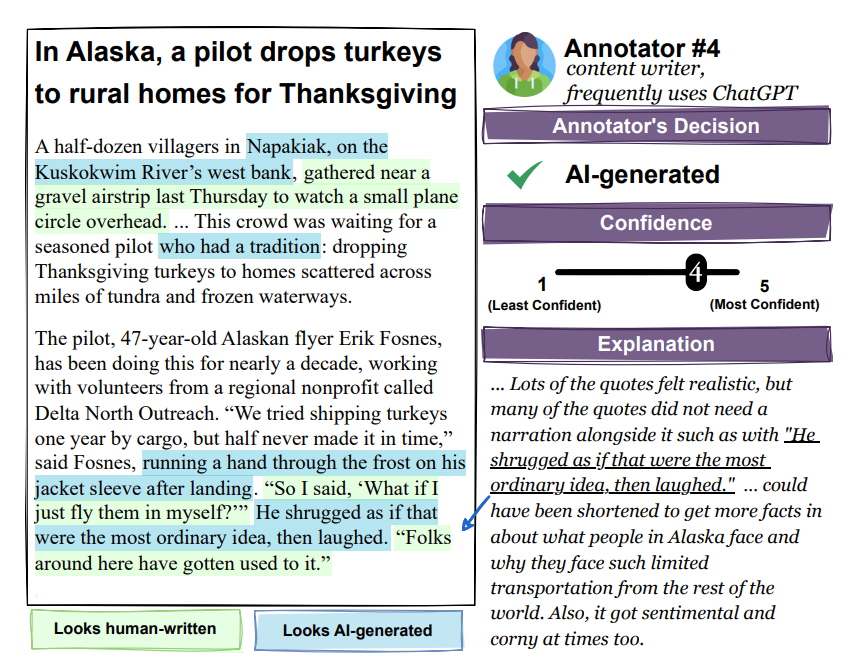
A 2025 COLING study on machine-generated text detection found that detector performance could change with writing style and text complexity. In the systems evaluated, some easier-to-read human text was more likely to be misclassified. The study does not describe every detector, but it shows why the style of the test material belongs in any discussion of AI detector accuracy.
A 2023 study of seven detectors offers another reason for caution. Across the systems examined, writing by non-native English authors was misclassified more often. The result belongs to those seven tools and that research period, so it should not be treated as a verdict on every detector available today.
Short passages create a different problem: there may not be enough text for a stable classification. A score produced from one paragraph should not quietly become a claim about an entire article or the person who wrote it.
Why One Score Should Not Decide Publication or Rejection
Whether a draft should be published depends on more than a probability score. Editors still need to check its facts, sources, originality, disclosure, usefulness to the audience, and fit with the publication’s stated policy.
The seriousness of the decision should determine how much evidence is required. A routine request for revision is not the same as rejecting paid work or accusing its author of misconduct. The second decision can affect income and reputation, so it needs the exact file tested, a policy known in advance, supporting records, human review, and a way to challenge a mistake.
A 2025 ACL study gives a useful picture of what people add to the review. Experienced AI users examining nonfiction articles paid attention to originality and word choice, as well as how clear and formal the writing felt. They still made mistakes. The difference was that they could weigh several clues together instead of working from the text classification alone.
How Writers Should Respond to a Flagged Draft
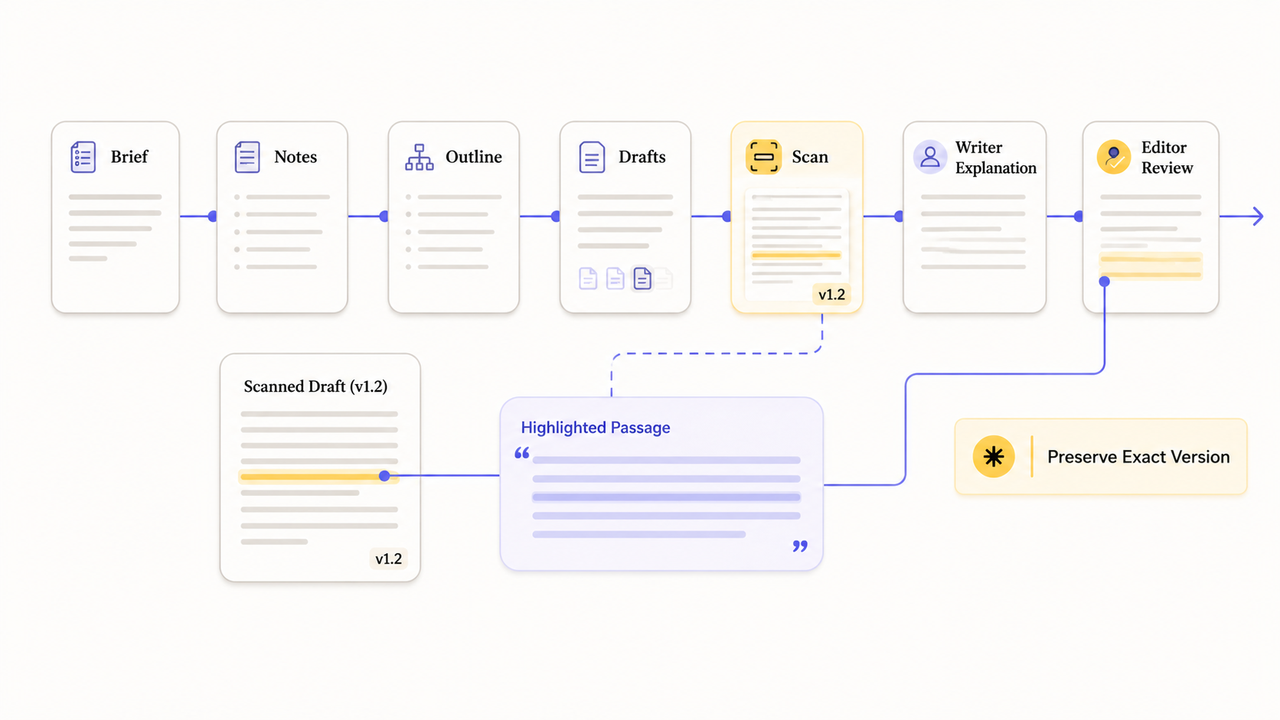
First, preserve the exact version that was scanned. A later revision cannot explain why an earlier file produced a particular result.
Next, ask to see exactly what raised the concern:
- The detector and version used
- The date of the scan
- The score or classification
- Any passages the tool highlighted
- The editorial or client policy being applied
Without that information, neither the writer nor a second reviewer can reproduce the finding. The result remains a lead to investigate, not a settled conclusion.
If a writer needs to answer a flag, the most useful first step is to build a timeline rather than draft a defense. Put the original brief and outline beside the first version of the article. Add the research notes, source history, later drafts, interview material, tracked edits, and a short explanation of any AI assistance allowed by the assignment. Together, those records show how the finished piece developed.
Then set the score aside for a moment and read the highlighted passage as an editor would. Does it repeat an earlier point? Is a claim unsupported, or does the wording sound unlike the rest of the publication? Revise the passage if the answer is yes. The reason for the edit should be visible in the prose, not merely in a detector report.
Do not pull apart clear writing simply to satisfy an AI content checker. That gives the software control over the edit without establishing anything about how the draft was produced.
How Editors and Brands Should Use Detection Tools
Before scanning submissions, decide what the organization is trying to detect. Undisclosed AI assistance, fabricated sources, copied language, factual errors, and weak original insight are separate problems. An AI detector cannot investigate all of them.
Set the AI-use rule before the first draft arrives. Writers need to know whether assistance is banned, permitted for limited tasks, or acceptable when disclosed. A policy introduced only after a flag appears cannot fairly serve as the standard for work submitted under different expectations.
For any result that could affect publication, payment, or reputation, keep a compact decision record:
- Exact file or text version reviewed
- Detector, version, settings, and review date
- Applicable editorial or client policy
- Output and passages that raised concern
- Draft history, sources, and other evidence checked
- Name of the human reviewer
- Decision and reasoning
- Correction, appeal, or second-review path
This record makes the review reproducible. It also gives the editor somewhere to return when the tool changes, the writer supplies additional evidence, or two reviewers disagree.
FAQ
Can AI detectors be wrong about human writing?
Yes. A detector can produce a false positive, particularly when the text differs from the languages, genres, lengths, or writing styles represented in its evaluation. A flag should prompt a review of the exact draft, source records, version history, and applicable policy. It should not be presented as proof of authorship on its own.
Do edited AI drafts become harder to detect?
Editing may change a detector’s result, but there is no reliable way to predict how far the score will move—or in which direction—from one tool or text to the next. The better editorial question is whether the writer followed the agreed policy and whether the finished work is accurate, original, properly sourced, and useful.
Should a writer rewrite only to lower a detector score?
No. Rewrite a passage when it is vague, repetitive, inaccurate, poorly supported, or inconsistent with the publication’s voice. Changing sound prose solely to influence a score gives the AI content checker too much authority. It may leave the article less readable without proving anything about how the original draft was produced.
Are AI detectors equally reliable across languages?
No such assumption is safe. A detector tested mainly on English may perform differently on Chinese, Spanish, bilingual writing, or translated material. Before relying on the result, check whether the provider or independent researchers have evaluated the relevant language, text type, and writer population. If that evidence is unavailable, leave the limitation open.
What evidence should matter besides a detector result?
The strongest record usually includes the outline, research notes, source list, version history, tracked edits, interview material, editorial messages, and the writer’s explanation of the process. Editors should compare that trail with the final article. Factual accuracy, original contribution, citation quality, and compliance with a policy announced before submission carry more weight than an isolated score.
Conclusion
AI detector accuracy is not one permanent percentage. It changes with the detector, threshold, test material, language, genre, sample length, and type of error being measured.
Writers should preserve the record of how a draft developed. Editors should preserve the record of how the publication decision was made. Keep every result attached to the exact text, policy, evidence, reviewer, and consequence: the score may open the review, but the evidence must close it.