AI Content Detection Workflow for Substack Writers
Searching for a Substack AI detector? Use this editorial workflow to review AI-assisted drafts without treating one detection score as proof.
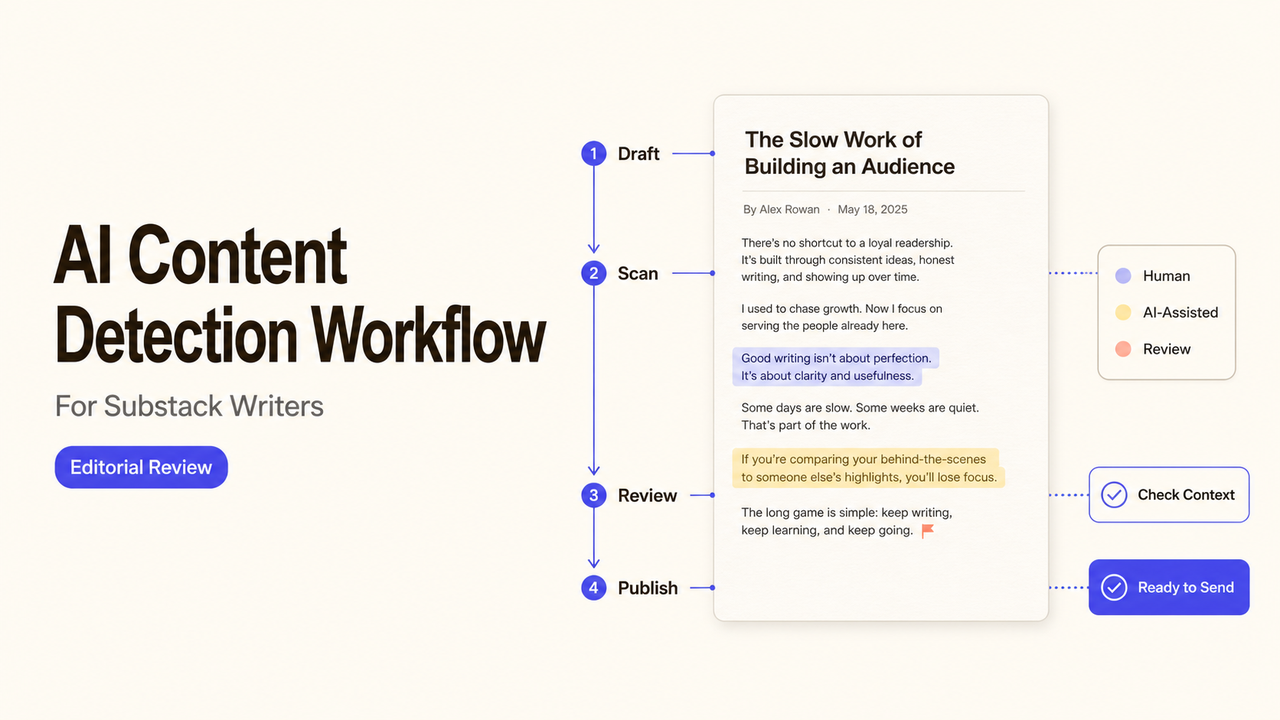
Your Substack draft has passed copy editing, the subject line is scheduled, and the Publish button is waiting. Yet the source links remain scattered across messages, a co-writer’s AI edits are not recorded, and nobody has approved the disclosure. Searching for a Substack AI detector will not resolve those gaps by itself. I’m Alex; in this workflow, detection enters only after the team can show how the edition was researched, written, reviewed, and approved.
Start With an AI Use and Disclosure Standard
Decide what acceptable AI use means before reviewing a draft. Otherwise, editors will interpret the same activity differently after a detector produces a score.
Your standard might distinguish among:
| Writing activity | Example policy treatment |
|---|---|
Brainstorming questions | Allowed without disclosure |
Grammar or spelling suggestions | Allowed and recorded internally |
Translating original writing | Allowed with human verification |
Rewriting full passages | Allowed only with disclosure |
Generating quotations, reporting, or personal experience | Prohibited |
Producing sponsored claims | Subject to source and sponsor approval |
These are editorial choices, not universal rules. A solo essayist may allow proofreading support, while a reported newsletter may prohibit generated copy in interviews, quotations, and firsthand scenes.
Connect the standard to existing platform obligations. Substack’s current Content Guidelines prohibit plagiarism and place responsibility for published content on the creator. A detector classification does not change that responsibility: human-written plagiarism still violates the rule, while disclosed AI assistance is not automatically plagiarism.
Name the person who interprets uncertain cases. For a solo publication, that may be the writer. A small team may assign the decision to the managing editor rather than whoever happens to run the scan.
Preserve Draft History, Sources, and Author Notes
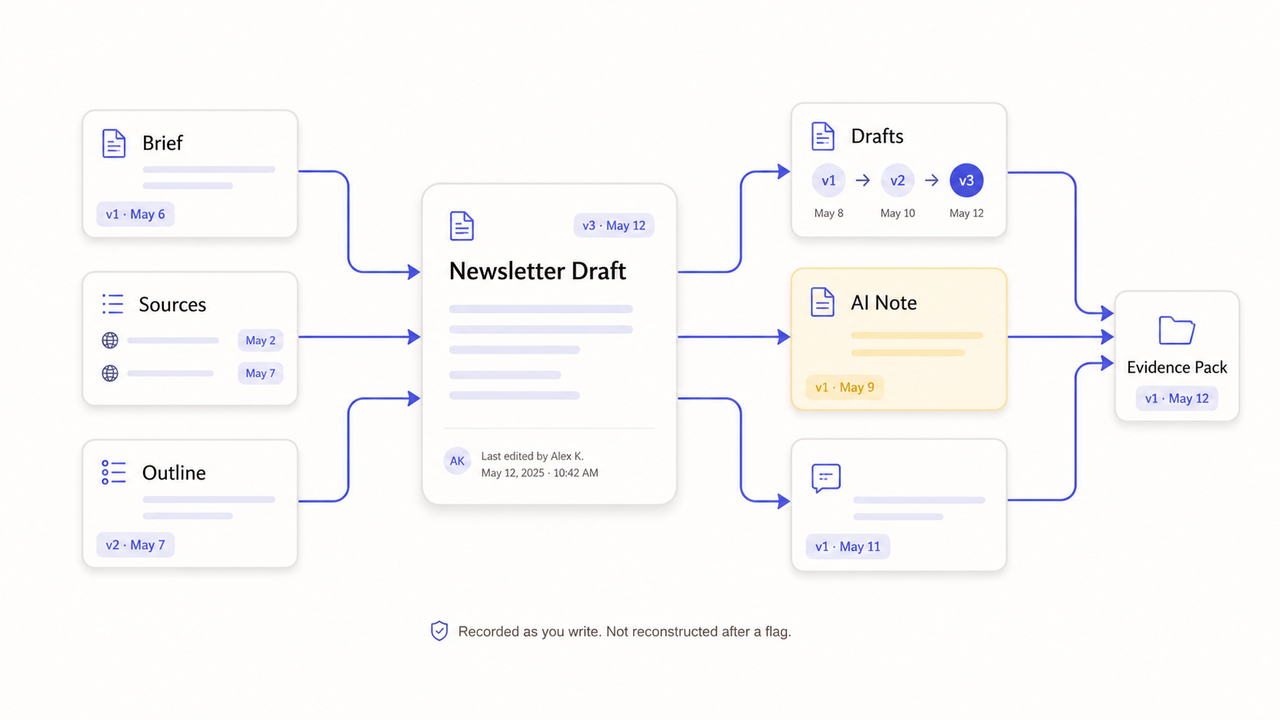
Keep the evidence of authorship while the work is being created, not after a flag appears.
For each edition, preserve:
- the original brief or working question;
- research notes and interview records;
- source URLs and access dates;
- an early outline;
- meaningful draft versions;
- comments from editors or co-writers;
- a note describing any AI assistance;
- approval for quotations and sponsored claims.
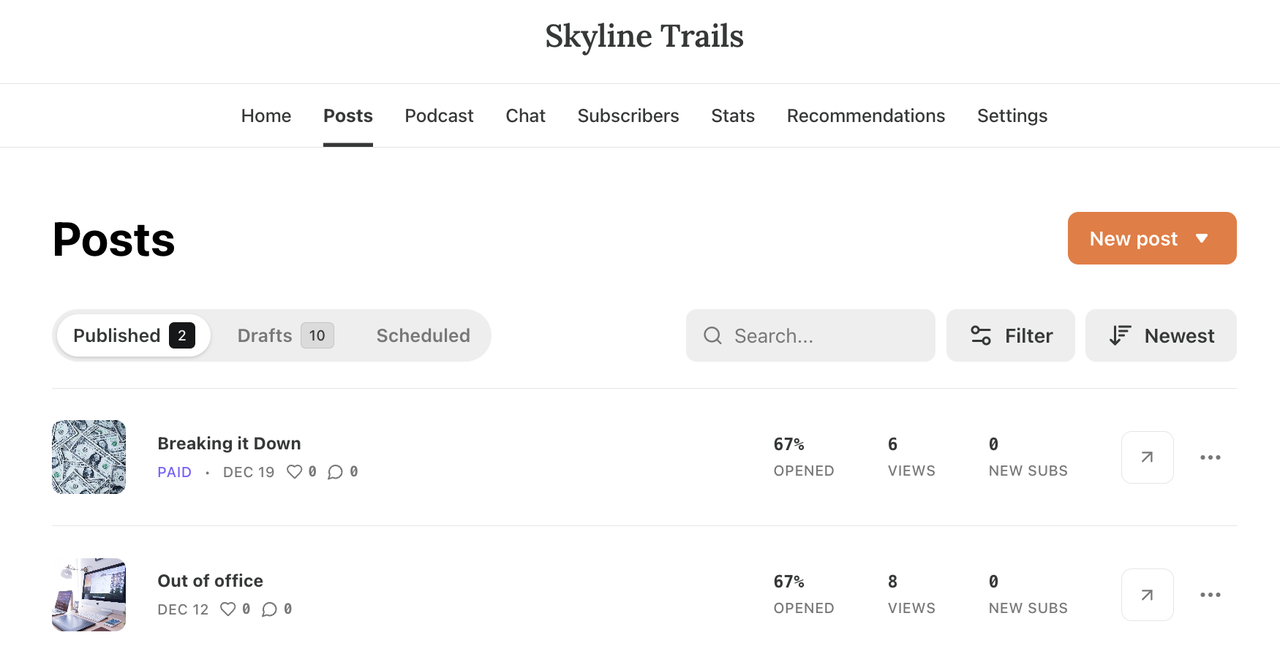
Substack’s Posts page separates drafts, scheduled posts, and published posts, but that organization should not be mistaken for a complete authorship record. If detailed version history matters, retain it in the writing environment used to prepare the newsletter.
Save evidence proportionately. A personal weekly update may need an outline and draft history. Investigative reporting may require interview files, source correspondence, fact-check notes, and a formal approval record.
Run an AI Detector as a Secondary Review Signal
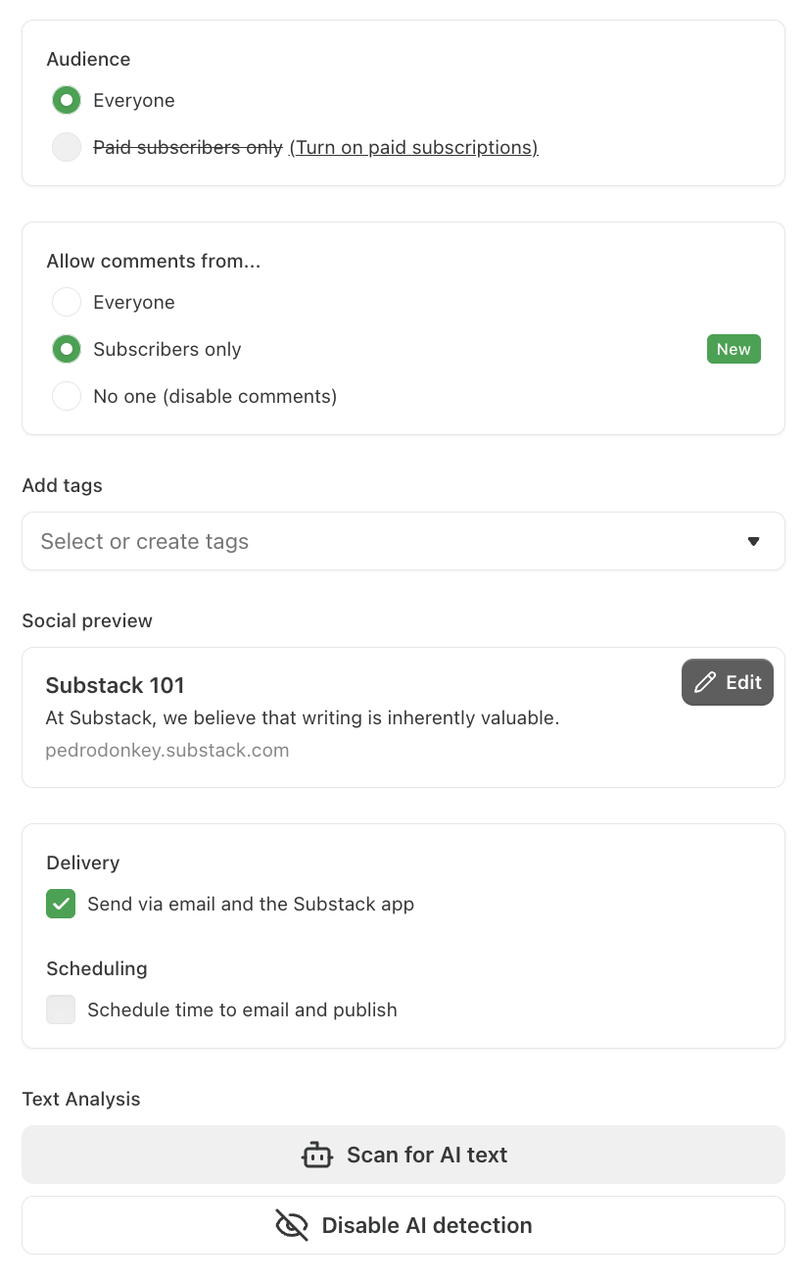
As of July 28, 2026, Substack does provide an AI transparency feature. Its official name is Scan for AI text, not “Substack AI detector.”
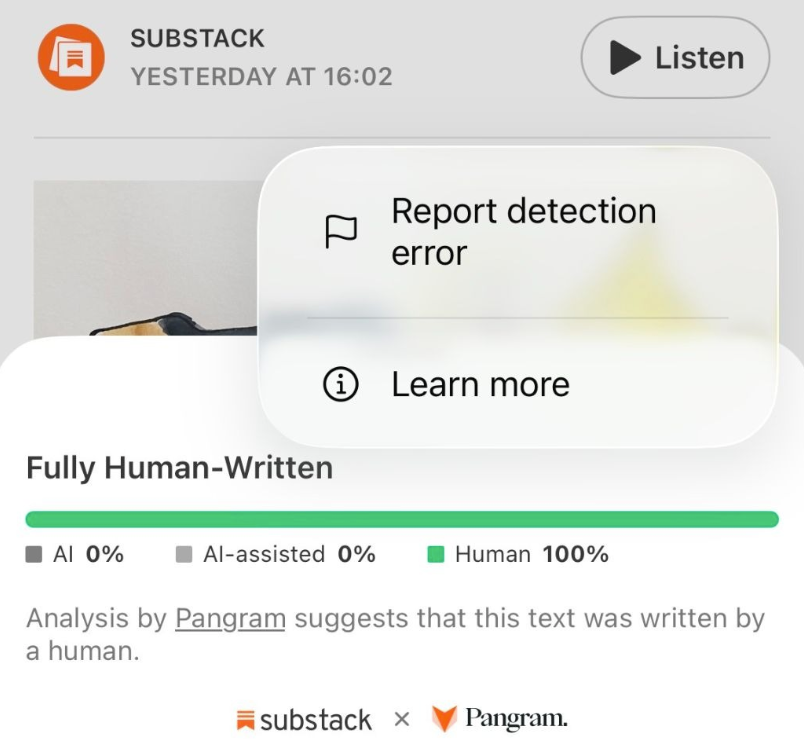
According to Substack’s current AI detection help page, the feature uses Pangram to estimate how much text appears human-written or AI-assisted. It applies to eligible posts and Notes published on or after July 21, 2026.
The current feature is available in the web-based Substack Reader, Notes, comments and replies, and the iOS app. The help page says it is not available for email views, standalone Substack sites, custom domains, or video and audio posts. Short Notes may not contain enough text for analysis.
Run the scan after substantive editing but before the final approval. Record:
- the exact version scanned;
- date and tool;
- document-level result;
- passages highlighted;
- any confidence information shown;
- the reviewer’s initial interpretation.
Do not edit merely to reduce the percentage. That turns an editorial review into a contest against a classifier and can make clear writing worse without resolving the underlying authenticity question.
Investigate Flagged Passages Without Assuming Misconduct
Open the highlighted passage and compare it with the surrounding draft. A different pattern may come from a guest contribution, quotation, translated section, sponsor insert, reused description, or extensive copy edit.
Ask the writer to explain the drafting process and provide the relevant files. The request should identify the passage and policy involved rather than begin with an accusation.
Use this review sequence:
- Confirm that the correct version was scanned.
- Separate original prose from quotations and supplied copy.
- Compare the passage with earlier drafts and notes.
- Check what AI use the publication allowed.
- Let the writer explain any tools or collaborators involved.
- Decide whether the issue concerns disclosure, quality, originality, or policy compliance.
Substack allows users to report a detection error from the analysis view. Its current Publisher Agreement also states that creators will have an opportunity to dispute automated classifications that affect how content is displayed to readers.
That appeal path matters. A percentage without a response route creates an unresolved accusation, not an accountable editorial decision.
Edit for Facts, Original Insight, and Newsletter Voice
Once the drafting process is understood, return to the article itself.
Check every factual claim against its source. Confirm that quotations preserve the speaker’s meaning, links lead to the material cited, and examples are identified correctly. A human classification cannot make weak sourcing reliable.
Then look for the contribution readers expect from this particular newsletter:
- an observation the writer can support;
- analysis that goes beyond a source summary;
- a clear reason for publishing the edition now;
- language consistent with previous issues;
- a distinction between reported fact and personal judgment.
AI writing detection cannot assess whether the argument is useful or whether the author has earned the conclusion. Those remain editorial questions.
If the copy sounds generic, ask the writer for missing reasoning, evidence, or firsthand detail. Do not instruct them to add random quirks, errors, or unusual synonyms to appear human.
Complete the Final Editorial and Disclosure Review
The final review should answer two separate questions: is the edition ready to publish, and do readers need to know how it was produced?
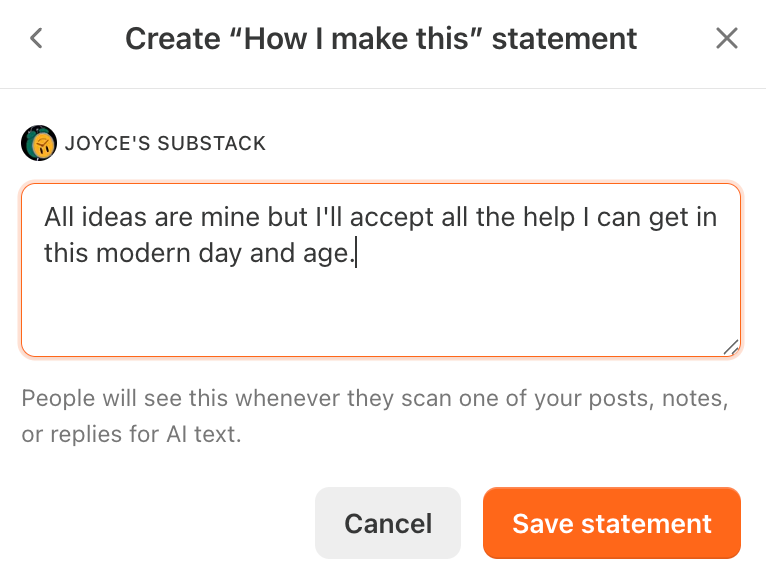
Substack now lets creators add a How I make this statement. According to its AI detection help page, that statement can appear when readers scan a post, Note, or reply. Creators can also disable detection for particular content, although readers will then see that AI detection is unavailable.
A useful production statement can describe the process without turning into a defensive essay:
I research and draft each edition myself. I may use AI for transcription and grammar suggestions, but I verify sources, approve every revision, and remain responsible for the published text.
Adapt the wording to the actual workflow. Do not claim “fully human-written” if a model rewrote substantial passages, and do not describe simple spell-checking as full AI co-authorship.
Commercial disclosure is a separate issue. If an edition includes paid or sponsored material, follow the rules that apply to that relationship. The FTC advises publishers to make native advertising disclosures clear and prominent, close to the sponsored content they qualify. An AI-use note should not replace a sponsorship disclosure.
Document the Decision Before Publishing
Create a compact release record for every edition that receives enhanced review.
| Field | Record |
|---|---|
Edition | Title and scheduled publication date |
Final file | Link or version identifier |
Sources checked | Reviewer and completion date |
AI assistance | Tools and permitted uses disclosed by contributors |
Detection | Tool, date, result, and highlighted passages |
Resolution | Explanation and supporting evidence |
Disclosure | Wording approved or reason none was needed |
Final owner | Person authorized to publish |
Exception path | Contact for a later reader or contributor challenge |
Keep the detector output attached to the exact version reviewed. If the copy changes materially afterward, the old scan no longer describes the final edition.
The release record does not need to become public. Its purpose is to preserve the basis for the decision if a reader, guest writer, sponsor, or editor later asks what happened.
Decide When an Outside Editor Is Needed
A solo writer can usually manage the workflow when the edition is low-risk, the sources are accessible, and the author is the only contributor.
Bring in an outside editor when:
- the writer cannot independently assess their own disclosure;
- a guest contributor disputes a detection result;
- the newsletter covers sensitive or high-consequence claims;
- sponsor requirements conflict with editorial judgment;
- several writers used different AI workflows;
- a correction could materially affect a person or organization;
- the publication lacks a clear final decision-maker.
The outside editor should receive the brief, policy, sources, drafts, flagged passages, contributor response, and proposed disclosure. Sending only a detector screenshot reproduces the same evidence gap.
For legal, regulatory, or contractual questions, use an appropriately qualified professional. An editor can organize the record but should not invent an answer outside their role.
FAQ
Should guest newsletter submissions follow a different review process?
The core process should remain the same, but guest contributors need the AI-use policy before they begin. Request sources, drafts, disclosure information, and approval for edits as part of the submission workflow. If a passage is flagged, give the contributor the same opportunity to explain it that an internal writer would receive.
How should co-written newsletters document AI assistance?
Use one contribution record showing who drafted each section, which tools affected the copy, and who approved the combined edition. Co-writers should resolve conflicting recollections before publication. The final editor owns the assembled record rather than assuming each contributor retained compatible notes.
Should sponsored copy follow the same authenticity rules?
Yes, but it also requires a separate commercial review. Record whether the sponsor supplied, edited, or approved the wording, verify objective claims, and place any required sponsorship disclosure where readers can notice it. An AI disclosure does not explain the financial relationship behind the content.
Can previously published newsletters be reviewed later?
Yes. Preserve the original publication date, review the version readers actually received, and document why the retrospective check was opened. Do not silently rewrite the historical record. If the review reveals a material factual or disclosure problem, use a visible correction or editor’s note appropriate to the issue.
What should a writer do when two detectors disagree?
Keep both results and compare the passages each tool highlighted. Disagreement shows that the text alone has not produced a stable conclusion. Move to stronger evidence: drafts, notes, source files, revision history, permitted-use policy, and the writer’s explanation. Do not keep adding detectors until one produces the preferred answer.
Conclusion
A Substack AI detector is no longer merely a search phrase: Substack now offers Scan for AI text, powered by Pangram. The feature can expose a question about an edition, but it cannot reconstruct the full writing process or approve publication.
Before the Publish button moves the edition forward, name the person who owns the final authenticity and disclosure decision. If no one can defend that decision from the drafts, sources, review notes, and contributor record, the newsletter is not ready to send.