Ecommerce SEO Audit Services: What to Expect
Ecommerce SEO audit services should identify store-specific technical, category, product, and measurement problems. Learn what useful delivery includes.
The store owner receives an audit marked final. The developer finds screenshots, severity labels, and a long URL export, but no affected template, reproduction step, or acceptance test. This guide explains how to compare ecommerce SEO audit services by the store problems they investigate and the evidence their handoff contains. I’m Alex. I’ll treat a finding as useful only when the store team can reproduce, assign, and retest it.
Quick Fit: When an Ecommerce SEO Audit Is Useful
An ecommerce technical SEO review is useful when the team sees a search symptom but cannot locate the system behind it. Category visibility may fall, new products may be slow to appear, or filters may create more URLs than the team can account for.
It can also establish a baseline before a redesign, migration, international rollout, or catalog change. The brief should name the decision the audit must support. “Check the whole store” gives the provider no basis for choosing which templates, markets, or data flows need close review.
Use this quick fit test:
| Store condition | Likely audit value | Clarification needed first |
|---|---|---|
Search traffic changed after a theme or catalog release | Trace affected templates, URLs, and dates | Confirm what changed and when |
Important categories are difficult to find in search | Review architecture, internal links, intent, and indexation | Name the priority categories |
Product variants create duplicate or inconsistent pages | Review URL, canonical, rendering, and data behavior | Document how variants are generated |
Reports disagree about organic revenue | Test event, attribution, and reporting setup | Decide which records are authoritative |
The team already knows the defect and only needs it fixed | Limited audit value | Scope implementation instead |
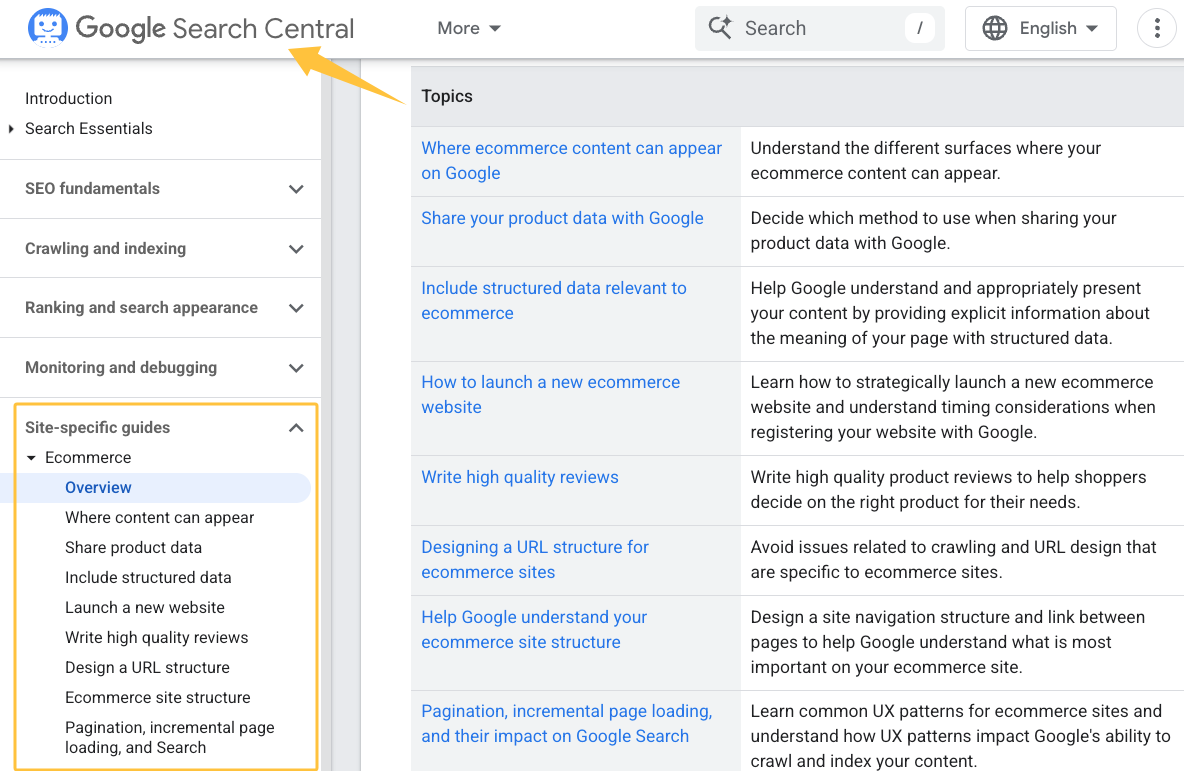
Google groups its current ecommerce search guidance around product data, site structure, URLs, pagination, and launch practices. A useful audit connects those mechanisms to the store’s actual templates and operating decisions rather than copying the guide into a report.
Define the Store Problems the Audit Must Investigate
Before requesting an ecommerce site audit, write down what the team observes. Use dates, page groups, releases, and examples. “SEO is down” is difficult to investigate; “nonbrand impressions fell on three footwear categories after the navigation release” gives the auditor a starting point.
The intake brief should cover:
- platform, theme, storefronts, markets, and languages;
- catalog size and the main product or category groups;
- product, inventory, pricing, and feed data sources;
- recent releases, migrations, redirects, or merchandising changes;
- known crawl, indexation, structured-data, or tracking concerns;
- priority templates and business seasons;
- available Search Console, analytics, merchant, and crawl records;
- the people who own SEO, merchandising, development, and analytics.
Ask the provider to separate symptoms from confirmed causes. A click decline may coincide with a theme release without being caused by it. The audit should show what was tested and which explanation remains open.
Put exclusions here too. If paid feeds, international SEO, conversion research, backlinks, or implementation sit outside the engagement, say so before access is granted.
Compare Technical, Category, Product, and Content Scope
An ecommerce SEO audit needs to follow the store’s architecture, not a generic page checklist.
| Audit area | Store-specific questions | Useful evidence |
|---|---|---|
Technical | Can crawlers reach and render the intended pages? How do canonicals, redirects, pagination, sitemaps, and status codes behave? | Sample URLs, response data, rendered output, crawl paths |
Categories | Do category and subcategory pages reflect demand and merchandising priorities? | Hierarchy map, internal links, query evidence, template examples |
Products | How are variants, availability, discontinued items, descriptions, media, and structured data handled? | Product families, markup tests, feed-page comparisons |
Facets | Which filters create URLs, and which combinations should be crawlable or indexable? | Parameter patterns, link discovery, crawl samples, intended rules |
Content | Where do buyers lack comparison, sizing, compatibility, use-case, or policy information? | Page samples, customer questions, search intent, content ownership |
Google explains that ecommerce navigation should connect menus, categories, subcategories, and products through crawlable links in its guidance on helping Google understand an ecommerce site structure. The auditor should test real paths, including products exposed only through a filter, search, or script.
Filters require their own decision. Google’s current documentation warns that parameter-based faceted navigation can generate very large URL spaces. The recommendation is not automatically “block every filter.” The audit should identify which combinations serve a distinct search need, which exist only for shoppers, and what the platform can safely control.
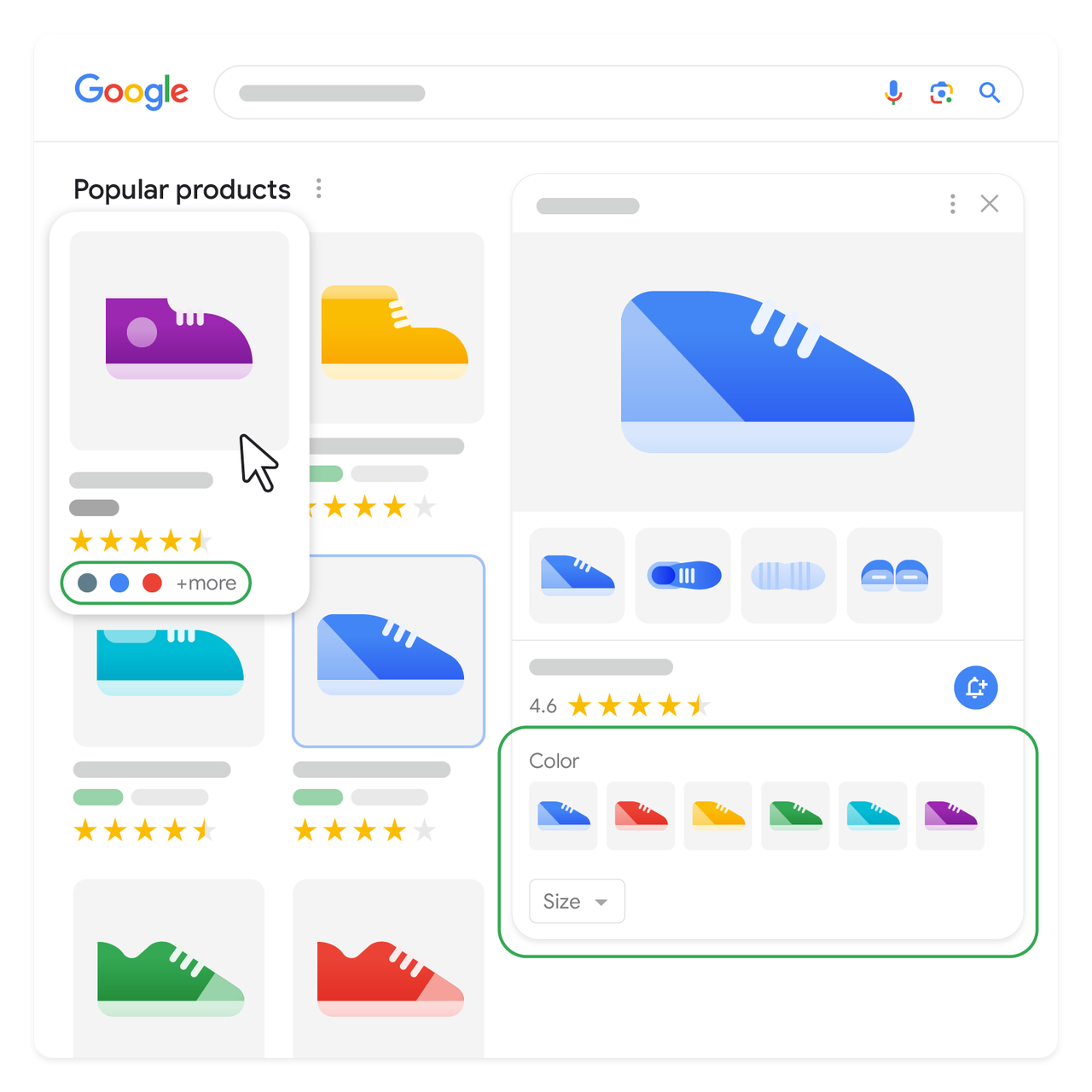
A product page audit extends beyond copy length. Check how the page represents price, availability, variants, reviews, shipping, returns, and visible facts. Google distinguishes product snippets from merchant listings in its Product structured-data guidance. Markup should match the page and current store data; eligibility does not guarantee a particular search appearance.
Review Evidence, Priorities, and Recommended Actions
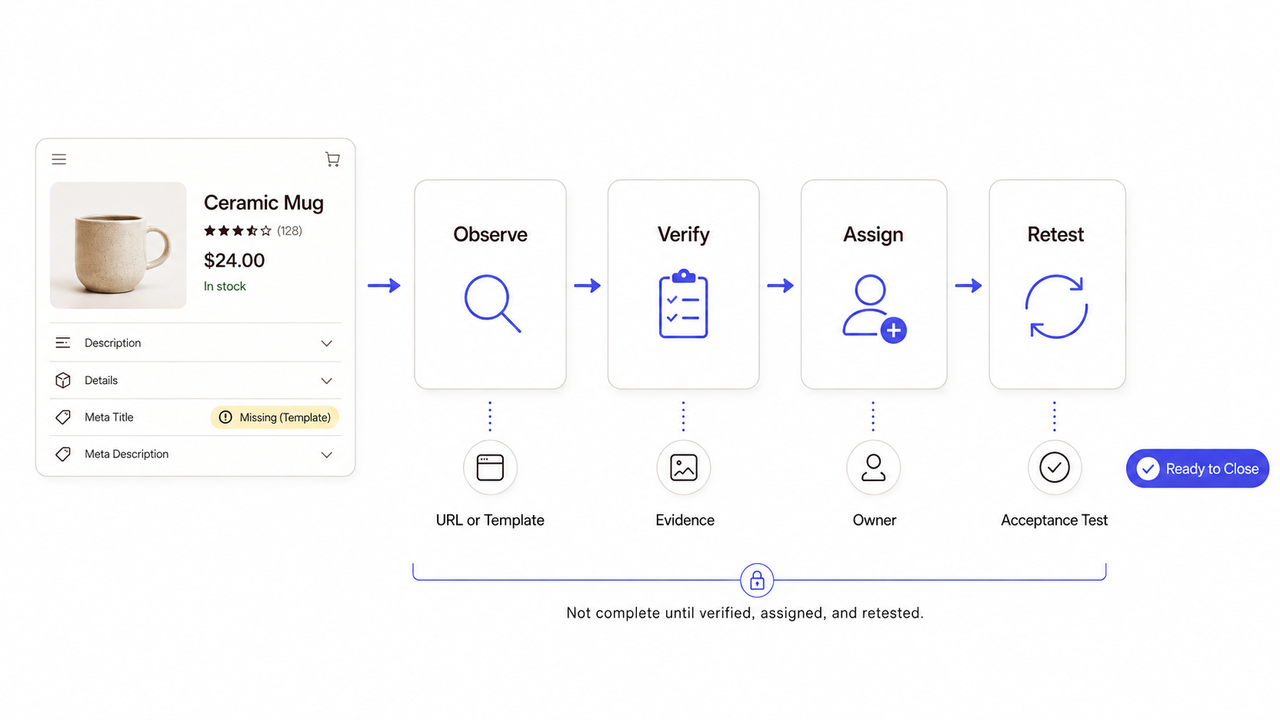
A severity label is a conclusion, not the evidence behind it. Every material finding should identify the observed behavior and the path used to reproduce it.
A practical finding record contains:
- issue and affected business question;
- sample URL and affected URL or template group;
- device, crawler, account, or environment used;
- current behavior and expected behavior;
- screenshot, response, report, or source record;
- likely impact, stated as a hypothesis where causation is unproven;
- recommended action and credible alternative;
- dependencies, risk, effort owner, and approval owner;
- acceptance test and retest date.
Priorities should reflect sequence as well as severity. Fixing a title template before confirming the canonical and variant model may create rework. So may rewriting a category that should not remain indexable.
Ask the auditor to explain the first five actions in working order. “High impact, low effort” is not enough when a change depends on a theme release, feed owner, platform limitation, or merchandising decision. Clear scope before commitment: the report should reveal who must decide and what that decision enables.
Set Access, Collaboration, and Implementation Boundaries
Access should follow the audit questions. A provider may need read-only access to Search Console, analytics, merchant data, the content system, or staging. Administrative access should not be the default when exports or limited roles will do.
Record:
- system and property name;
- named recipient;
- permission level;
- purpose;
- approval owner;
- date granted and removal date;
- restrictions on downloads or customer data.
The agreement should identify who can change production. Some engagements are diagnosis only. Others let the auditor implement defined metadata changes while developers handle templates, routing, and integrations.
Put the exception path next to the normal workflow. If the auditor discovers a critical issue during a code freeze, the finding may be documented and escalated without changing production. If staging behaves differently from the live store, both environments should remain in the evidence record rather than silently replacing one with the other.
Compare Proposals and Audit Deliverables
Compare online store SEO services against the same brief. Tool names and report length do not show whether the provider understands the catalog.
| Proposal question | Strong answer | Warning sign |
|---|---|---|
What will be sampled? | Defines full checks, representative samples, and excluded areas | Promises every URL without explaining crawl limits |
How will findings be grouped? | By template, page family, market, or system dependency | One undifferentiated list of URLs |
What evidence is delivered? | Reproduction details, exports, examples, and test conditions | Scores and screenshots without source records |
How are priorities set? | Uses impact, confidence, effort, dependency, and reversibility | Labels everything critical |
What does handoff include? | Review meeting, editable findings, tickets, and open questions | Final PDF with no working files |
Is implementation included? | Names included changes, owners, QA, and exclusions | Uses “fixes” without defining who deploys them |
Useful ecommerce SEO audit deliverables may include a decision brief, findings register, category and product observations, prioritized roadmap, source exports, and implementation handoff. The store should be able to continue without asking the auditor to reconstruct basic context.
Ask who performs the review, which platforms the team understands, and how follow-up questions are handled. A specialist may fit one complex platform; a broader agency may help when SEO changes require several disciplines.
Plan the Work That Follows the Audit
An audit does not change the store until someone converts accepted findings into controlled work. Assign each accepted item to an owner and a release window. Keep rejected, deferred, and unresolved recommendations visible with the reason for their status.
Tickets should retain the evidence, affected templates, expected behavior, dependencies, and acceptance test. That prevents a developer from receiving “fix duplicate content” with no explanation of the URLs or platform rule involved.
Measurement also needs a pre-change record. Google’s current guide to measuring ecommerce events in Google Analytics describes events across product views, carts, checkout, refunds, and promotions. The audit should verify only the events and parameters the store intends to use, then document known gaps rather than assuming that a dashboard proves implementation.
Retest after deployment in the environment customers and crawlers reach. A code merge, closed ticket, or disappearing tool warning does not by itself prove that the intended page behavior changed.
If the store needs outside diagnosis, compare current SEO and website optimization services through SpringBrand before approving an audit scope.

FAQ
Can an audit continue during a platform migration?
Yes, but split current-state diagnosis from migration validation. Preserve the old URL map, templates, crawl data, redirects, and measurement baseline. Mark which findings affect migration requirements and which need the new environment for retesting.
What changes when one business operates several storefronts?
Define each storefront before looking for shared patterns. Markets may use different languages, currencies, domains, catalogs, templates, inventory, and product identifiers. Test whether a shared recommendation is valid for every property.
Should an audit pause during a development freeze?
Not necessarily. Diagnosis, data review, and prioritization can continue if the evidence remains stable. Production changes should follow the freeze rules. Mark findings that require a later retest, and do not present an unimplemented recommendation as resolved.
Can useful findings be produced without sharing revenue data?
Yes. Crawl evidence, Search Console records, templates, product data, and analytics events can reveal useful problems. Revenue data may improve prioritization, but it is not required for every technical finding. Category tiers can replace detailed financial records.
How should a store handle recommendations from a previous audit?
Revalidate them against the current store. Mark each item as fixed, still present, changed, no longer relevant, or not reproducible. Preserve the earlier evidence and implementation history so the new provider can distinguish an unresolved defect from a recommendation that the business deliberately rejected.
Conclusion
Useful ecommerce SEO audit services go beyond automated warnings by connecting product, category, facet, data, and measurement findings to reproducible store behavior.
The audit is ready to close when every accepted priority has an owner, its original evidence, an implementation boundary, and a repeatable acceptance test.