SEO Content Writing Services: A Quality Checklist
Evaluate SEO content writing services using search intent, accuracy, editorial process, reporting, and acceptance criteria—not ranking promises.
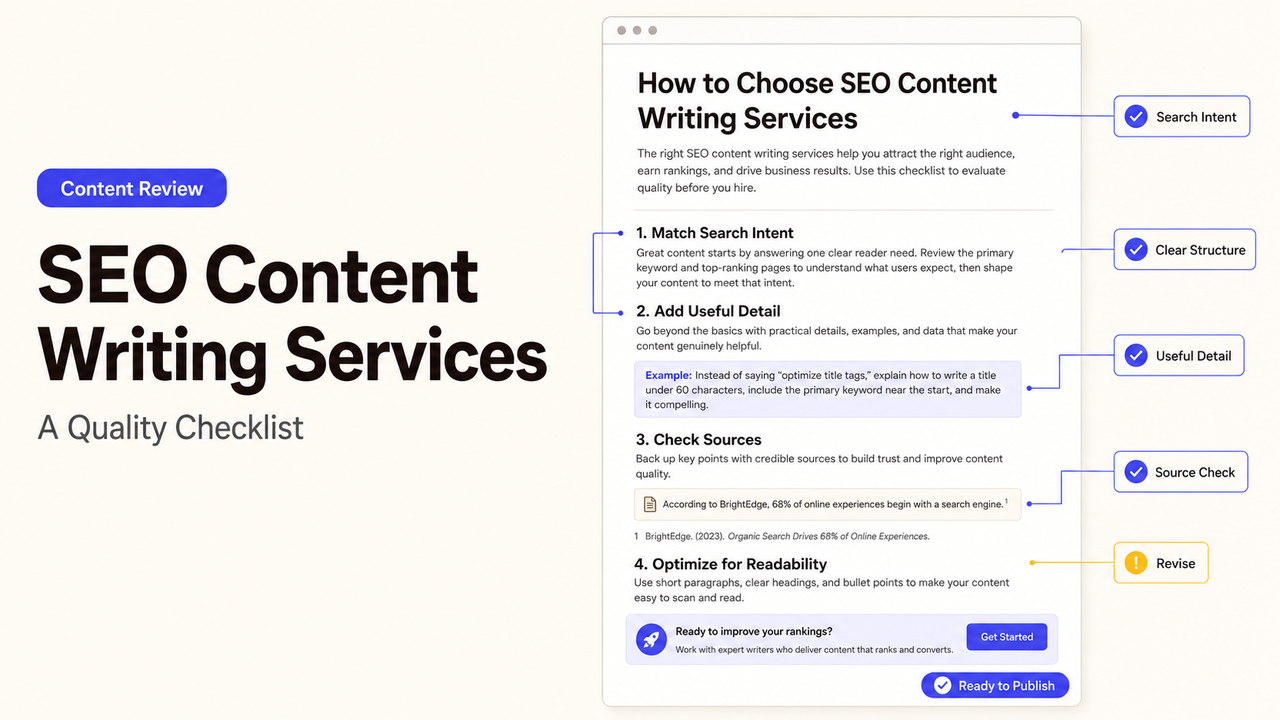
The delivery sheet says twelve articles are final. The marketing lead opens the first file and finds no search-intent note, source record, or named reviewer. The provider has finished writing, but the buyer cannot yet verify the work. This guide explains how to compare SEO content writing services without replacing quality evidence with a ranking promise. I’m Alex. I would not approve the batch until each article has a named intent, evidence trail, reviewer, and acceptance state.
What SEO Content Writing Services Should Cover
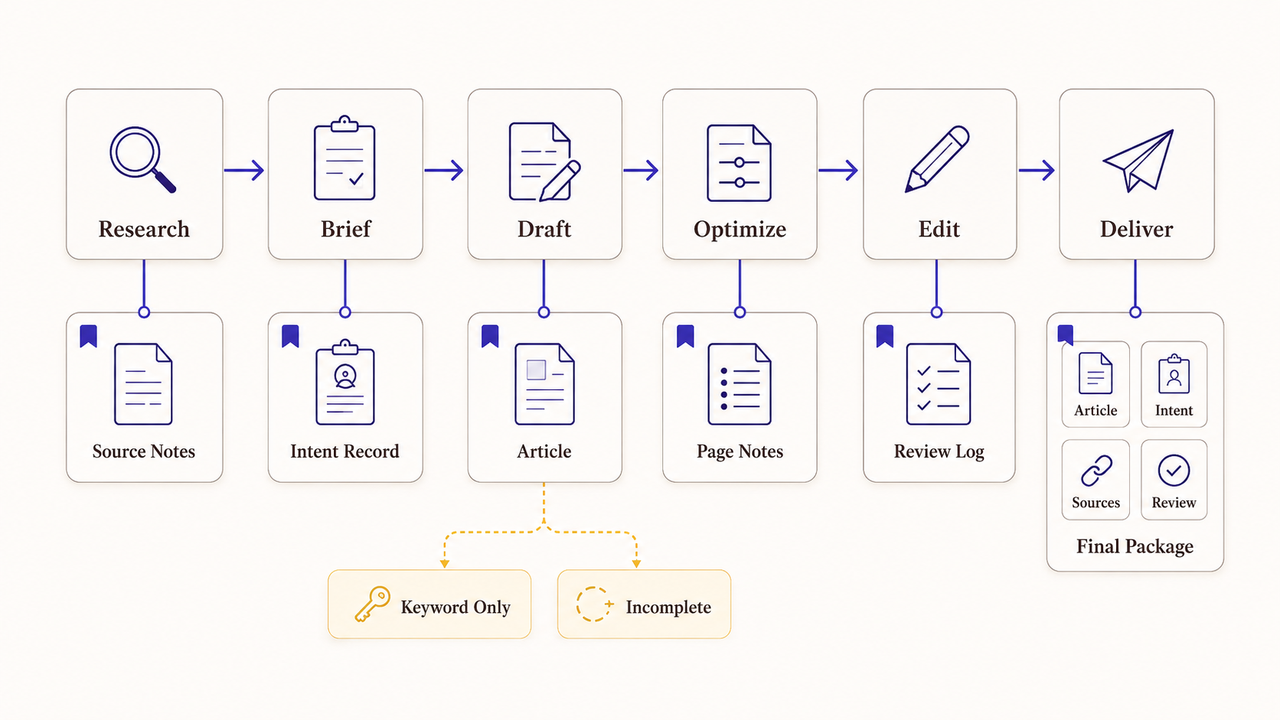
A useful service covers more than drafting words around a keyword. It should explain how the provider researches the topic, interprets the search intent, verifies claims, prepares the page, handles feedback, and records what was delivered.
Research, briefing, drafting, optimization, and editing
Research should begin with the business, audience, topic, and decision the page needs to support. Search results can help the provider understand likely intent and competing page types, but they should not become the only source material.
The brief should identify:
- primary audience and search intent;
- focus topic and relevant supporting terms;
- required evidence or internal expertise;
- page purpose and desired next step;
- internal links and excluded topics;
- brand, legal, or product restrictions;
- deliverables and review stages.
Drafting turns that direction into a useful argument. Optimization then checks the title, headings, topic coverage, internal links, metadata, and page structure without forcing repeated keywords into unnatural sentences.
Editing should include more than grammar. Someone must review factual accuracy, logic, source use, brand fit, unsupported claims, and whether the draft answers the searcher’s actual question.
Service deliverables—not copywriting examples or templates
A procurement scope should name files and responsibilities, not promise that a provider will follow a “winning formula.” A standard delivery may include the brief, article, title options, meta description, source record, internal-link notes, revision log, and final publishing file.
If the team needs examples of page structures or transferable writing patterns, treat that as a separate SEO copywriting examples topic. This service brief should remain focused on who produces the article, what evidence accompanies it, and how the buyer accepts it.
Specify whether publishing, image sourcing, CMS formatting, keyword research, interviews, or performance reporting are included. These are separate tasks unless the agreement says otherwise.
No provider can establish an industry-wide delivery time, price, or ranking result for this work. Compare the actual scope and production method behind the quote.
Define Quality Before Requesting Samples
A sample is easier to judge after the buyer has defined quality. Without that standard, reviewers tend to reward smooth prose, an attractive layout, or a familiar tone while missing weak evidence and poor intent alignment.
Search intent, factual accuracy, usefulness, and brand fit
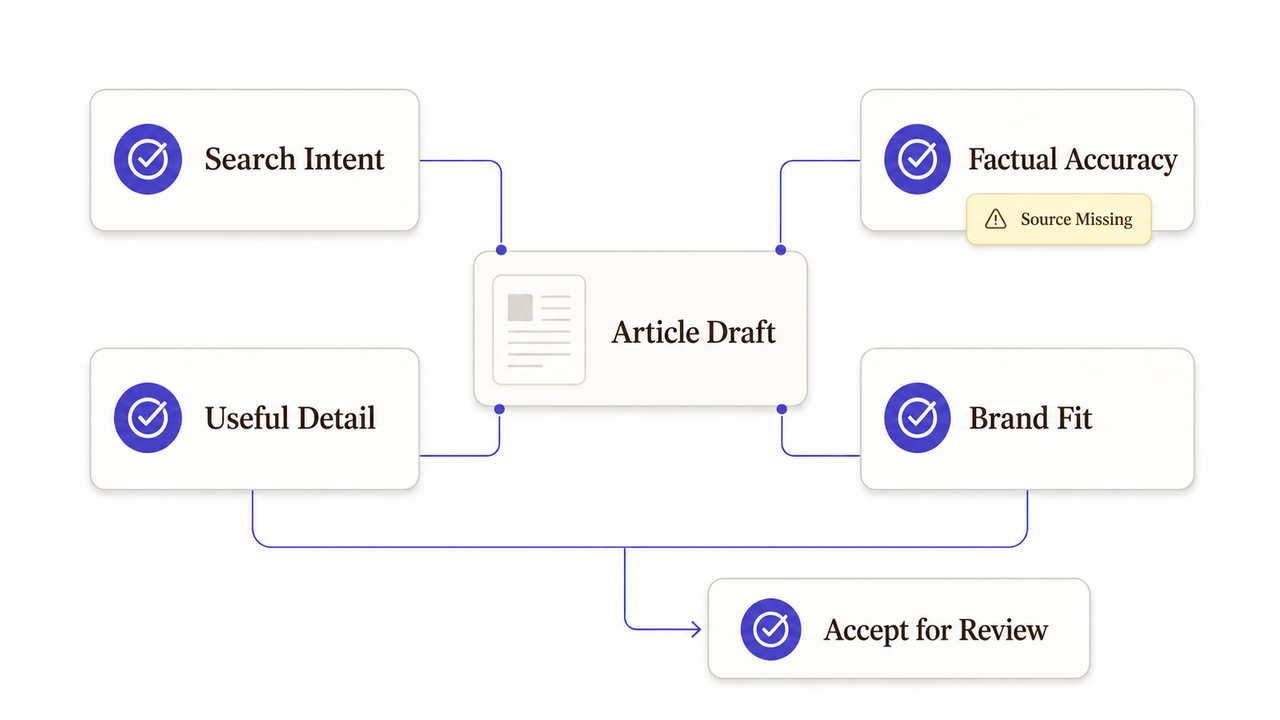
Start with four questions:
| Quality area | Acceptance question |
|---|---|
Search intent | Does the page answer the decision or problem behind the query? |
Accuracy | Can material claims be traced to current, suitable sources or internal evidence? |
Usefulness | Does the reader gain information or a practical next step unavailable from a shallow summary? |
Brand fit | Does the article reflect the company’s expertise, audience, offer, and stated boundaries? |
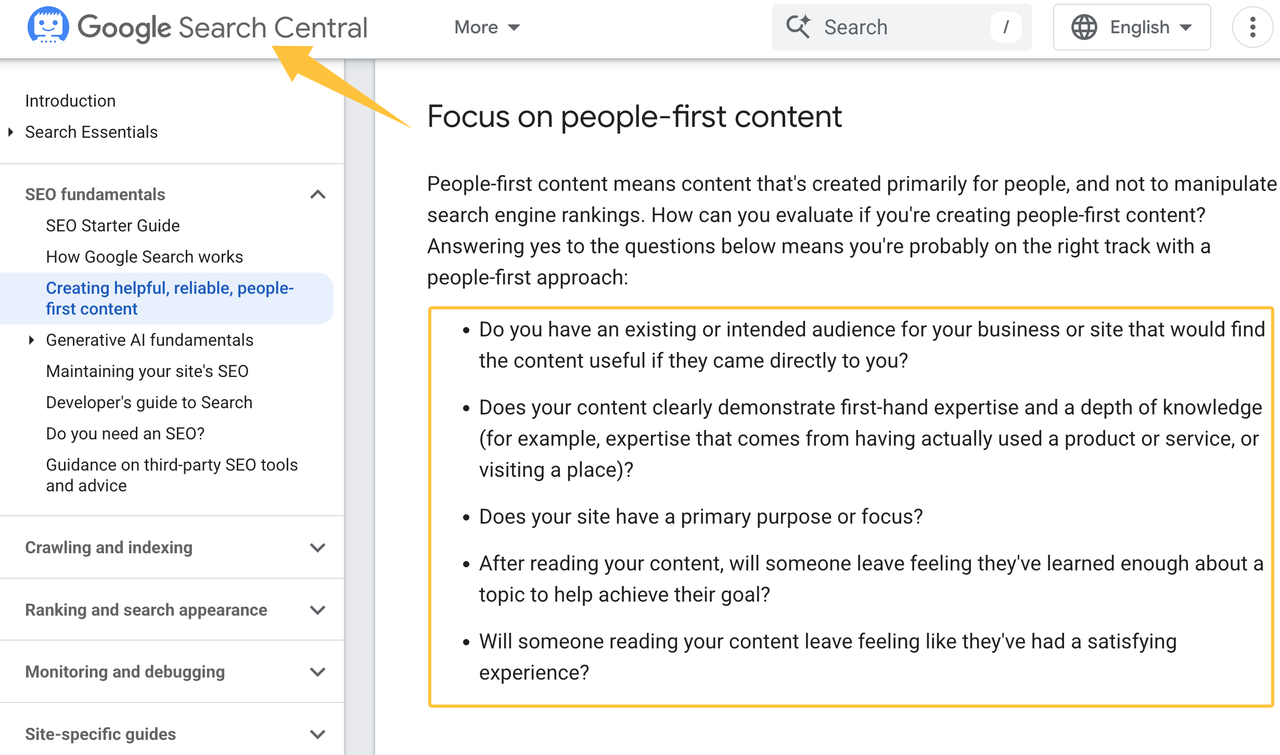
Google’s people-first content guidance asks whether content serves an intended audience, demonstrates relevant knowledge, and leaves readers feeling that they learned enough to achieve their goal. Those questions are more useful for acceptance than an arbitrary keyword-density score.
Brand fit does not mean inserting the product name into every section. The provider should understand where the company has authority, where a claim needs qualification, and where another source or internal expert must carry the evidence.
Original information and source discipline
Original value may come from an expert interview, internal process, survey, product documentation, operating example, or a clearer synthesis of credible sources. It does not require an unsupported opinion presented as unique insight.
A source log should record the claim supported, source title, URL, publisher, access date, and any limitation. If the source provides a dated statistic, the article should preserve the date and context rather than presenting the figure as permanent.
A provider should not copy a competitor’s structure paragraph by paragraph, lightly rewrite several search results, or use citations that do not support the surrounding claim. Google’s scaled content abuse policy applies to large amounts of low-value or unoriginal content created mainly to manipulate rankings, regardless of whether automation or manual production was involved.
Define how missing evidence is handled. The writer may remove the claim, qualify it, request an internal source, or leave a visible review note. Guessing should never be the default response to an incomplete brief.
Compare Providers Beyond a Writing Portfolio
A portfolio shows finished outputs selected by the provider. It rarely shows the original brief, factual corrections, rejected drafts, review time, or how responsibility was handled when something went wrong.
Subject expertise, editorial controls, and communication
Ask who performs research, writing, fact-checking, SEO review, and final editing. One person may hold several roles, but the proposal should still make the responsibilities visible.
Useful evaluation questions include:
- How does the provider determine search intent?
- Which topics require access to an internal expert?
- Who checks citations and changing product facts?
- What happens when the writer and client disagree on a claim?
- How are edits, approvals, and final versions recorded?
- Will subcontractors or white-label writers participate?
Google’s current guidance for hiring an SEO recommends asking providers to explain their recommendations and warns that no one can guarantee a number-one ranking. A service that hides its method leaves the buyer responsible for work it cannot inspect.
A polished portfolio cannot compensate for a provider who hides the production method or refuses to name the person accountable for corrections.
Questions about AI use, revisions, and accountability
Do not reduce the AI question to “Was AI used?” Ask where it entered the workflow and what happened afterward.
The provider should disclose whether AI supports research organization, outlines, drafting, editing, translation, or metadata. It should also explain the human review applied to sources, claims, quotations, originality, and brand voice.
Google’s guidance on AI-generated content focuses on original, high-quality, people-first results rather than treating every use of automation as spam. That does not remove the buyer’s need for an internal policy, disclosure decision, or contractual restriction.
State whether confidential briefs, customer information, unpublished research, interview transcripts, or internal documents may be entered into third-party tools. The contract should address approved tools, data handling, secondary use, retention, and deletion where relevant.
Revision terms should separate factual corrections from new scope. Name who fixes an unsupported claim, what response time is expected, and when unresolved work moves to a senior reviewer.
Build a Brief and Review Workflow
A strong brief does not dictate every sentence. It gives the writer enough context to make decisions without inventing facts or crossing into adjacent topics.
Audience, intent, evidence, internal links, and exclusions
Use these minimum fields:
| Brief field | What to record |
|---|---|
Audience | Role, knowledge level, problem, and decision |
Intent | Informational, comparison, how-to, or commercial investigation |
Business context | Relevant offer, expertise, market, and page objective |
Evidence | Approved internal materials, expert contact, and external-source standard |
Internal links | Destination, purpose, anchor direction, and placement boundary |
Exclusions | Claims, competitors, topics, customer details, and regulated advice to avoid |
Delivery | Word range, file format, metadata, due date, and revision terms |
An internal link should help the reader continue a relevant task. It should not be inserted solely because the destination page needs authority.
The exclusions field is equally important. It prevents overlap with another article, unsupported comparisons, accidental disclosure of confidential information, and claims the business is not prepared to approve.
Review roles and escalation for factual issues
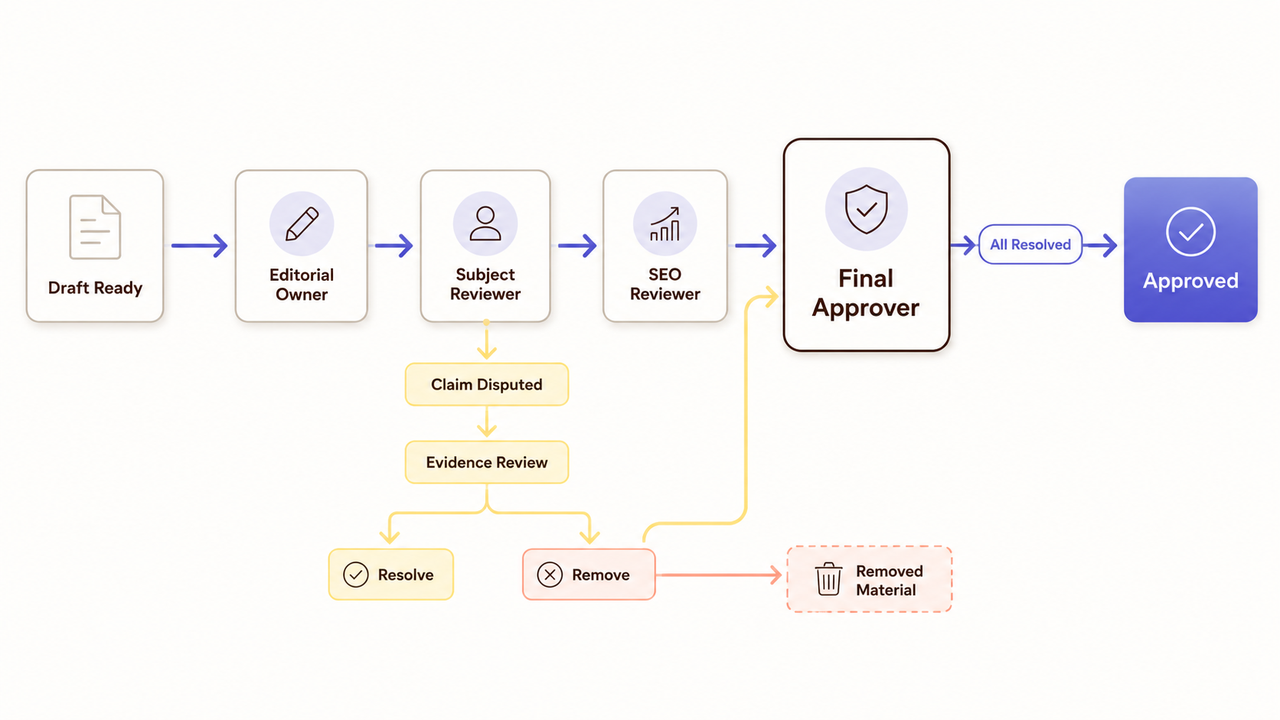
Assign four roles where the team has the capacity:
- editorial owner for structure and usefulness;
- subject-matter reviewer for factual accuracy;
- SEO reviewer for intent and on-page requirements;
- final approver for publication.
Several roles may belong to one person. What matters is that the decision owner is named.
When a factual issue appears, preserve the draft, claim, source, reviewer comment, and resolution. The draft is complete. The factual disagreement is not. Keep the article out of the approved state until someone with appropriate authority resolves it.
For regulated or safety-sensitive subjects, the writing provider should follow approved language and flag uncertainty. It should not silently become the company’s legal, medical, financial, technical, or compliance reviewer.
Accept Content Without Ranking Guarantees
Acceptance happens before the article has enough publication history to evaluate search performance. It should therefore be based on controllable delivery evidence.
On-page quality and delivery checks
Before approving an article, confirm that:
- the title and opening match the intended query and reader;
- headings create a logical information path;
- factual claims have appropriate support;
- quotes, statistics, and examples retain their original context;
- internal links are relevant and functional;
- the byline and author information are accurate;
- the meta description describes the page without making unsupported promises;
- AI use and disclosure follow the contract and publishing policy;
- confidential or third-party materials were handled as agreed;
- revision notes and unresolved questions are attached.
A byline should identify a real contributor or accountable reviewer where readers would reasonably expect authorship information. It should not be assigned to an employee who never reviewed the article merely to create an appearance of expertise.
Acceptance means the contracted work is complete and reviewable. It does not mean the article is guaranteed to rank, attract traffic, or create revenue.
Performance measurement as a separate post-publication step
After publication, record the live URL, date, target topic, baseline, and material site changes. Decide in advance when the team will review the page; indexing, competition, internal links, site authority, and changing demand can all affect the result.
Google’s Search Console definitions for impressions, clicks, position, and click-through rate show that these metrics describe different parts of search visibility and interaction. None independently proves that the writing provider caused the outcome.

Review queries and pages, compare suitable periods, and combine search data with business signals where available. Treat optimization after publication as a new decision supported by evidence, not as an automatic rejection of the original delivery.
How SpringBrand Fits This Workflow
SpringBrand can help buyers clarify a request and compare independent SEO service options. The platform does not write or approve the article for the buyer.
Turn the writing request into a comparable SEO service brief before approving an independent provider.
FAQ
Should outsourced SEO articles have named author bylines?
Use a byline when readers would reasonably expect to know who created or reviewed the content. The name must reflect a real contribution or accountable review. Agree on ghostwriting, editing, AI disclosure, and author-page responsibilities before publication.
Who updates an article when cited information becomes outdated?
Assign the owner in the service scope or internal editorial calendar. The original provider may offer updates, but this should not be assumed. Record which claims are time-sensitive, when they were checked, and who approves future revisions.
What happens when an important source disappears?
Preserve the source title, publisher, date, URL, and relevant notes. Then find a suitable replacement or revise the affected claim. Do not leave a citation in place when reviewers can no longer verify what it supported.
Can a provider work without access to an internal expert?
Yes, for topics supported by sufficient public evidence and a detailed brief. Access becomes more important when the article depends on proprietary methods, nuanced products, technical claims, customer experience, or regulated information.
How should multilingual SEO writing be commissioned?
Define the target country, language variant, search intent, terminology, reviewer, and localization scope. Translation alone may not preserve local search behavior or legal meaning. Require a qualified language reviewer and separate approval for material claims.
Conclusion
SEO content writing services should close with a brief, final draft, source record, review history, approved byline, internal-link notes, and a named owner for unresolved issues.
Accept the article when that record is complete; measure search performance after publication as a separate decision.