SEO Copywriting Examples: 12 Useful Patterns
SEO copywriting examples show how useful pages satisfy search intent and guide action. Review 12 adaptable patterns without copying formulas blindly.
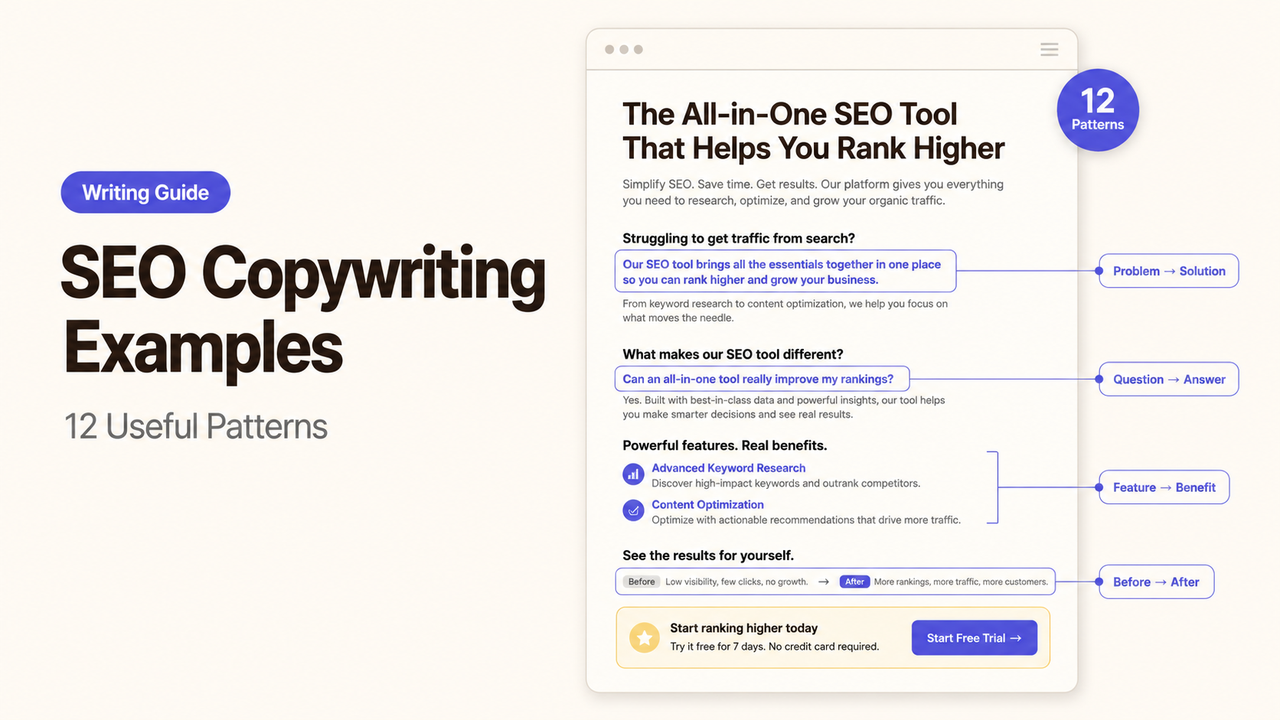
The homepage says “Book a consultation.” The service page asks visitors to “Request a quote,” while the related blog post ends with “Contact us.” The owner sees three calls to action; a visitor sees three different decisions. Useful SEO copywriting examples solve that kind of mismatch by connecting one search question, enough evidence, and one sensible next step. I’m Alex; treat each pattern below as a diagnostic, then rewrite it around the words, proof, and decision your customer actually needs.
What Makes an SEO Copywriting Example Useful
A useful example reveals the page’s job, information order, and the evidence a reader needs before acting.
Before adapting any pattern, identify five parts:
| Part | Question to answer |
|---|---|
Search need | What was the visitor trying to learn, compare, or complete? |
Page job | Should the page explain, qualify, reassure, or convert? |
Information order | What must the visitor understand first? |
Evidence | Which detail, process, source, or deliverable supports the claim? |
Next step | What action makes sense after the question is answered? |
Use this as a website copy structure check, not as a rigid template. It prevents teams from copying a page without knowing why its structure fits the query. A pricing page and a how-to guide resolve different uncertainties.
Google’s guidance on creating helpful, reliable, people-first content asks whether readers will leave with enough information to achieve their goal. That is a better test than whether a paragraph contains a particular formula.
The examples are original and illustrative, not ranking or conversion guarantees.
Match Copy Structure to Search Intent

Search intent writing starts with the decision behind the query. “Payroll software” could mean a definition, shortlist, current pricing, implementation help, or troubleshooting. The same keyword does not always require the same page.
Use the query and page type together:
| Visitor need | Page should do first | Evidence that may help | Suitable next step |
|---|---|---|---|
Learn | Give a direct explanation | Definitions, steps, examples | Read a related guide |
Compare | State the decision criteria | Feature boundaries, scenarios | Compare options |
Buy or hire | Clarify the offer and fit | Scope, process, deliverables | Request or purchase |
Troubleshoot | Identify the likely issue | Checks, screenshots, conditions | Complete the next check |
Do not infer intent from the keyword alone. Review sales questions, support conversations, the current results page, and queries recorded in the Google Search Console Performance report. Query data shows how a page is found, although it cannot reveal every visitor’s motivation.

Once the job is clear, begin it on the first screen. A comparison should not spend four paragraphs defining the category.
Review 12 Patterns for Common Business Pages
These patterns are building blocks. Rewrite each one around the audience, evidence, and page purpose.
Problem-to-solution introductions
- Symptom → consequence → practical route
Use this when readers recognize the problem but may not understand why it keeps happening.
Your booking form receives inquiries, but half arrive without the service location or preferred date. Add those two fields before increasing traffic, so the team can qualify requests without another email round.
The copy names an observable symptom, its operating cost, and a proportionate response.
2. Direct answer → condition → article promise
This fits informational queries that deserve an immediate answer.
A separate location page can help when each office serves a real local audience and has distinct information to publish. This guide shows what belongs on those pages and when one shared service page is clearer.
The answer comes first; the condition defines what the article will help readers decide.
3. Desired outcome → missing requirement
Use this when the visitor knows the result but is overlooking a dependency.
Faster proposals begin with a consistent intake brief. Before changing the template, decide who supplies pricing, technical constraints, and final approval.
This connects the desired outcome with work the buyer must still support.
Comparison and decision sections
4. Conditional quick verdict
Give each option a clear fit rather than declaring one universal winner.
Choose the monthly plan if the team needs ongoing monitoring and can review work every week. Choose the project option when the scope has a fixed endpoint and an internal owner can maintain the result.
5. Criteria before features
Name the decision factors before presenting a table or list.
Compare the proposals on source-file access, revision limits, implementation responsibility, and post-delivery support. A longer feature list will not resolve those ownership questions.
This establishes which differences matter before presenting features.
6. Scenario → suitable choice → exception
Use a concrete operating scenario to make an abstract comparison easier.
A two-page event site with a fixed end date may justify a simple builder. If the same site will later hold product pages, lead routing, and regional content, migration and ownership deserve more weight.
Evidence-led service explanations
7. Deliverable → business use
Replace vague service labels with something the buyer can inspect.
The audit includes a prioritized issue sheet with affected URLs, evidence, recommended changes, and acceptance checks. Your developer can use it to create tickets without reconstructing the review.
Unlike “comprehensive audit,” this tells the buyer what arrives and how it will be used.
8. Process step → approval point
Show where client input changes the work.
After the message options are drafted, the product owner reviews claims and the sales lead checks common objections. Production begins after both comments are resolved in the approved version.
9. Scope → exclusion → alternative
State a boundary without making the offer sound incomplete.
The project covers page structure and final copy for five approved URLs. Development is not included; the handoff provides implementation notes for the client’s web team.
Put important exclusions before commitment, not after the first draft.
Objection and next-step sections
10. Objection → factual response → proof
Answer the concern in the language a real buyer might use.
“Will our team be locked out after launch?” No. The handoff includes administrator access and an account list; confirm the ownership terms in the agreement before work starts.
The response points to inspectable evidence instead of unsupported reassurance.
11. Changing condition → update rule
Use this for prices, availability, dates, inventory, or policies that may change.
Prices shown here are reviewed monthly. The amount displayed in the final quote applies to the approved scope; new deliverables require a revised quote.
12. Completed answer → relevant action
Place the call to action after the page has resolved the main question.
If the comparison shows that both options meet your technical requirements, send the shortlist to the budget owner for final review.
The action matches the reader’s current decision instead of demanding a premature sale.

Balance Search Clarity With Conversion
Search clarity shows that the page addresses the query. Conversion copywriting explains the offer, evidence, and next action.
Use the main topic naturally in the title, opening, relevant headings, and explanation. Then use customer vocabulary. Repetition that replaces a clearer role or action does not prove relevance.
Keep one primary action for each decision state. A first-time reader may need a guide; a qualified buyer may be ready for a quote. Five competing calls to action hide the next step.
Localized pages need more than translated keywords. Offers, proof, and actions may change by market. The W3C guidance for declaring language in HTML explains how a page or passage should identify its language in markup.
Edit Claims, Examples, and Calls to Action
During editing, separate facts, interpretations, examples, and promises. Each needs a different check.
Objective claims need support. The FTC’s advertising guidance for small businesses says advertisers need a reasonable basis for them. Outside the United States or in regulated sectors, confirm the applicable review requirements.
Label illustrative scenarios. Remove invented quotes, results, tests, and unsupported numbers. If the evidence is narrower than the claim, narrow the claim.
AI drafts require the same discipline. Google’s guidance on generative AI content emphasizes accuracy, quality, and relevance and warns against producing pages at scale without added value. Review sources, originality, voice, and business-specific knowledge.
Read every CTA with the preceding paragraph. It should be the logical next step, not an attached advertisement.
Test the Copy Against Real Customer Questions
Give a reviewer the page without explaining its job. Ask them to identify the audience, question, evidence, and next action.
A practical review can use five prompts:
- Can the reader identify the page’s answer from the first screen?
- Does each major claim have evidence or an appropriate qualifier?
- Are important objections answered before the CTA?
- Does the requested action match the reader’s likely readiness?
- Can an owner update changing facts without rewriting the entire page?
Compare the language with calls, emails, forms, and search queries. Customers may use a problem phrase absent from the brand vocabulary. Keep the accurate term, but explain it with customer wording where useful.
Record revisions by URL, owner, reason, and date so a later edit does not erase the decision behind the copy.
FAQ
How should copy handle products with frequently changing prices?
Show a price only when someone keeps it current. Record its source, review date, market, inclusions, and owner. If scope determines the final amount, explain where the buyer confirms it.
Can AI-generated drafts be used as a starting point?
Yes, with human review before publication. Check claims, sources, examples, product details, and actions. Add original business knowledge and remove passages that could belong to any company. The publisher remains responsible for the page.
What if customers use different terms from the brand?
Map both vocabularies. Use the customer’s phrase to make the problem recognizable, then introduce the accurate brand or technical term. Do not force inaccurate wording into the page because it appears in a keyword tool.
Should localized pages reuse the same examples?
Only when the example fits the local offer, terminology, and approval rules. Another market may require a different price, process, disclosure, or buyer expectation. Keep the structure if useful, but review the details locally.
Are copywriting patterns useful for low-volume keywords?
Yes. A low-volume query can represent an important customer question. Judge it by audience fit, business relevance, and the quality of the answer. A pattern cannot guarantee visibility, traffic, or conversion.
Conclusion
The best SEO copywriting examples make their reasoning visible. Strong SEO content examples show what the reader needs, which information comes first, what evidence supports the answer, and which action belongs at the end.
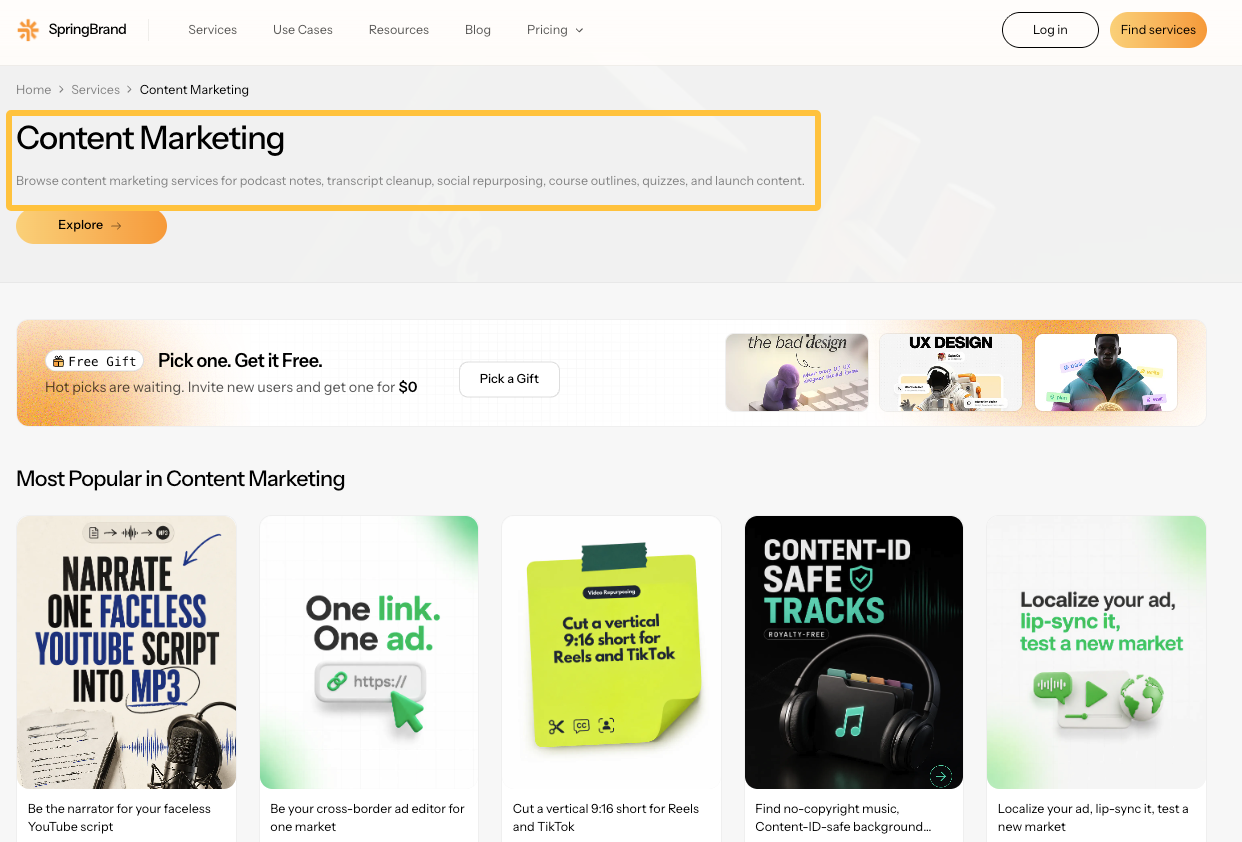
If the review exposes a production gap, compare current Content Marketing service scopes on SpringBrand before assigning outside work.
Reuse the pattern only after naming the page’s question, evidence, and owner. If those three elements change, the copy should change with them.