Content Strategy Services: What They Should Deliver
Content strategy services should clarify audiences, priorities, deliverables, governance, and how a small team will use the resulting roadmap.
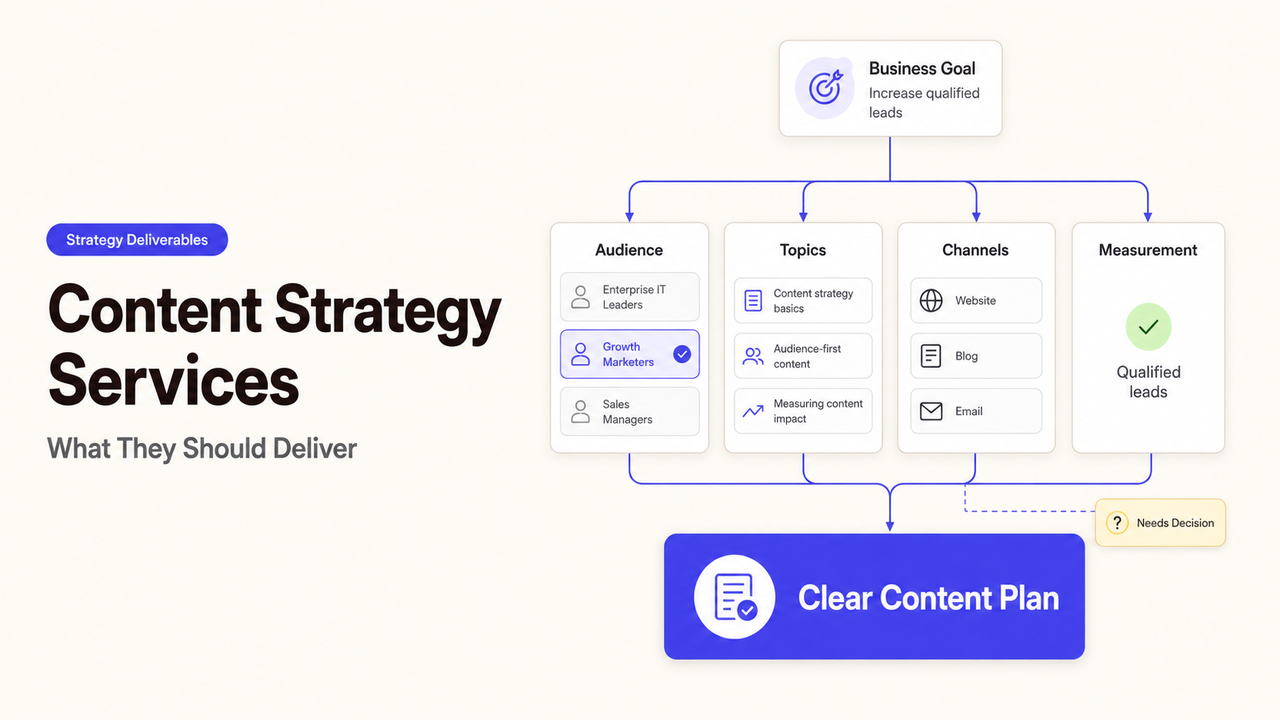
A founder approves an audience deck, sales approves a topic list, and the freelance writer receives a calendar that reflects neither. Each file looks complete, yet no one owns the decision connecting a business goal to the next piece of content. This guide explains what content strategy services should deliver before a lean team pays for production. I’m Alex; I would treat any roadmap without named owners, supporting evidence, and an update rule as unfinished.
What Content Strategy Services Cover
Audience, goals, topics, formats, channels, and governance
A useful content strategy establishes whom the business needs to reach, what those people need from the brand, and which business goal the work is meant to support. It then turns those choices into topic boundaries, suitable formats, channel roles, and publishing rules.
The strategist should identify more than demographic labels. “Small-business owners” is too broad to direct a writer. A usable audience description includes the situation that brings someone to the content, the question they need answered, the evidence they will trust, and the action the business can realistically support.
Governance belongs in the scope as well. The team needs to know who may propose a topic, who checks factual claims, who approves publication, and who decides when older material should be updated or retired. Without those decisions, a topic roadmap quickly becomes another request queue.
Strategy decisions—not hub-and-spoke production or distribution
Content strategy decides what deserves attention and why. It does not automatically include drafting articles, designing assets, scheduling posts, or running ongoing distribution.
A provider may recommend a pillar topic and supporting questions without producing every asset. Creative services may begin after the strategy is approved, but their deliverables, deadlines, and acceptance criteria need a separate scope.
If the next problem is turning an approved topic into coordinated channel assets, the hub-and-spoke content marketing workflow covers that downstream system. The strategy engagement should stop at the agreed planning and governance boundary unless production is explicitly included.
Translate Business Goals Into Strategy Questions
Demand, sales enablement, retention, and trust use cases
“Publish more” is an activity, not a business goal. Before commissioning content marketing consulting, identify which decisions the content is supposed to influence.
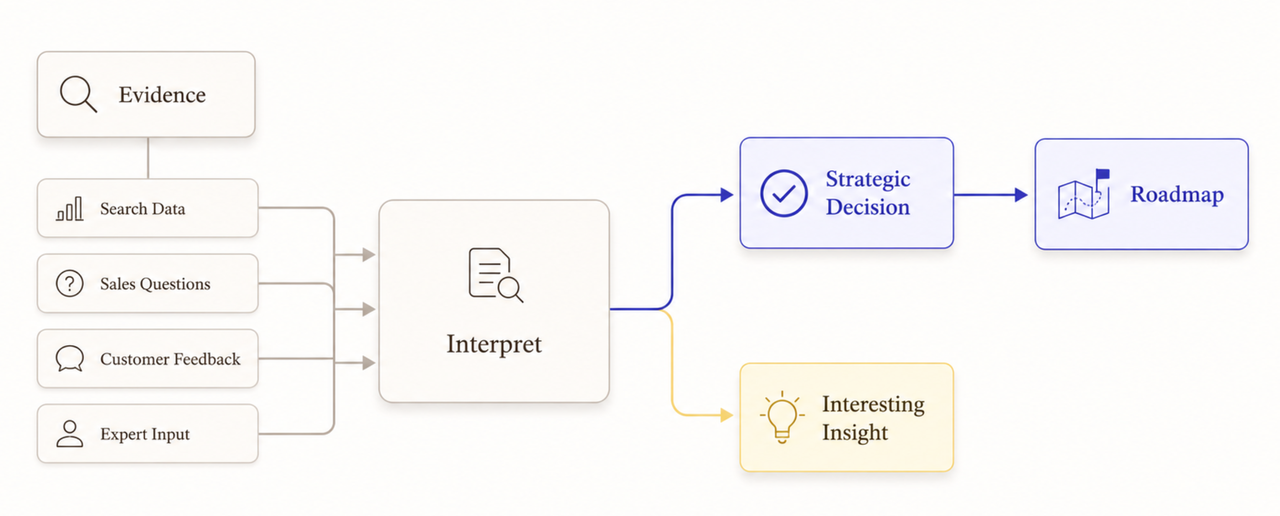
| Business use case | Strategy question | Evidence to examine |
|---|---|---|
Demand | Which buyer problems already produce active research? | Search behavior, sales questions, market language |
Sales enablement | Where do prospects hesitate or ask for proof? | Call notes, objections, proposal feedback |
Retention | What information helps customers use or renew the service? | Support tickets, onboarding gaps, account feedback |
Trust | Which claims require explanation, sourcing, or expert review? | Customer concerns, regulatory limits, subject-matter input |
One engagement can support several use cases, but a lean team still needs an order. If demand content, customer education, and sales materials all receive equal priority, the available experts and reviewers may become the real bottleneck.
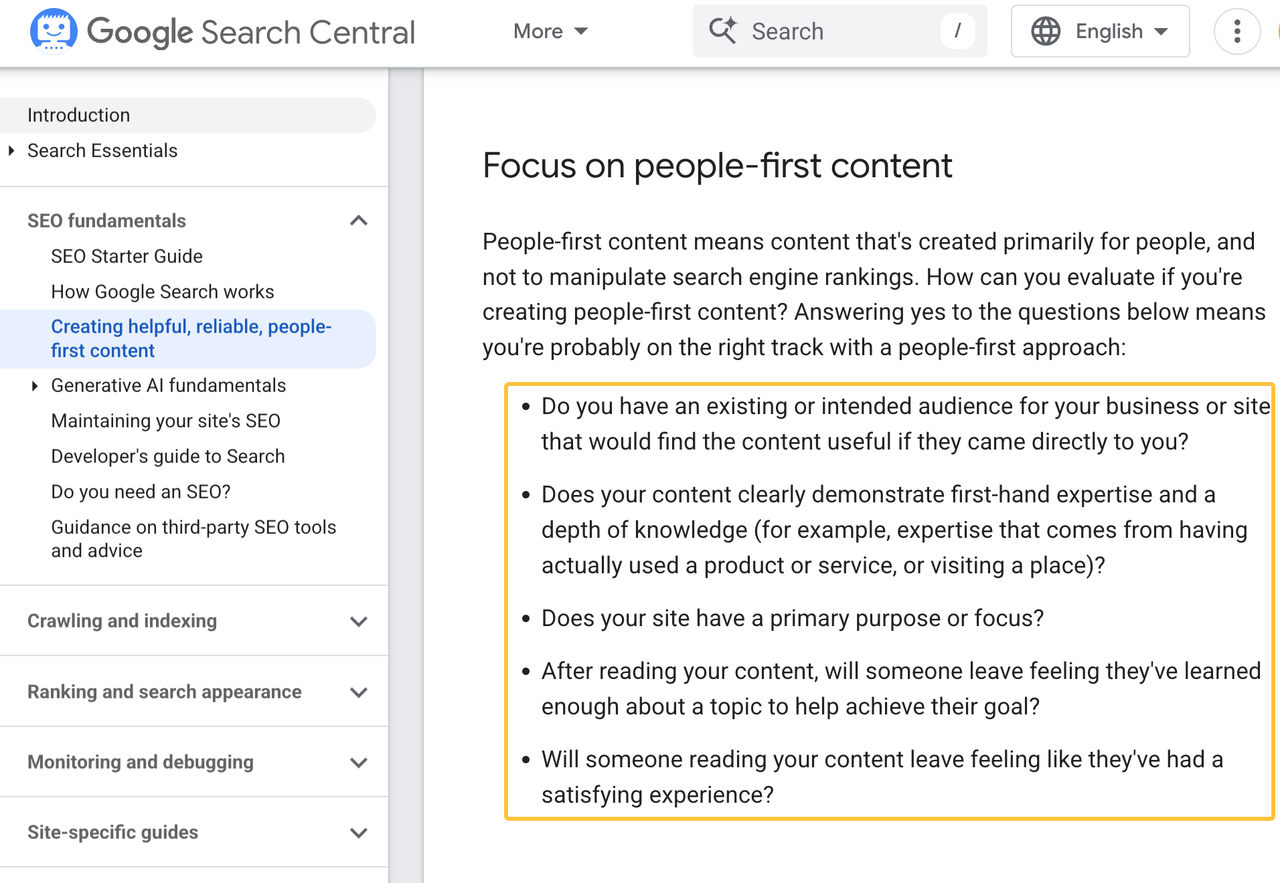
For search-led work, the strategist should connect topics to audience usefulness rather than treating keyword volume as the decision by itself. Google’s guidance asks whether content serves an intended audience, offers original value, and leaves readers with enough information to accomplish their purpose in its people-first content assessment.
Constraints, evidence, and stakeholder decisions
The strategist needs access to enough evidence to challenge internal assumptions. Useful inputs can include customer questions, search data, product documentation, support themes, sales objections, past performance, and interviews with internal experts.
The evidence will rarely agree perfectly. Sales may report that buyers need comparison material while support sees confusion after purchase. The founder may want thought leadership even though the team lacks reliable expert-review time. These disagreements should remain visible until a decision owner resolves them.
Record each material assumption with:
- the evidence behind it;
- the person who can approve or reject it;
- its effect on the roadmap;
- the date it should be reconsidered.
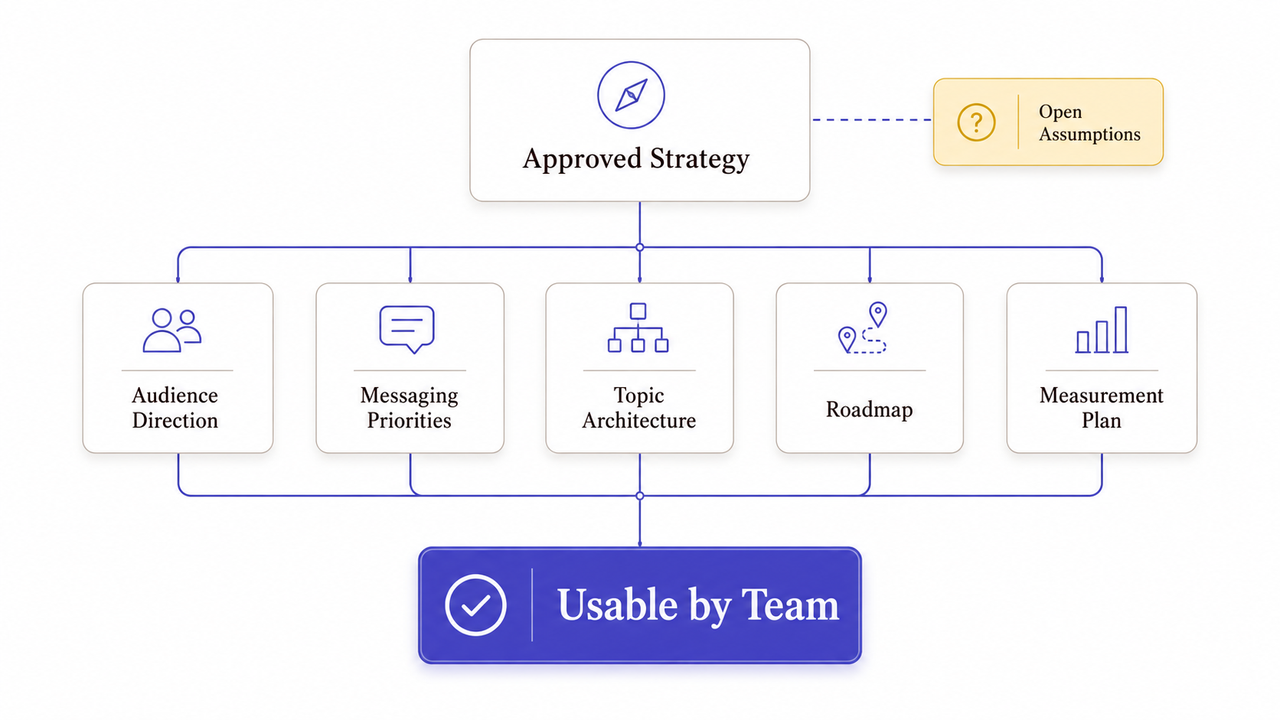
If a key assumption remains open, label it accordingly. A polished slide should not quietly convert an unresolved belief into an approved strategy.
Evaluate the Deliverables
Research, messaging, topic architecture, roadmap, and measurement plan
A proposal should name the actual outputs. “Content strategy” alone does not tell the buyer what will be available at handoff.
Depending on the engagement, deliverables may include:
- an audience and decision-stage summary;
- a review of current content and documented gaps;
- messaging priorities and evidence requirements;
- a topic architecture with inclusion and exclusion rules;
- format and channel recommendations;
- a sequenced roadmap;
- review and governance responsibilities;
- a measurement plan tied to specific decisions.
A content strategy SEO component may add search-demand evidence, page-role recommendations, and topic boundaries. It should not turn the roadmap into a list of loosely related keywords.
Acceptance criteria should describe what the team can inspect. For example, every roadmap item might need an audience, purpose, owner, evidence source, intended format, review requirement, and priority reason. That is more useful than accepting a spreadsheet because it contains the promised number of topics.
What makes a deliverable usable by a small team
A strategy fails operationally when its workload exceeds the team’s capacity. Forty recommended articles are not a practical roadmap if one internal expert can review only one draft each month.
Ask the provider to identify dependencies. A product comparison may require current pricing approval. A technical guide may depend on an engineer. A customer story may require permission that has not been obtained. Those conditions affect sequence even when the topic itself is valuable.
The roadmap should also distinguish:
- work that can begin immediately;
- work waiting for evidence or approval;
- ideas intentionally deferred;
- topics that should not be pursued.
Clear scope before commitment matters here. A small team should be able to open the final document and identify the next owner without scheduling another workshop to interpret it.
Understand Common Service Models
Consultant, agency, and embedded strategist tradeoffs
An independent consultant may suit a focused strategy problem with a small decision group. The client usually supplies more coordination and may hire other providers for research or execution.
An agency can bring research, SEO, editorial, and channel specialists into one engagement. That broader capacity helps when the strategy crosses several disciplines, but the proposal should still name who performs each part and who owns the final recommendation.
An embedded strategist works more closely with internal meetings and decisions over time. This model may fit a changing product or a team that needs ongoing governance. It also requires access, availability, and a clear boundary between advising the team and becoming the default owner of every content request.
No model is automatically better. Choose according to the decisions that must be made, the evidence required, and the coordination the internal team can provide.
Scope, collaboration, and cost drivers
There is no responsible universal price for content strategy services. Cost can change with research depth, interview volume, stakeholder count, market coverage, languages, existing-content complexity, workshop requirements, and implementation support.
Ask what each estimate assumes. A lower proposal may exclude original research, stakeholder interviews, taxonomy development, or post-delivery support. A larger proposal may combine strategy with production that the business does not yet need.
The comparison should separate fees from scope. Check the number and purpose of workshops, revision limits, expected client inputs, research method, final files, and support after handoff. If two proposals contain different commitments, comparing their totals alone does not reveal value.
Prepare Inputs and Use the Roadmap
Inputs, decision owners, milestones, and exclusions
Begin the brief with the business situation rather than a requested content quantity. Explain the audience, offer, sales cycle, current channels, known problems, available evidence, internal expertise, publishing capacity, and decisions the engagement must support.
Then assign owners:
- one business owner for priorities;
- one factual reviewer for each specialist subject;
- one approver for brand or regulated claims;
- one person responsible for applying the roadmap after delivery.
Sensitive inputs need a handling plan. The FTC’s business security guidance recommends limiting collected information, controlling access, setting expectations for service providers, and disposing of material that is no longer required in its Start with Security guidance. The brief should identify confidential files, approved systems, retention expectations, and return or deletion requirements.
Exclusions deserve equal attention. State whether the engagement omits writing, design, publishing, paid distribution, translation, or implementation. Otherwise, the first disagreement may appear after the strategy has already been approved.
How teams test assumptions after delivery
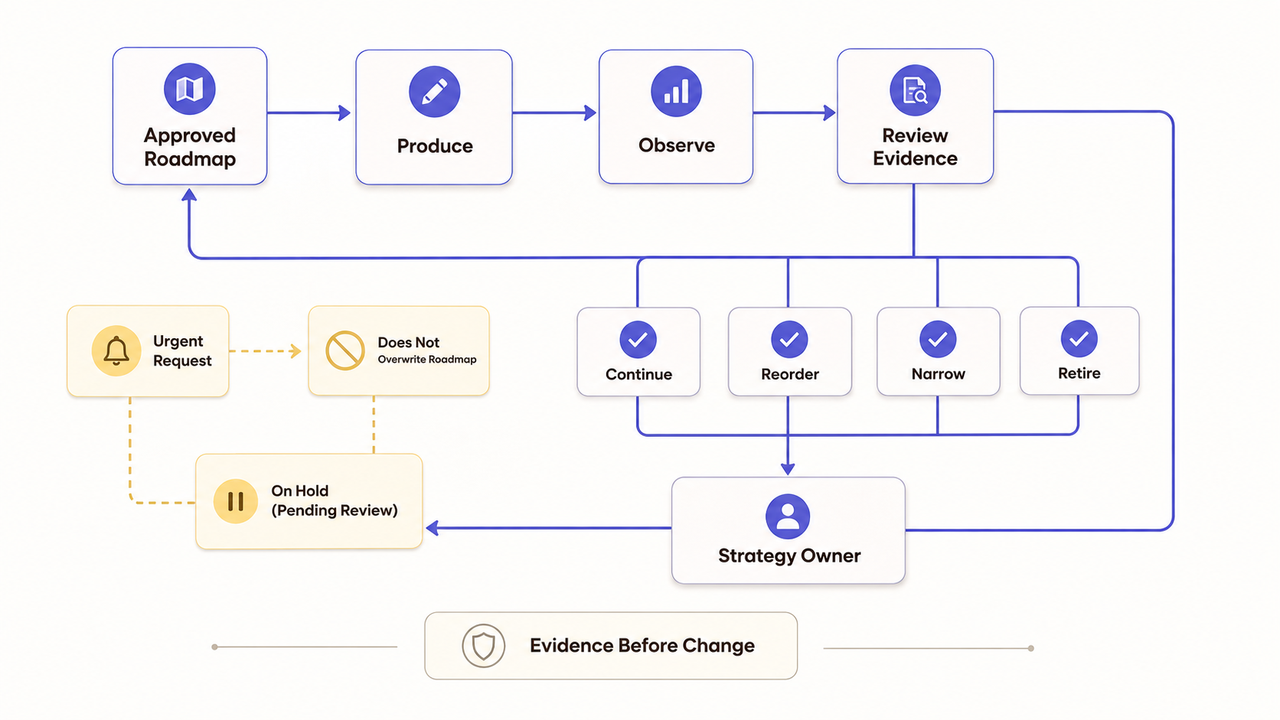
Treat the roadmap as a set of informed choices, not a forecast guaranteed to produce traffic or leads. Select a manageable group of priorities and record what the team expects to learn.
During the first review cycle, examine whether the assigned owners could complete the work, whether expert access arrived on time, whether audience questions were accurately represented, and whether sales or customer teams found the material useful.
A failed assumption does not automatically invalidate the entire strategy. It may justify changing a message, reordering a topic, narrowing an audience, or removing a format that consumes more capacity than it returns.
The update rule should state who may change priorities, what evidence is required, and where the reason is recorded. Otherwise, urgent requests will gradually replace the roadmap without anyone explicitly deciding to abandon it.
How SpringBrand Fits This Workflow
SpringBrand is an AI-assisted service marketplace that helps buyers clarify requests and match with independent providers from its current catalog. It does not create or guarantee the resulting content strategy.
Turn your approved strategy questions into a comparable content-service request before selecting an independent provider.
FAQ
The following answers identify practical review points. Contractual, privacy, and intellectual-property outcomes depend on the facts and applicable law, so they are general information rather than legal advice.
Can customer interview transcripts be sent to an external strategist?
Possibly, but approval to conduct an interview does not automatically authorize unrestricted external sharing. Check the participant notice, consent, contract, data sensitivity, destination, and provider role. Where UK data-protection rules apply, the ICO explains when a controller using a processor needs an appropriate processing contract or other binding legal act. Share only what the strategist needs through an approved system.
What consent is needed to publish a survey quote?
Research participation does not necessarily include permission for public quotation. Confirm whether the quote may be attributed, edited, anonymized, and used in the intended channels. If it functions as a customer endorsement in U.S. advertising, the FTC says endorsements must be truthful and not misleading in its advertisement endorsement guidance. Obtain qualified review when the intended use is unclear.
Who owns a proprietary taxonomy created during the project?
The contract should state who may use, modify, license, and share the taxonomy and its supporting materials. Do not infer ownership from who paid for the engagement. The U.S. Copyright Office explains that copyright does not protect underlying ideas, methods, or systems, although original expression may receive protection, in Circular 33. The specific deliverable still requires contract and jurisdiction-specific review.
How should embargoed product plans be handled by the provider?
Mark the material as confidential, share it only with named recipients who need it, and use the approved transfer and storage system. The agreement should address subcontractors, access changes, incident reporting, permitted uses, publication timing, and return or deletion. Do not place embargoed plans into an external AI or research tool unless that use has been expressly reviewed and authorized.
Can private competitor data be used in a strategy benchmark?
Only when the business has a legitimate and authorized basis to possess and use it. Public information, licensed research, confidential partner data, and improperly obtained material are not interchangeable. Record the source, access terms, date, and permitted purpose. If those facts cannot be established, exclude the data and seek qualified advice rather than presenting it as an ordinary benchmark.
Conclusion
Useful content strategy services leave a small team with decisions it can apply, not simply observations it agrees with. The final roadmap should reveal why each priority exists, what evidence supports it, who owns the next action, and which assumptions remain open.
The engagement is ready to close when the internal owner can apply the roadmap without asking the provider to reinterpret its central decisions.
Recommended Reads
- Marketing Strategy vs GTM Strategy: Key Differences
- Fractional Marketing Services: When They Make Sense
- Integrated Digital Marketing for Small Teams