Brand Strategy Services: Scope, Process, and Fit
Understand brand strategy services, their deliverables, provider models, and acceptance criteria before commissioning an engagement.
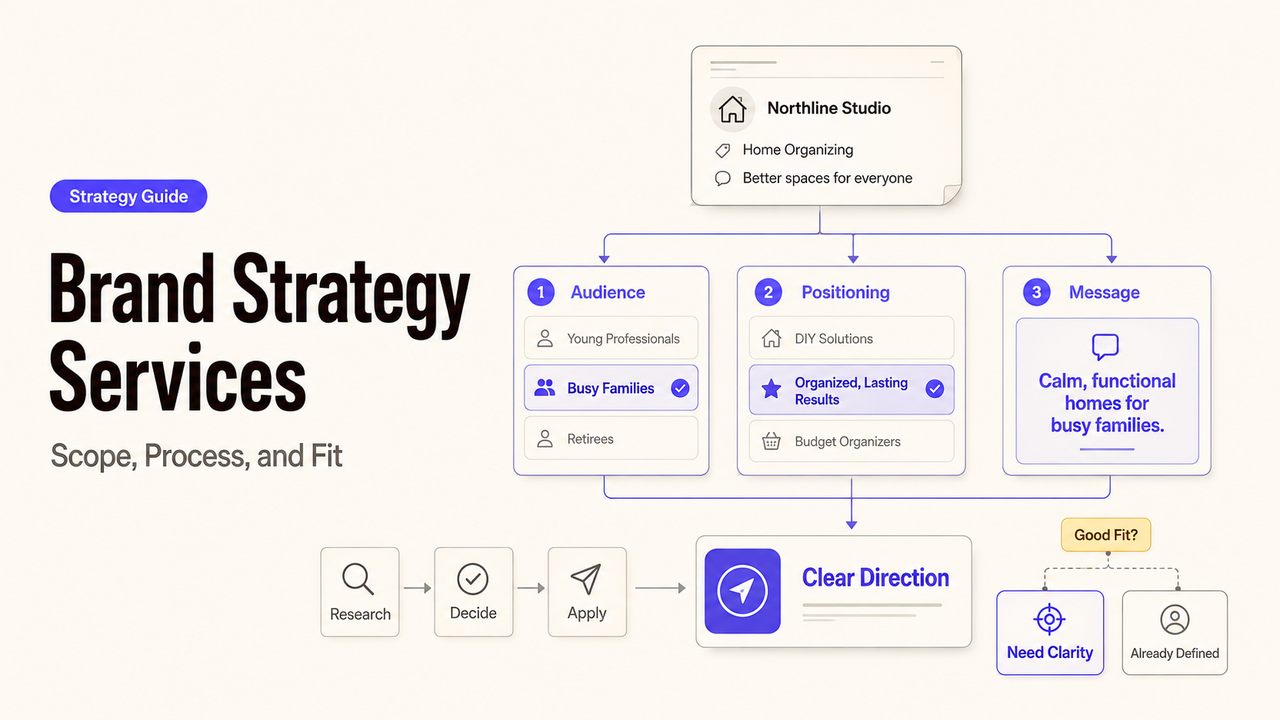
A founder leaves a strategy workshop with six pages of promising adjectives. The designer still does not know whether the new product should have its own brand, marketing cannot agree on the audience, and sales continues using the old pitch.
The meeting produced material. It did not produce a decision.
I’m Alex. When reviewing brand strategy services, I would ask what choices the engagement is expected to close, who has authority to close them and what evidence will remain when the workshops are over. This guide explains that scope without treating one process, price or timeline as an industry standard.
What Brand Strategy Services Are Meant to Solve
Positioning, audience clarity, differentiation, and choices
Brand strategy should help a business decide where it will compete, whom it intends to serve and what it wants to be known for. The output is not simply a more polished description of everything the company already does.
Positioning establishes the relevant audience, problem, market context, value and reasons to believe. Audience clarity identifies which buyers deserve priority and which groups the business will not organize itself around. Differentiation turns strengths into choices that matter to those buyers.
The choices are the important part. A business may decide to lead with specialist expertise rather than speed, serve one profitable segment before entering another or keep a new offer under the existing company brand.
Brand architecture addresses another set of choices: how the company, product lines, services and sub-brands relate to one another. It should make ownership and navigation clearer, not create additional names for their own sake.
A strategy that refuses to exclude anything will rarely guide later work. If every audience, claim and opportunity remains equally important, the difficult decisions have only been postponed.
Strategic decisions—not identity or full-service branding deliverables
Brand strategy sits upstream from design and campaign execution. It may shape the visual brief, but it does not automatically include a logo, colour system, website or finished advertising assets.
Businesses looking for a broader combination of strategy, messaging and identity can review the guide to branding services for small businesses. Teams that have already settled the strategic direction and need a visual system should use the separate guide to brand identity design services.
Keep these scopes distinct when requesting proposals. A strategist may define the role of a new product brand but not design it. A design studio may interpret the strategy visually without conducting fresh customer research. A full-service agency may offer both, but the proposal should still separate the strategic decisions from the later production work.
This boundary protects the buyer as well. It becomes easier to see whether the engagement failed to resolve the direction or whether the approved direction was not carried through during execution.
Decide Whether the Business Is Ready
Trigger events, decision owners, and available evidence
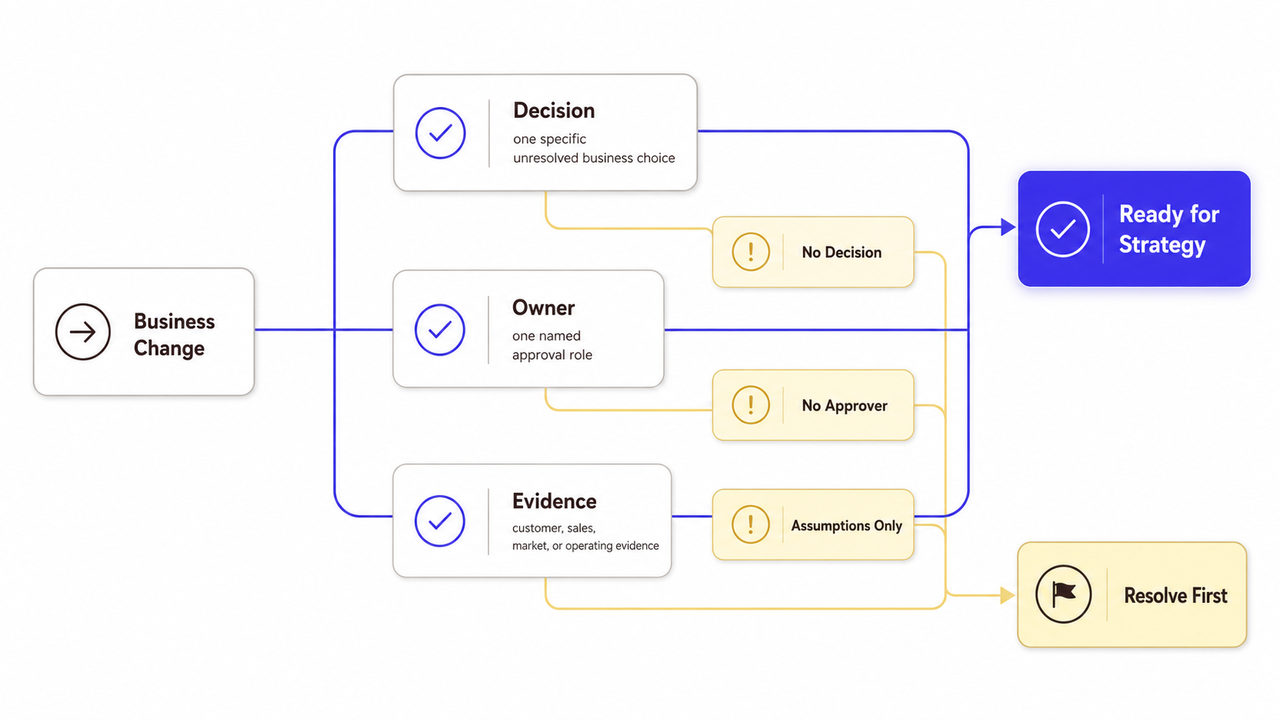
A company may need brand strategy consulting when a meaningful business change exposes uncertainty. Common triggers include entering a market, launching a new offer, repositioning after growth, combining businesses, addressing an outdated reputation or deciding how several products should relate.
The trigger alone does not make the business ready. Someone must have authority to approve choices about audience, offer, positioning and architecture. If three founders can veto the strategy but nobody can close the decision, the provider will spend the engagement managing unresolved governance.
Inventory the evidence already available. It may include sales calls, customer interviews, win-loss notes, support records, search behavior, proposals, competitor material and performance by segment. The SBA’s current market research and competitive analysis guidance identifies questions about demand, market size, saturation and pricing that can help frame the research.
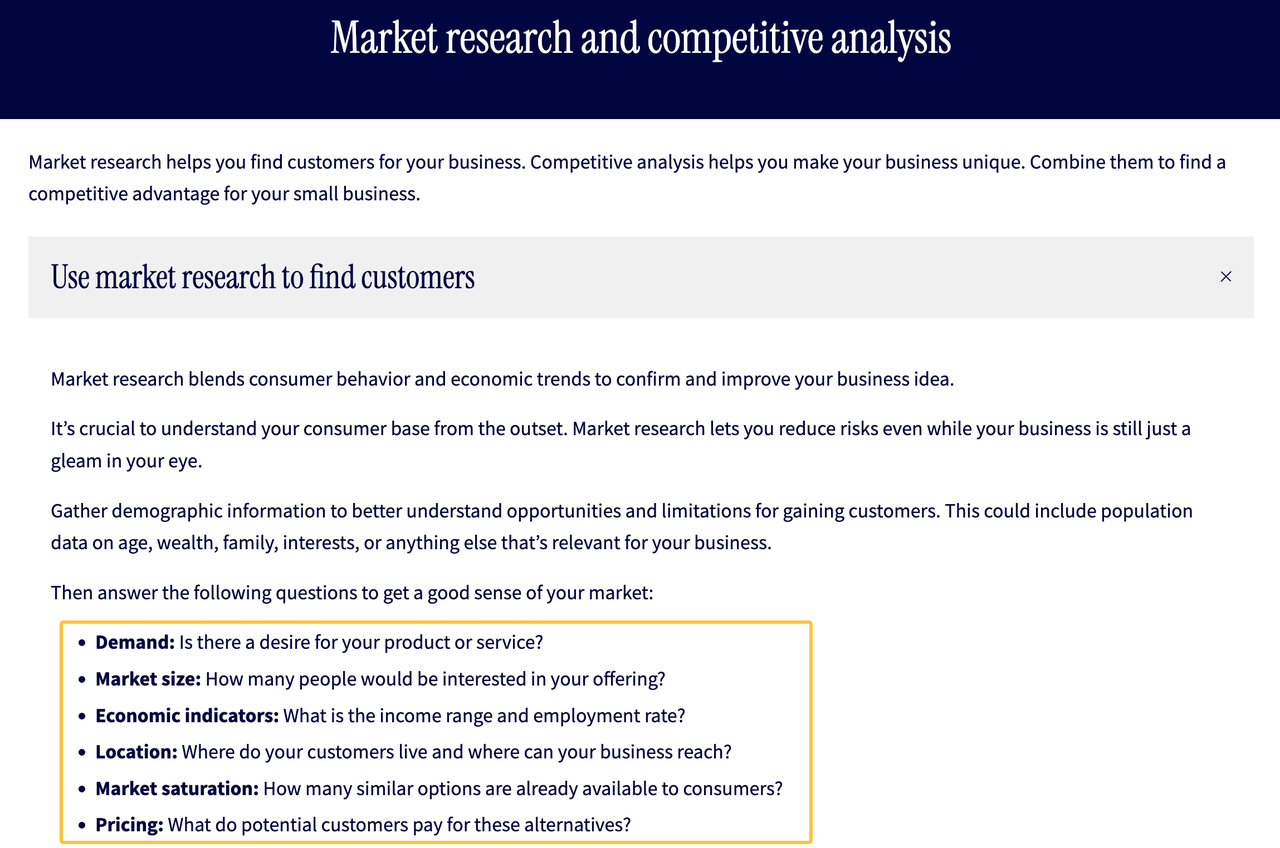
Do not present assumptions as findings. Label what the team knows, what it believes and what still needs to be tested.
Questions to resolve before requesting proposals
A provider can help investigate the market. It should not have to guess why the business commissioned the work.
Before requesting proposals, answer:
- What business event created the need?
- Which decision must be made?
- Who can approve it?
- Which audiences, regions or offers are in scope?
- What evidence can the provider access?
- Which claims or information are sensitive?
- What later work must the strategy support?
- Which decisions have already been made and are not being reopened?
Also decide how disagreement will be handled. A workshop is not an approval mechanism by itself. The proposal should name the person who receives recommendations, the people who advise that decision and the point at which the direction becomes approved.
If leadership is unwilling to make tradeoffs, a shorter alignment or research project may be more useful than commissioning a complete branding strategy.
Understand the Engagement Process
Discovery, research, synthesis, and decision workshops
Discovery gives the provider a working view of the business. It may include leadership interviews, existing materials, product information, sales processes, customer feedback and previous brand decisions.
Research depends on the unanswered question. A provider might interview customers, review competitors, analyze lost opportunities or examine how different audiences describe the problem. The sample and method should match the decision being made; there is no universal number of interviews that makes a strategy valid.
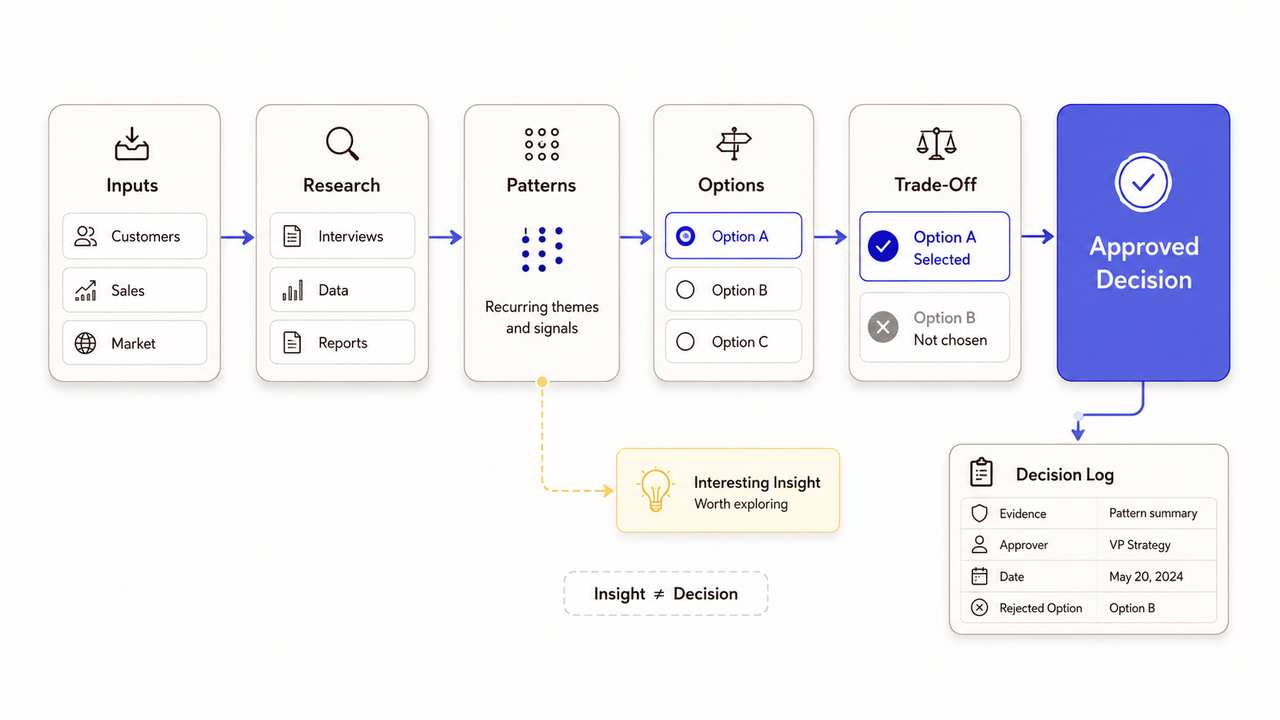
Synthesis turns those inputs into patterns, tensions and options. A useful provider should show how it moved from evidence to a recommendation. A slide should not become “the answer” simply because it looks finished.
Decision workshops are where the team tests the options and their consequences. For example, choosing one priority segment may change product emphasis, sales qualification and website structure. The facilitator should surface those effects rather than asking attendees to vote for their favorite sentence.
Keep a decision log throughout the engagement. Record the option considered, supporting evidence, approver, decision date and any condition that could reopen it.
Typical strategic deliverables and how teams use them
Deliverables vary, but a focused engagement may produce:
- a priority audience and buyer context;
- a positioning statement with supporting rationale;
- differentiation and proof themes;
- brand principles or strategic attributes;
- a brand architecture recommendation;
- approved choices and explicit exclusions;
- unresolved assumptions requiring further research;
- an activation brief for messaging, identity and marketing teams.
Each item should have a user. Sales might use audience priorities to qualify opportunities. A copywriter may use the positioning and proof hierarchy. A designer needs strategic principles translated into a visual brief.
Competitive material should remain evidence, not decoration. Label its source and capture date, and distinguish observation from interpretation. Screenshots may still be protected material; the U.S. Copyright Office’s Fair Use Index shows that fair-use outcomes depend on the particular facts rather than a universal screenshot exception.
Do not assume that research material can become public creative. Interview recordings, private documents and competitor references may require separate permission before entering a campaign or client-facing deliverable.
Compare Consultants, Studios, and Agencies
Depth, facilitation, research method, and implementation support
An independent consultant may provide senior attention and direct facilitation, but capacity for large research programs or implementation may be limited. A strategy studio may combine research and positioning specialists. An agency may connect strategy with design, content and campaigns.
The label tells you less than the actual team. Ask who will conduct interviews, analyze findings, lead workshops and write the final recommendation. Confirm whether the people in the pitch will remain involved after the contract begins.
Compare the research method as well. Does the provider rely mainly on leadership input, or will it speak with customers and other market participants? How are conflicting findings handled? Will the client receive source notes or only the final interpretation?
Implementation support can be valuable, but it may also reduce independence if the provider benefits from recommending a larger second phase. Ask which recommendations stand on their own and which lead into additional services.
No model removes the client’s decision responsibility. The provider can frame choices and challenge weak reasoning; leadership still approves the commercial direction.
Cost drivers and scope boundaries without fixed benchmarks
The cost of an engagement follows its complexity. Important drivers include the number of audiences, markets, products and decision-makers; the amount of original research; recruitment of participants; senior facilitation; brand architecture work; and the expected implementation support.
Access can change the effort as well. A provider that receives organized sales records and prompt leadership feedback can work differently from one that must reconstruct the business from scattered documents.
Clarify whether the proposal includes:
- participant recruitment and incentives;
- transcription and research analysis;
- travel or in-person workshops;
- several strategic options;
- revisions after leadership review;
- architecture for multiple offers or sub-brands;
- messaging or identity handoff;
- implementation support.
Compare assumptions rather than looking for a standard fee. A shorter engagement with limited research is not the same service offered at a better price.
Accept and Operationalize the Strategy
Decision clarity, evidence trail, and unresolved assumptions
Acceptance should test whether the strategy can guide a real decision. It should not depend on whether every stakeholder likes every word.
For each major recommendation, ask:
| Acceptance question | Evidence to expect |
|---|---|
What was decided? | A clear choice rather than a list of possibilities |
Who approved it? | Named decision owner and approval date |
Why was it chosen? | Research, business constraints and reasoning |
What was rejected? | Alternatives and the reason they were not selected |
What remains uncertain? | Open assumptions and a plan to test them |
Where will it be used? | Named teams, briefs or operating processes |
Preserve the research trail without turning every interview into a permanent archive. The final record should show enough evidence to explain the decision while respecting consent, confidentiality and retention limits.
If an important assumption remains unresolved, keep it visible. “Priority audience pending distributor interviews” is more useful than allowing an incomplete conclusion to appear settled.
The engagement is not accepted merely because the final presentation was delivered. It closes when the designated owner can state the direction, explain its basis and authorize the next team to act.
Handoff to naming, identity, messaging, and campaigns
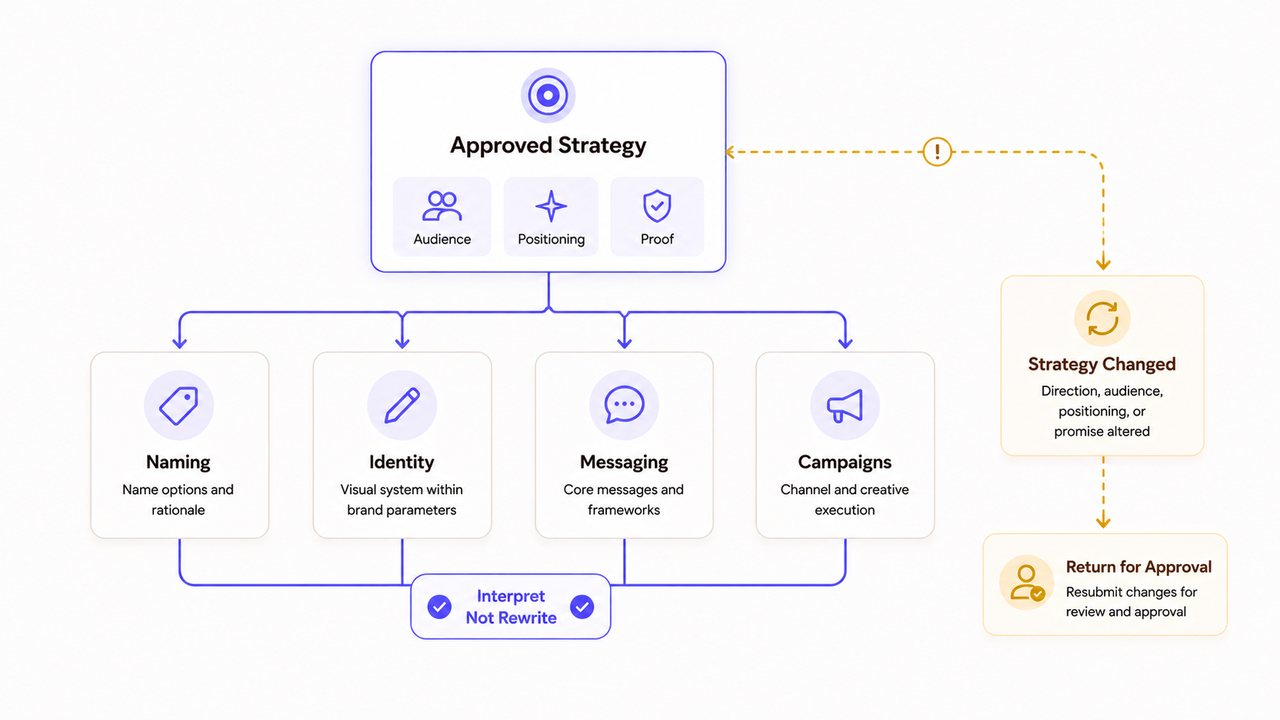
Translate each decision into the next team’s language. A naming brief needs architecture, audience and constraints. A visual identity brief needs positioning, strategic attributes and application contexts. Messaging requires proof, objections and audience priorities.
Do not ask downstream teams to reinterpret the entire research archive. Give them the approved decision, relevant evidence, exclusions and open questions.
The handoff should also say what cannot change without returning to leadership. A campaign may adapt wording for a channel. It should not quietly change the priority audience or promise a benefit the strategy did not approve.
Name one internal strategy owner after the provider leaves. That person maintains the record, answers questions and decides when new evidence warrants a review.
How SpringBrand Fits This Workflow
SpringBrand can help a business structure its request and explore relevant services from independent providers when the live catalog matches the need. It is not a brand strategy consultancy and does not certify recommendations or guarantee implementation outcomes.
Turn the unresolved brand decisions into a structured service request before comparing available independent providers.
FAQ
Can research recordings be shared with subcontractors?
Only after checking the original participant notice, contractual scope, applicable privacy requirements and the subcontractor’s role. Sharing a file internally with the provider does not automatically authorize another organization to receive it.
Where UK data protection rules apply, the ICO’s current controller and processor contract guidance addresses processing instructions and sub-processors. Other jurisdictions may impose different requirements.
What consent is needed to quote interview participants?
Consent to participate in private research may not include permission to publish a named quotation. Confirm whether the quote will be anonymous or attributed, where it will appear, how it may be edited and whether it becomes marketing material.
If a quotation is used as a testimonial or endorsement in U.S. advertising, the FTC’s endorsement guidance may also apply. Obtain advice appropriate to the jurisdiction and planned use.
Who may reuse workshop recordings after the engagement?
The agreement should identify who controls the recording, who can access it, how long it will be kept and whether it may be reused for training, promotion or another client.
Participants should know that recording is taking place and how it will be used. Remove provider and subcontractor access when the agreed purpose ends, unless a documented requirement justifies continued retention.
How should sensitive pricing research be stored?
Keep only the material required for the business decision, restrict access and define a deletion date. Avoid placing confidential pricing interviews in an unrestricted shared folder or a provider’s general training library.
The FTC’s business data-security guidance recommends understanding what information is held, limiting access, protecting retained data and securely disposing of material no longer needed.
Can competitor screenshots remain in the final deliverables?
They may remain as internal research evidence only after the business checks the purpose, access, contractual terms and applicable copyright rules. Label the source and date, avoid implying ownership and do not treat inclusion in an internal deck as permission for public reuse.
For public presentations or campaigns, consider whether a written description or link can support the point without reproducing the image. Material use questions should be reviewed by a qualified professional.
Conclusion
Brand strategy services are useful when a business needs to make consequential choices before paying for design or campaign execution. The engagement should resolve direction, not simply produce more language about the brand.
Choose a provider whose research, facilitation and delivery model fit the actual decision. Require an evidence trail, named approver and visible list of unresolved assumptions.
The strategy is ready to move downstream when the next team knows what it may interpret, what it must preserve and who can authorize a change.