Digital Marketing for Plumbers: A Practical Channel Plan
Digital marketing for plumbers works best when local search, paid demand, reviews, and follow-up share one lead path. Prioritize the right channels.

A homeowner discovers water under the sink at 6:45 a.m., taps a plumbing ad, and lets the phone ring until the call drops. The advertising dashboard records an interaction, but the dispatcher never receives a bookable job. A useful digital marketing for plumbers plan must connect the channel to the entire lead path. I’m Alex; in this plan, a channel earns attention only when the business can receive, qualify, assign, and review the inquiries it creates.
Map the Customer Journey From Urgent Need to Booked Job
Plumbing customers do not all enter the market in the same state.
An urgent customer may search for a burst pipe, blocked drain, failed water heater, or overflowing toilet. Speed, service area, and immediate availability shape the decision.
A planned-service customer has more time to compare options for fixture installation, repiping, water treatment, or a scheduled inspection. The website must provide enough detail to support that comparison.
Commercial buyers may need maintenance coverage, documentation, procurement approval, or coordination across several properties. Their path from first search to approved work can be considerably longer.
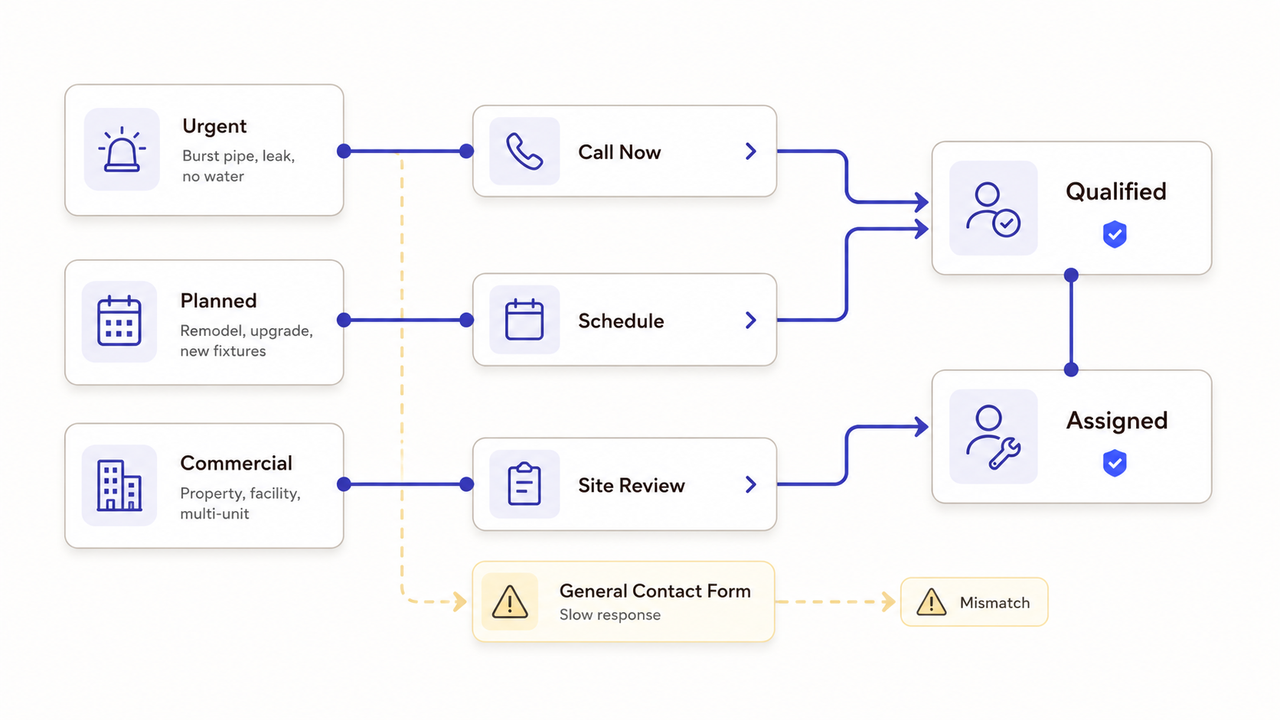
Map these differences before selecting channels:
| Journey stage | Customer question | Business requirement | Evidence to retain |
|---|---|---|---|
Search | Can this company solve my problem here? | Accurate service and location information | Search term or lead source |
Evaluation | Is the company qualified and credible? | Relevant page, reviews, credentials, clear limitations | Landing page and source viewed |
Contact | Can I reach someone now? | Working phone, form, or booking path | Call or submission record |
Qualification | Is the property and job a fit? | Intake questions and service-area check | Lead status and reason |
Scheduling | When will someone arrive? | Crew availability and customer confirmation | Appointment record |
Completion | Was the work delivered? | Job notes, invoice, and follow-up | Completion status |
Retention | Is another service appropriate later? | Permission-aware customer communication | Follow-up or opt-out record |
Create one definition for a qualified plumbing lead. It might require a covered service, an address inside the operating area, a reachable customer, and a realistic next step. Website sessions and phone clicks remain useful diagnostic measures, but they are not substitutes for this operational definition.
Fix the Website, Tracking, and Call Conversion Basics

A plumbing company marketing plan should not send more visitors into a broken contact path.
Open the website on a phone and test it as a customer would. Can you identify the service area? Is the phone number easy to tap? Does the emergency wording match actual availability? Can a customer understand what information to provide before requesting an appointment?
Priority pages should cover the services the company wants to sell and can reliably deliver. Each page needs to explain:
- the problem or project it addresses;
- the locations covered;
- when the service is available;
- what the customer should do next;
- which information helps the team assess the job;
- any important exclusions or qualifications.
A general “Contact us for all plumbing needs” page makes qualification harder. A drain-clearing page can ask about property type, affected fixtures, recurrence, and access. A commercial maintenance page may need company details, site count, urgency, and purchasing requirements.
Tracking should follow the same distinction. Record at least:
- source or campaign;
- landing page;
- service requested;
- service location;
- call answered or missed;
- qualified or unqualified;
- appointment booked;
- job outcome when available.
Google Ads separates a phone call from a phone-call conversion. The advertiser chooses a duration threshold for the conversion, so a long call may meet the platform definition without becoming a suitable job. Google’s call-reporting documentation explains that distinction.

The business still needs its own lead record. If calls are recorded or messages are used for marketing follow-up, check the consent, disclosure, privacy, and retention requirements that apply in the relevant jurisdiction.
Capture Local Demand Through Search and Listings
Local SEO for plumbers should make the real service operation easier to find and understand. It is one part of the channel plan, not the entire plan.
Start with the Google Business Profile and the pages connected to it. Confirm:

- real-world business name;
- appropriate category;
- service area;
- phone route;
- regular and special hours;
- website destination;
- current services;
- profile ownership;
- genuine photographs;
- review-response responsibility.
Google says local results are mainly based on relevance, distance, and prominence. Complete information can help the platform understand the business, but there is no way to request or pay Google for a better organic local position. Its local ranking guidance provides a useful standard for reviewing SEO promises.
Match organic pages to meaningful customer needs rather than producing a generic page for every nearby city. A drain service page, water-heater page, emergency page, and commercial services page usually serve clearer purposes than dozens of lightly edited location pages.
Location content becomes useful when it reflects a genuine operating difference: service availability, property types, crew coverage, local contact instructions, or licensing boundaries. It should not imply that the business has an office in every place it serves.
Measure local visibility alongside call quality. If searches and profile interactions rise while inquiries arrive from uncovered areas, the service information or location targeting needs correction. More activity is not an improvement when dispatch rejects most of it.
Use Paid Channels Without Losing Lead Visibility

Paid demand can help a plumbing company reach customers who are ready to contact a provider. It can also spend money quickly while the phone goes unanswered.
Common options include:
- search advertising for defined services and locations;
- local service advertising where the category and region are eligible;
- remarketing to previous website visitors where appropriate;
- social advertising for planned projects, seasonal services, or maintenance offers.
Availability, screening, interfaces, and campaign requirements vary by country, category, and account. Google notes that Local Services screening may include business, license, insurance, or background checks depending on the category and region. Review the current provider qualification requirements before making the channel part of the forecast.
Paid search needs a narrow connection between query, ad, page, and phone route. An ad for emergency drain service should not land on the homepage or run during periods when no one can respond. Commercial and residential services may share a brand, but their campaigns, intake questions, and landing pages often need to be separated.
Check geographic settings carefully. Google explains that its location targeting relies on several signals and does not guarantee perfect geographic accuracy. Depending on the selected option, ads may reach people physically in an area, regularly there, or showing interest in it. Google Ads location-targeting guidance describes those available boundaries.
Review search terms, locations, call outcomes, and rejected leads together. If a campaign receives calls from outside the service area, do not judge it by click cost alone.
Set a capacity rule before launch. For example:
- reduce or pause spend when the same-day schedule is full;
- limit emergency ads to staffed response periods;
- route overflow calls to an approved backup;
- review missed paid calls before increasing the budget;
- stop a campaign when tracking or call routing fails.
The budget should not continue moving simply because nobody has been assigned permission to stop it.
Build Reviews, Referrals, and Repeat-Service Campaigns
Reviews help future customers judge whether the company has handled work like theirs. Build the request into the completion process instead of running occasional review drives.
After a completed job, the office can confirm that the customer received the invoice and knows how to request follow-up support. Once the service is complete, it can also provide a direct review link without prescribing a rating.
Do not offer a discount, gift, or free service in exchange for posting or changing a Google review. Google treats review incentives as prohibited fake or misleading content. Its review guidance recommends genuine requests, professional replies, and protection of customer privacy.
A referral process needs a record as well. Decide:
- who may make the referral;
- how the new customer identifies the source;
- whether any benefit is offered;
- when it is approved;
- how the arrangement complies with applicable rules.
Repeat-service marketing should reflect the customer’s history. Someone who joined a maintenance plan may need appointment reminders, seasonal preparation, or information about covered services. That person should not receive the same acquisition message as an unknown prospect.
Separate transactional notices from promotional communication. In the United States, the FTC explains that commercial email is subject to requirements including accurate sender information and a working opt-out process. Its CAN-SPAM compliance guide also notes that hiring another company to send email does not remove the advertiser’s responsibilities. Other countries and messaging channels may apply different rules.

Prioritize Channels by Budget and Capacity
The right sequence depends on how much demand the team can handle, not only how much media it can afford.
| Current condition | First priority | Add later | Hold until ready |
|---|---|---|---|
Calls are frequently missed | Routing, staffing, intake, and callback process | Local profile and website improvements | Additional paid demand |
Website is unclear or difficult to use | Service pages, mobile contact path, and tracking | Organic content and paid search | Broad awareness campaigns |
Organic demand exists but volume is limited | Profile, reviews, service pages, and selected paid search | Referral and retention campaigns | Multiple untested channels |
Crews have unused capacity in specific areas | Location and service targeting with controlled paid demand | Local partnerships | Region-wide campaigns |
Customer database is usable and permissions are understood | Maintenance and repeat-service communication | Referral offers and segmentation | Unreviewed bulk outreach |
A small business does not need to activate every channel. A workable initial mix may include:
- a reliable mobile website and call route;
- an accurate Business Profile;
- several commercially important service pages;
- a consistent review request;
- one controlled paid campaign;
- a basic customer follow-up process.
Give each channel one business job. Organic search may capture existing demand over time. Paid search may provide controlled access to urgent or high-value searches. Reviews reduce uncertainty. Email may support maintenance and retention. Social content can show workmanship and educate future customers, but it should not be expected to perform every role.
Set review dates and stop conditions before allocating more budget. A channel should earn expansion through qualified inquiries, operational fit, and acceptable economics rather than impressions alone.
Decide What to Keep In-House or Outsource
Keep work in-house when it depends on daily operational truth:
- current crew capacity;
- service availability;
- job qualification;
- missed-call follow-up;
- customer approval;
- review requests;
- final claims about licenses, pricing, or response times.
Outside support may be appropriate for website development, technical SEO, campaign configuration, reporting setup, creative production, or sustained content work. The provider still needs timely information from dispatch, sales, and management.
Write the engagement around a specific gap. “Handle plumber marketing” does not define who owns the result. A better scope identifies:
- channels included;
- services and locations covered;
- client inputs;
- account ownership;
- access level;
- budget authority;
- approval process;
- lead-routing responsibility;
- reporting definitions;
- change log;
- handoff files;
- acceptance criteria.
The plumbing company should retain control of its domain, Business Profile, advertising accounts, analytics, customer data, and primary phone numbers. A provider may manage them through approved access without becoming the only person able to retrieve the records.
Ask for reporting that connects spend and visibility to qualified demand. A dashboard containing clicks, impressions, and calls is incomplete if nobody can show which calls were answered, inside the service area, relevant to the advertised service, and moved toward an appointment.
FAQ
How should marketing change during severe weather events?
Update availability before increasing promotion. Confirm crew safety, operating areas, response times, inventory, call capacity, and any public restrictions. Pause or narrow campaigns if the company cannot support additional demand.
Messages should describe what the business can actually provide. Do not exploit an emergency with unsupported claims, misleading scarcity, or response times the dispatch team cannot meet.
Can one campaign cover residential and commercial plumbing services?
It can share the same account and brand framework, but one campaign is rarely ideal for both paths. Residential customers may need immediate scheduling and simple qualification. Commercial buyers may require site information, service agreements, documentation, or approval from several people.
Separate the targeting, landing pages, intake fields, and follow-up rules when those buying processes differ.
What if call handlers cannot answer every new lead?
Create an overflow and callback procedure before buying more traffic. Route unanswered calls to a staffed alternative, capture enough information for follow-up, and assign a response deadline. Test what happens when the primary handler is busy or absent.
Review missed paid calls as an operating cost. If the business cannot recover them reliably, narrow the schedule or pause the affected campaign.
Should maintenance-plan customers receive different messages after service?
Yes. Their messages should reflect the plan, completed work, next service interval, and coverage they already have. Avoid repeatedly selling benefits they have purchased.
Keep necessary service notices distinct from promotional messages. Record preferences and honor applicable opt-out or consent requirements.
How can a new plumbing business market without reviews?
Begin with information the business can already prove: services, qualifications, operating area, team, contact process, and genuine project photographs used with permission. Build helpful pages and claim eligible business listings.
Ask real customers for honest reviews after completed work. Do not buy reviews, copy testimonials, or imply a service history the company has not earned.
Conclusion
Effective digital marketing for plumbers does not begin with a favorite channel. It begins with a service the company can deliver, a customer it can qualify, and a lead path someone is prepared to own.
Before adding another campaign, name the person responsible for an unanswered call. Until that exception has an owner, more demand may only make the existing leak more expensive.