AI Agent Frameworks vs Builders: Buy or Build?
AI agent frameworks offer code-level control, while managed builders can reduce infrastructure work; the right choice depends on ownership and constraints.
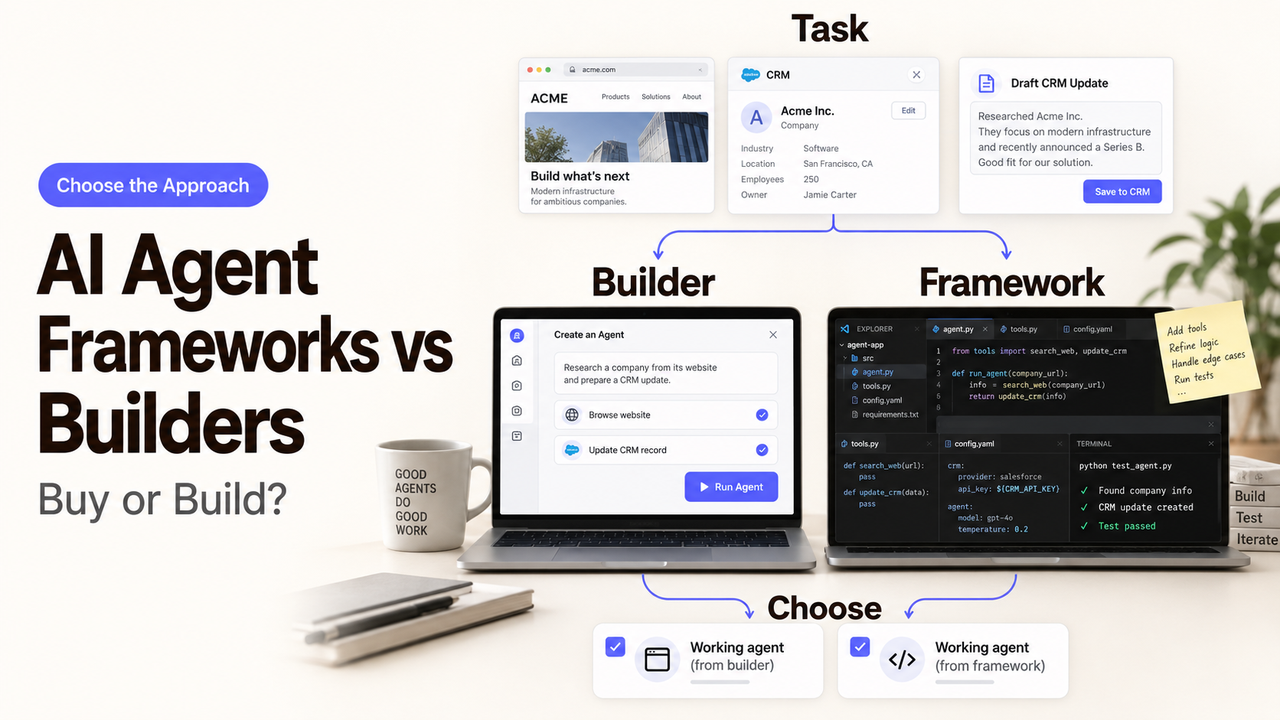
An agent can follow the same business rules in a code repository or a managed builder. The demo may look similar. The work left with your team will not.
I’m Alex, and I would make this choice from the maintenance calendar, not the canvas. Decide who will change the logic, repair connections, inspect failed runs, and answer for the system a year from now.
The export, evaluation, runtime, license, and SpringBrand positioning claims below use public documentation checked on September 16, 2026. This AI agent frameworks comparison does not rank model quality or universal winners.
Quick Verdict: Choose for the Team That Will Own It
Choose a framework when developers need to control orchestration, dependencies, deployment, or data paths. Choose a managed builder when operators need a supported place to configure, test, publish, and maintain a known business task.
Use a hybrid route when custom logic is valuable but your team does not want to operate every runtime component. A framework can run inside managed hosting, or a builder can call a separately owned service.
The decisive question is not whether your team can build the first version. Ask whether the named owner can handle the tenth change and the first production failure.
What Frameworks and Builders Provide
Both routes can connect models, tools, instructions, state, and review steps. They package those responsibilities differently.
Frameworks Provide Code-Level Building Blocks
An AI agent framework gives developers libraries or runtime primitives for defining state, decisions, tool calls, and recovery. The team chooses how those pieces enter its application and infrastructure.
LangChain describes LangGraph as a low-level framework and runtime for long-running, stateful agents. Its current framework and runtime guide emphasizes durable execution, persistence, human review, and low-level orchestration control.
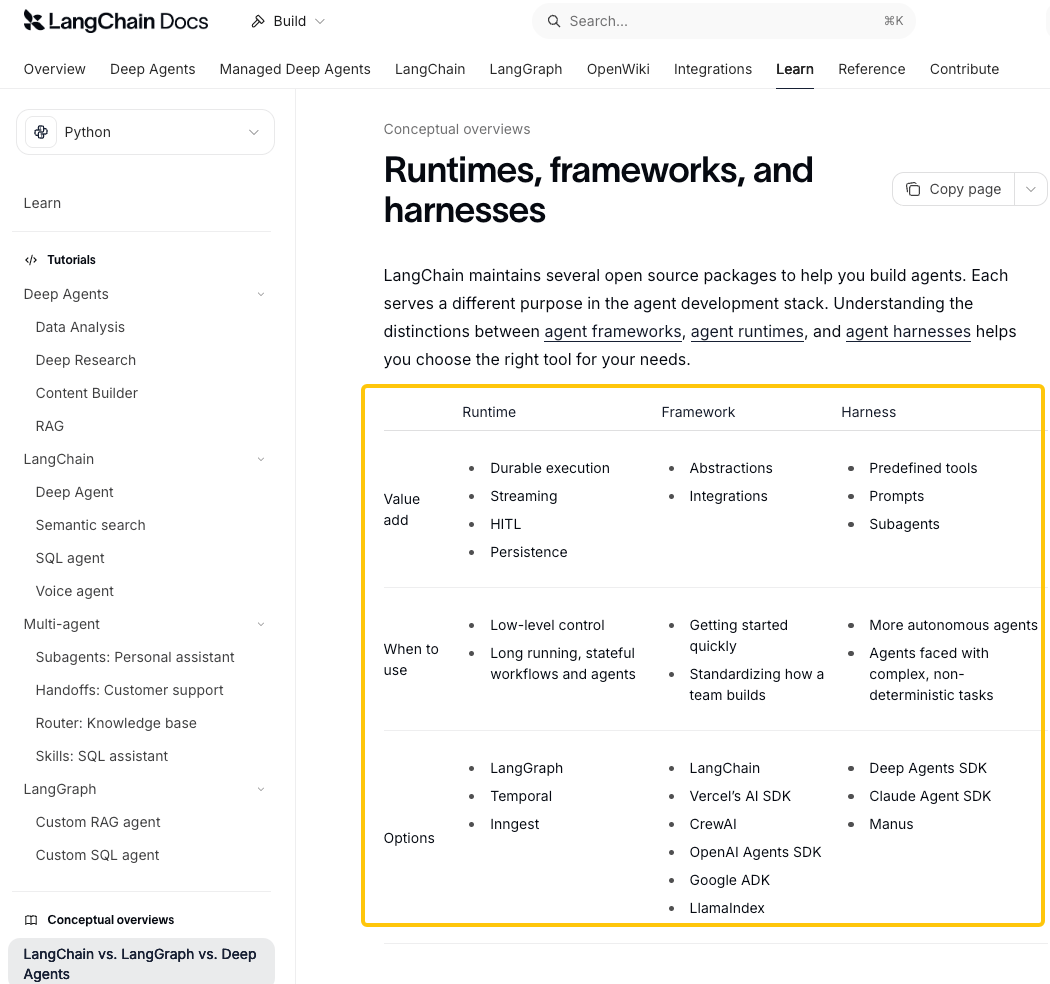
That control is useful when business logic does not fit a platform’s standard objects. It also creates work. Your team must decide how to package dependencies, manage secrets, deploy changes, collect traces, and respond when a component changes.
Framework does not automatically mean self-hosted. A framework application may run on your infrastructure or on managed hosting. Separate the code choice from the hosting choice.
Builders Provide Managed Configuration and Operations
A managed builder supplies an opinionated environment for assembling and operating agents. It may provide visual configuration, code extensions, managed deployment, environments, evaluation, analytics, and access controls in one product.
Builder does not mean no-code. Microsoft, for example, documents solutions, environments, imports, exports, and deployment pipelines for Copilot Studio. Those are application-lifecycle controls, not merely boxes on a canvas.
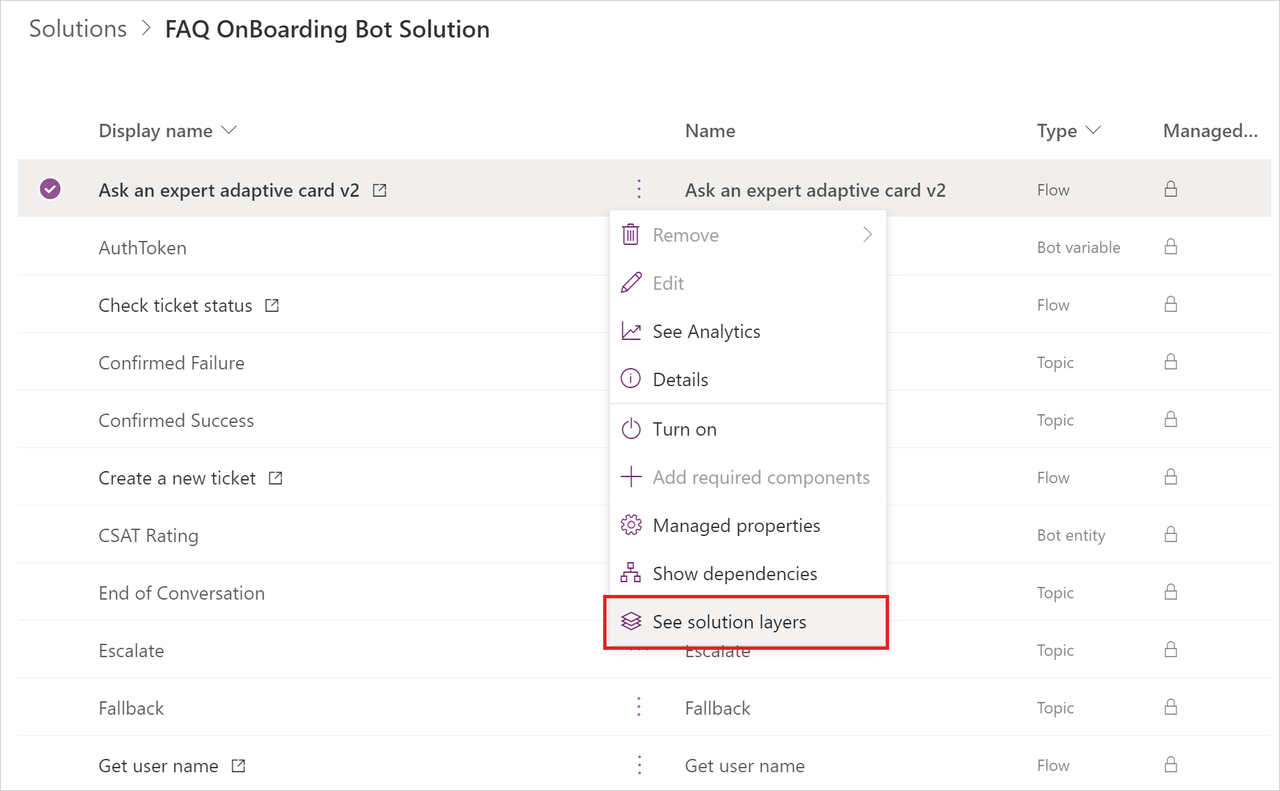
The vendor chooses more of the runtime contract. That can reduce infrastructure work, but it may also limit dependency versions, deployment patterns, or the form in which an agent can leave the platform.
Compare Control With Operating Work
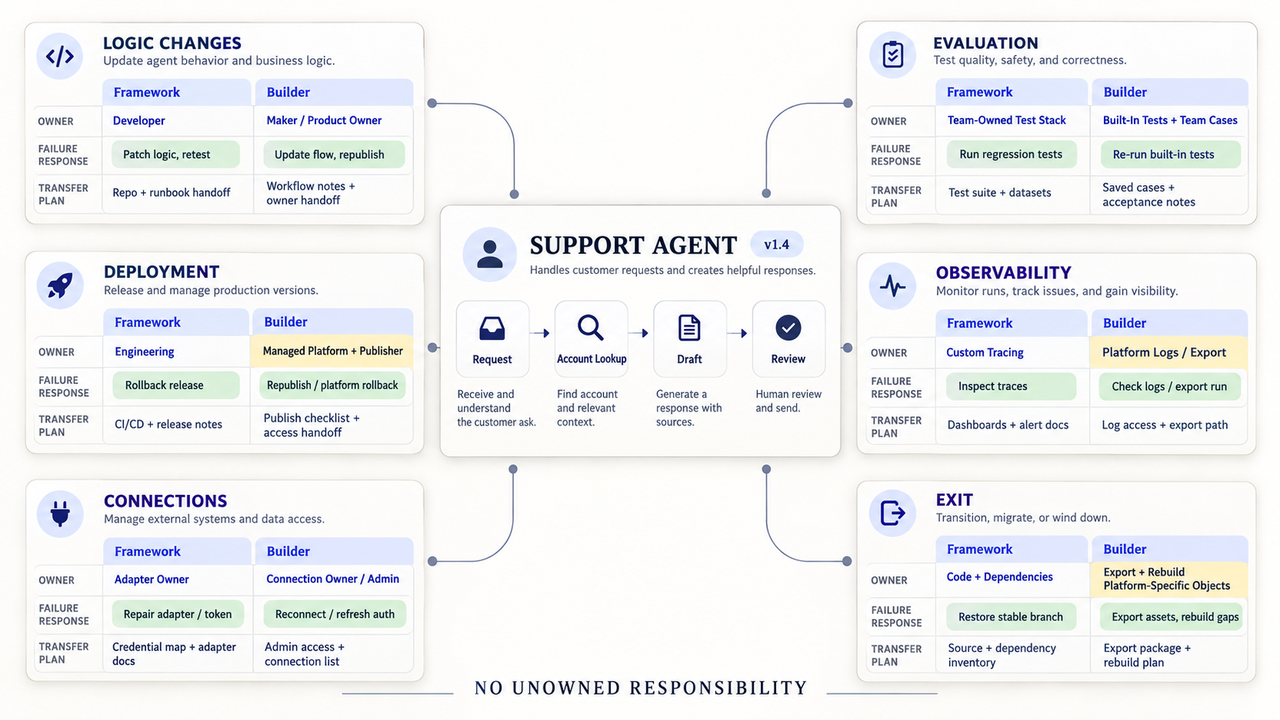
Do not count features before assigning responsibilities. Use an ownership ledger for the first workflow.
Decision area | Framework route | Managed builder route | Question to settle |
Logic changes | Team edits and reviews code | Makers change platform objects or extensions | Who approves a behavior change? |
Deployment | Team owns or selects hosting | Vendor supplies the supported runtime | Who responds when a release fails? |
Connections | Team implements or adopts adapters | Platform provides connectors and extension points | Who repairs an expired credential? |
Evaluation | Team selects the test stack | Platform may include test sets and graders | Can the same cases run outside the platform? |
Observability | Team designs tracing and retention | Platform defines available logs and exports | Can operations retrieve the detail they need? |
Exit | Code may move, with dependencies | Export may remain platform-specific | What must be rebuilt to leave? |
Development Skill and Maintenance Ownership
Framework work usually needs developers who can review code, manage packages, and diagnose failures across services. The team gains freedom to shape the system, but every custom choice becomes something it may need to maintain.
A builder can move routine changes closer to operations or product teams. It still needs an owner. Someone must understand the agent’s instructions, connected data, publication state, tests, and escalation path.
Staff continuity matters. A private repository is not portable if only one engineer understands it. A shared builder is not maintainable if every agent belongs to a departed employee’s account.
Integrations, Deployment, and Runtime Control
List the required systems and actions before comparing logos. “Connects to CRM” is incomplete. Reading an account, updating a field, and sending an email require different permissions and recovery plans.
Frameworks let developers design an adapter around an API or tool protocol. Managed builders may offer faster supported connections, but only for the actions and authentication modes they expose.
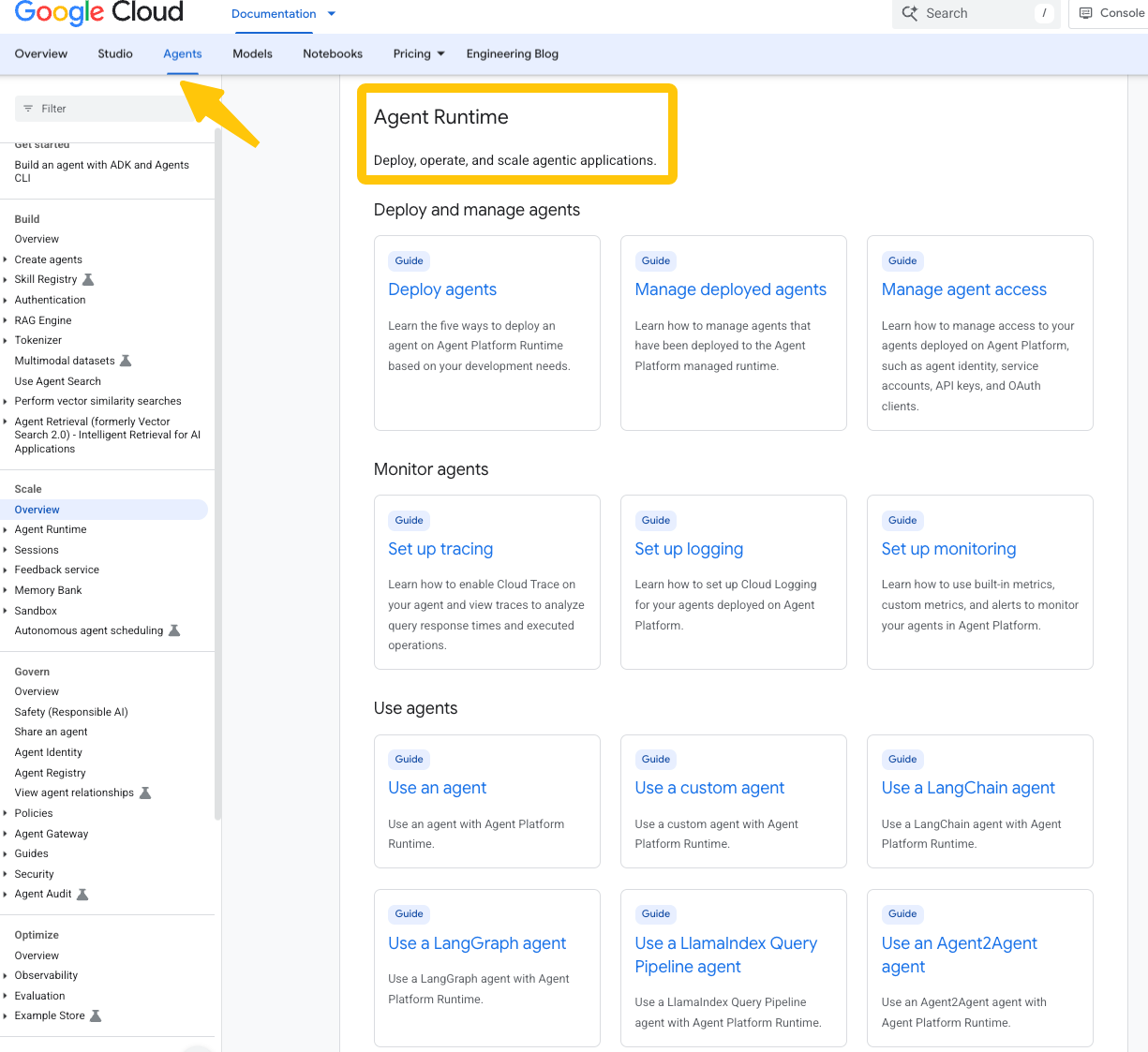
Managed hosting can also support custom code. Google’s current Agent Platform material lists a managed runtime for several framework types, plus custom agents, logging, tracing, and access management. This is why the decision is a spectrum, not a binary.
Evaluation, Observability, and Change Management
Use the same business cases to test both routes. Keep inputs, expected outcomes, prohibited actions, and review notes outside the implementation when possible.
Copilot Studio’s current agent evaluation documentation supports repeatable test sets and comparisons across changes. LangSmith likewise supports datasets and experiments for framework applications. A built-in evaluation page is convenient, but the team still defines what counts as a correct result.
Check the less visible controls: version labels, rollback, trace export, retention, and alerts. A strong demo can answer a test prompt while leaving operations unable to explain a failed tool call.
Choose a Framework for Custom Logic and Infrastructure Control
Choose a framework when the workflow contains logic that a managed platform cannot express cleanly. It also fits teams that must choose their runtime, networking, storage, or dependency versions.
The route is strongest when a development team already owns deployment and incident response. The agent should enter its existing engineering process: source review, automated tests, staged releases, monitoring, and rollback.
Do not choose agentic AI frameworks merely to avoid platform fees. Hosting, tracing, evaluation runs, dependency upgrades, and on-call work remain real costs. Custom code only earns its place when the control has a clear business or technical purpose.
Choose a Builder for Cross-Functional Ownership
Choose a builder when the workflow is close to the platform’s supported patterns and business operators will make frequent changes. A managed interface can make environments, publication status, permissions, and testing more visible to non-developers.
This route works best when the team accepts the platform’s objects and operating model. Verify the exact connector actions, authentication method, test features, log access, export format, and release controls before committing.
Do not assume a managed builder eliminates engineering. Custom APIs, identity design, data cleanup, and complex failures may still need technical support. The builder changes where engineering enters the job.
Use a Hybrid Approach When the Boundary Is Clear
A hybrid design can keep distinctive logic in code while using a managed service for deployment, evaluation, or business-facing configuration. It can also let a builder call a narrow internal API instead of receiving broad database access.
Draw the boundary as a contract. Name the input, output, authentication method, timeout, error response, version, and owner on each side. Without that contract, the hybrid route can create two operating surfaces and no clear incident owner.
Keep valuable assets portable. Evaluation cases, tool schemas, business rules, and acceptance criteria should not exist only as screenshots. Where a platform supports it, export them in a documented format and test the export before renewal time.
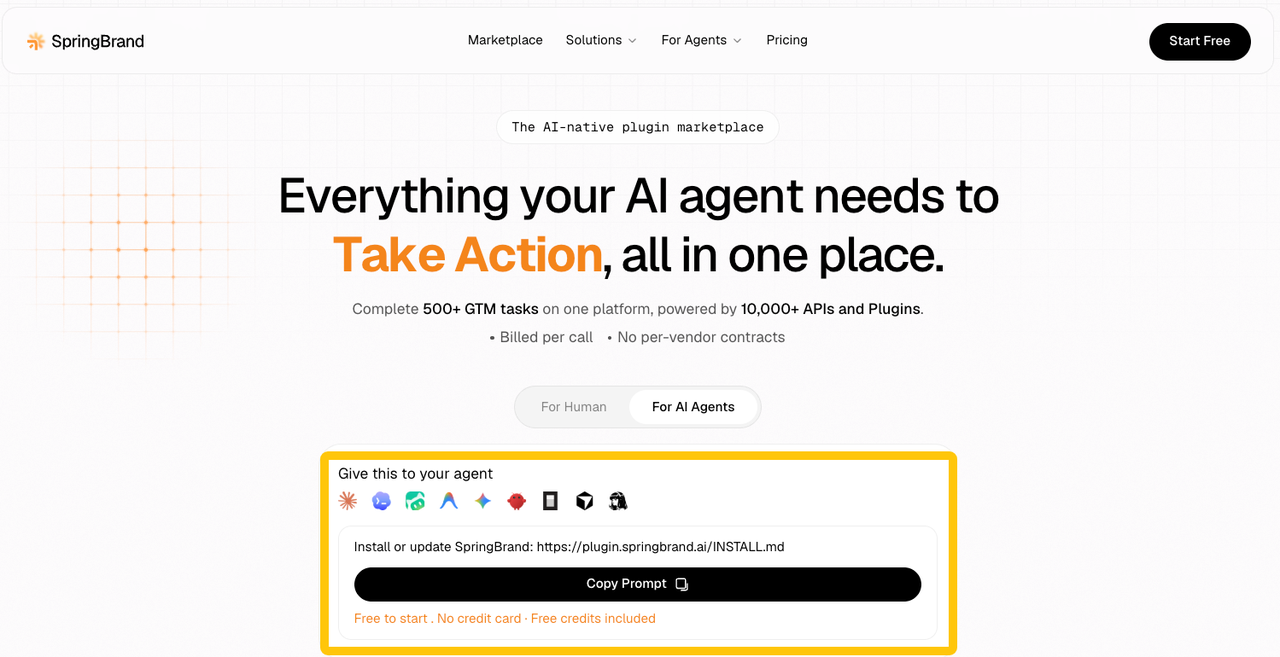
SpringBrand publishes this comparison and is not presented here as a general-purpose framework or managed builder. Its current site presents an AI-native plugin marketplace that gives existing agents access to GTM capabilities.
If your chosen route needs verified GTM capabilities, explore SpringBrand’s current plugin layer and confirm each tool’s inputs, authentication, outputs, and runtime limits.
Calculate the Cost of a Bounded Pilot
Price the same narrow workflow in both routes. A useful pilot has one input path, one output, a small exception set, and a named reviewer. It should be reversible without migrating a department.
Include Build Time, Hosting, Evaluation, and Ongoing Maintenance
Use three cost columns rather than one subscription figure:
- Initial work: design, implementation, integration, identity setup, test data, security review, and launch.
- Recurring operation: hosting, model and tool usage, platform seats, logs, evaluation runs, support, and routine maintenance.
- Change and exit: upgrades, retraining owners, replacing connectors, exporting records, rewriting platform-specific logic, and retiring the system.
Add named hours, not optimistic labels. “Maintenance included” should identify who performs it and which failures remain with the customer. “Open source” should identify who patches and deploys it.
Run ordinary cases and awkward ones. Expire a test credential, change a tool response, reject an output, and deploy a small logic update. The better route is the one the real owner can recover without improvising production access.
FAQ
Can agent definitions be migrated from a builder to a framework?
Usually not as a one-click conversion. A builder may export an agent between its own environments without producing framework-ready source code. Copilot Studio, for example, exports agents through Power Platform solutions. Preserve instructions, tool schemas, test cases, and business rules separately, then budget for runtime-specific rebuilding.
How do open-source licenses affect commercial deployment?
The license defines what you may do with the code and which notices or conditions follow it. It does not cover every dependency, model, hosted service, or trademark. LangGraph’s current repository uses the MIT License, but your full dependency tree may differ. Review each applicable license and current service terms; this is general information, not legal advice.
Can framework agents and builder agents share one evaluation dataset?
Yes, if the dataset describes task-level inputs and expected outcomes rather than platform-specific objects. Each route will need an adapter that converts the shared case into its native request and output. Keep sensitive production data out unless its approved handling rules permit reuse.
Can a managed builder install a private package or custom runtime dependency?
Sometimes, but support varies by product and hosting mode. Some AI agent platforms accept packaged code or custom agents, while configuration-first products restrict the runtime. Verify allowed languages, package sources, network access, build logs, version pinning, and rollback before selecting the platform.
Can a team keep the framework while replacing the managed hosting layer?
Often, if the framework is open and the application does not depend on proprietary runtime services. Migration still requires replacements for state, secrets, queues, tracing, and deployment. Prove portability by deploying the bounded pilot in a second environment before treating hosting as interchangeable.
Conclusion
The choice between managed builders and AI agent frameworks is a decision about retained responsibility. Frameworks give developers more freedom over logic and infrastructure. Builders can give cross-functional teams a more supported operating surface.
Choose the simplest route whose owner can test, change, observe, and recover the agent. If a hybrid is necessary, make the boundary explicit. The first demo matters far less than the team’s ability to operate the tenth version.