Marketing Automation Consulting: Scope and Deliverables
Marketing automation consulting should connect CRM data, lifecycle journeys, workflows, and ownership. Learn what useful delivery should include.
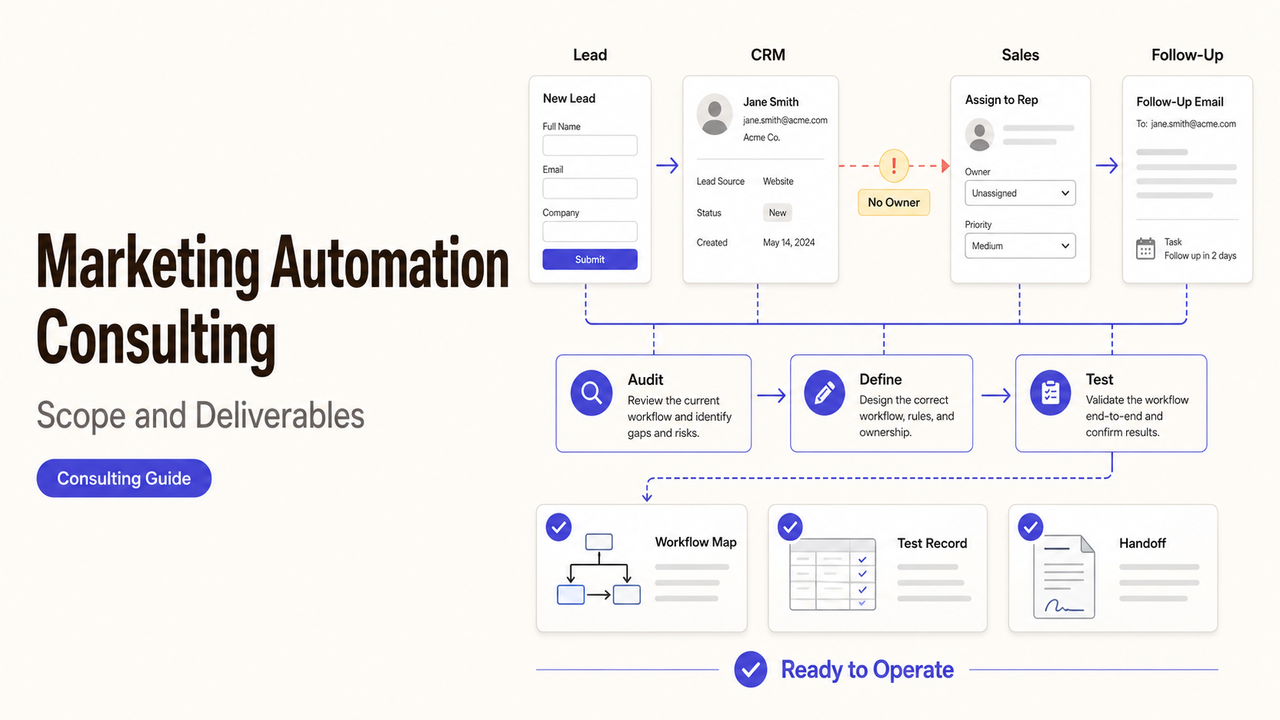
A demo request enters the CRM, receives a customer-onboarding email, and is assigned to a salesperson who left months ago. Every tool technically completed its task; the workflow definition was wrong, and nobody owned the exception. Marketing automation consulting is useful when a business needs to repair that operating system—not merely add another automation tool. I’m Alex; this guide will show you which audit records, workflow specifications, tests, and handoff materials should exist before the engagement closes.
When Consulting Is More Useful Than Another Tool
Another platform may help when the current system genuinely lacks a required capability. It will not resolve conflicting lead definitions, incomplete records, unclear ownership, or workflows that nobody has approved.
Consulting is usually more valuable when:
- Several tools hold different versions of the same contact
- Leads are assigned inconsistently
- Marketing and sales use different lifecycle stages
- Automations have no documented owner
- Employees cannot explain why a message or task was triggered
- Suppression and consent states do not move reliably between systems
- Old workflows remain active because nobody knows whether they are safe to remove
- Reporting counts activity without showing business progression
A marketing automation consultant should first identify where information enters, which system controls each field, what changes a lifecycle state, and who handles failures. Tool selection or configuration comes after those decisions.
This also separates consulting from campaign execution. An email agency may build and run campaigns. A consultant designs or repairs the data, workflow, governance, and measurement system those campaigns depend on.
Audit the Current Stack, Data, and Customer Journey
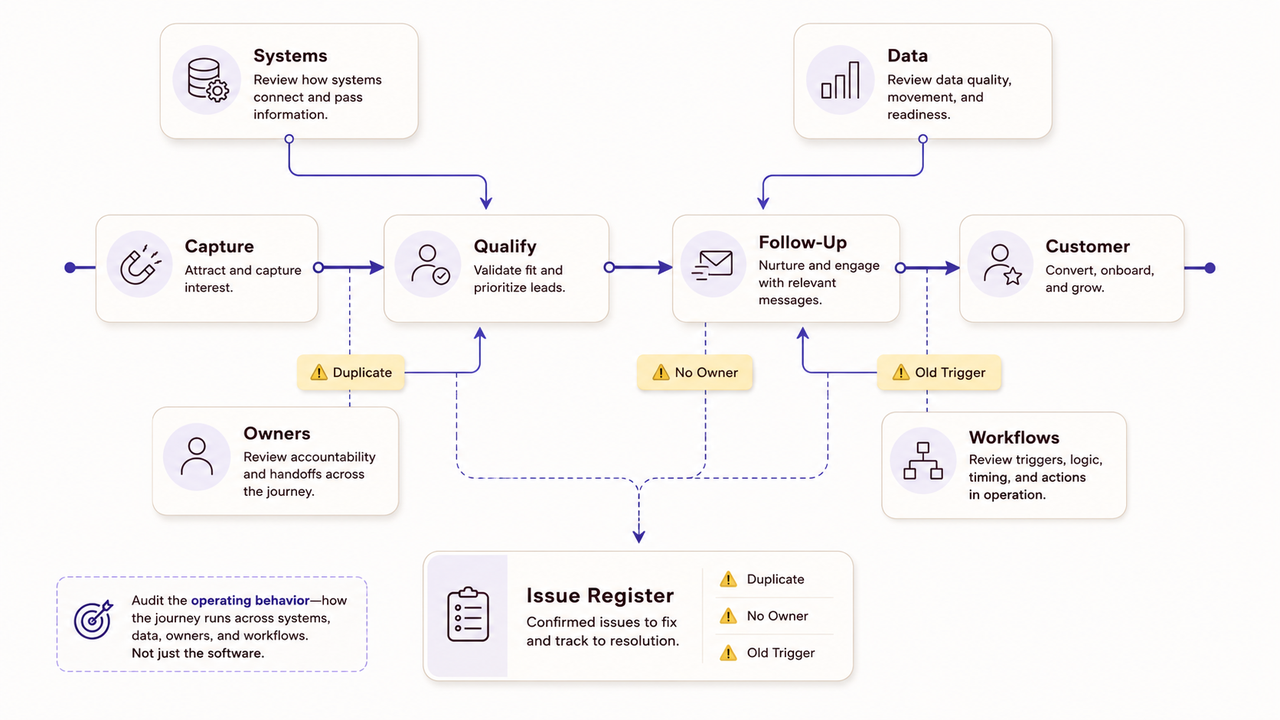
The audit should cover systems, data, people, and active workflows. A software inventory alone is not enough.
Start with a stack register:
| Item | What to record |
|---|---|
System | CRM, email platform, forms, analytics, advertising, support |
Business purpose | Why the system exists |
Data received | Contacts, accounts, events, consent, opportunities |
Data sent | Destination systems and fields |
Owner | Team responsible for configuration and accuracy |
Access | Users, service accounts, integrations, administrative roles |
Failure signal | How the team knows a transfer or workflow failed |
Retirement plan | What happens when the system is replaced |
The consultant should then trace several real customer journeys. Follow a contact from first capture through qualification, sales follow-up, purchase, onboarding, retention, and exit. Record which systems update the contact, which fields change, and where a manual handoff occurs.
Inspect data quality at the same time. Common problems include duplicate records, inconsistent country values, missing owners, obsolete lifecycle stages, untracked imports, and free-text fields that cannot support reliable routing.
The audit deliverable should not say only that the database is “messy.” It should identify the affected records or fields, explain the operational consequence, and recommend a controlled correction.
Design Lifecycle Workflows and Lead Rules
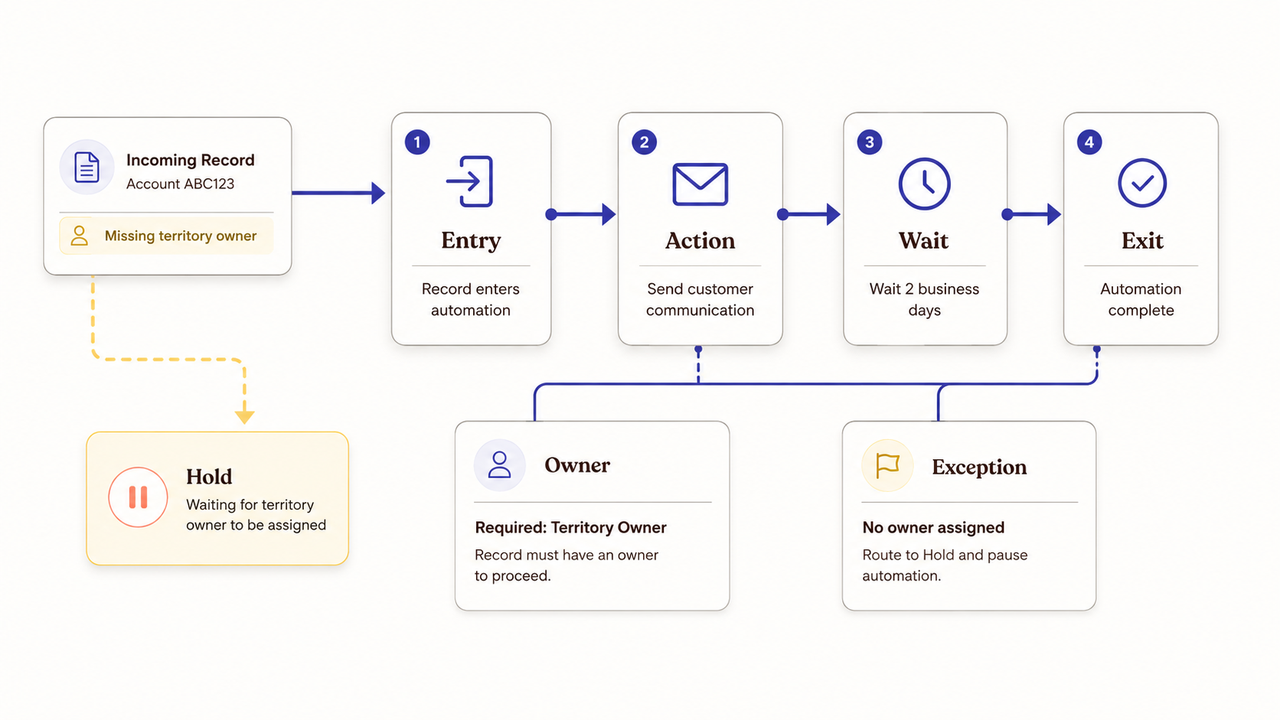
A lifecycle workflow needs an entry condition, actions, waiting rules, exit conditions, exclusions, ownership, and an exception path.
Use a specification like this:
| Workflow field | Required definition |
|---|---|
Business purpose | What movement the workflow supports |
Eligible records | Exact entry conditions |
Exclusions | Who must never enter |
Trigger | Event or field change that starts the workflow |
Actions | Messages, updates, tasks, or notifications |
Timing | Delays, deadlines, and business-hour rules |
Exit | Conversion, reply, disqualification, timeout, opt-out |
Owner | Team responsible for current operation |
Exception | What happens when data is missing or conflicting |
Evidence | Log, field, or test that proves expected behavior |
Lead rules require the same precision. Marketing and sales should agree on what creates a lead, what qualifies it, what causes rejection, and who owns the next action.
Google Analytics currently distinguishes events such as generate_lead, qualify_lead, disqualify_lead, working_lead, and closing outcomes in its recommended lead-generation events. A business does not have to adopt those exact names, but it should preserve the difference between receiving a record and deciding that the record merits sales attention.
Do not automate disputed definitions. If sales and marketing disagree about qualification, document both interpretations, test them against recent records, and assign an executive or revenue owner to approve the operating definition.
Define Integration, Governance, and Access Requirements
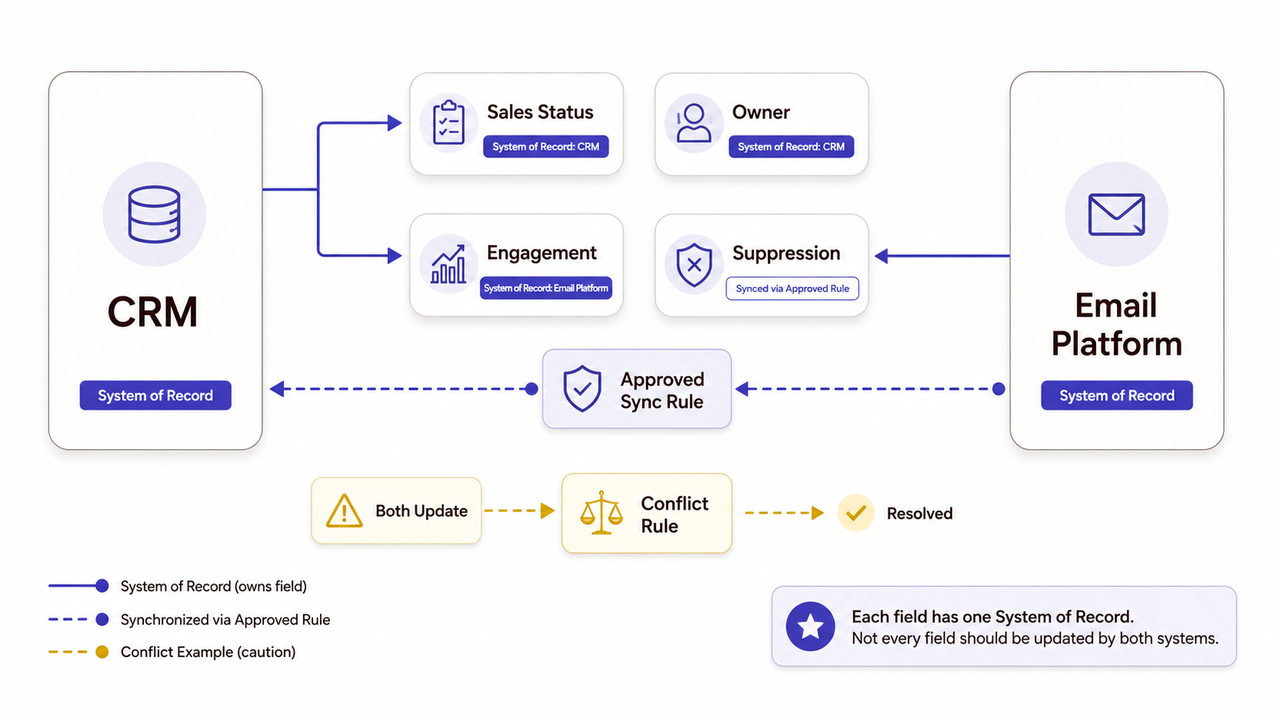
An integration specification should describe more than “connect the CRM and email platform.”
For every connection, record:
- Source and destination
- Authentication owner
- Objects and fields transferred
- Direction of transfer
- Update frequency
- Conflict rule
- Required versus optional fields
- Error handling
- Retry behavior
- Logs and alerts
- Data retention
- Deactivation process
Name a system of record for each critical field. The CRM might own sales status while the email platform owns campaign engagement. If both can overwrite the same field without a conflict rule, the workflow is not ready.
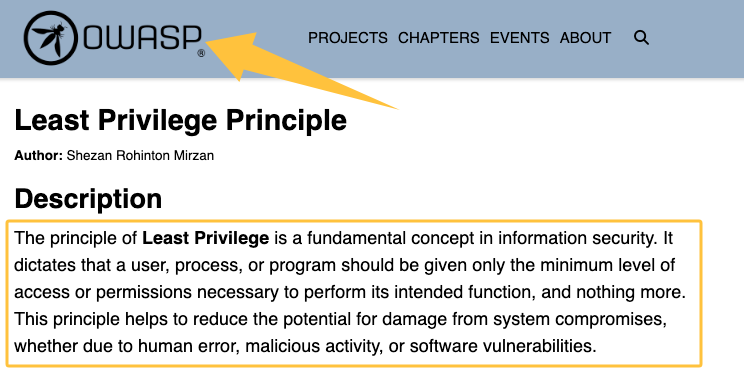
Apply minimum access. The OWASP least-privilege principle recommends giving users and processes only the permissions needed for their intended functions. A consultant who only maps fields may not need customer exports, billing access, or permanent administrator rights.
Privacy requirements should enter during design rather than after implementation. The UK ICO’s current data-protection-by-design guidance emphasizes considering privacy from the start and throughout the system lifecycle.
The consultant should document where personal data moves, which teams can access it, how suppression or deletion requests propagate, and which uncertainties require review. Applicable legal and regulatory conclusions belong to the client and qualified privacy or legal professionals.
Security governance should reflect business risk. NIST provides a Cybersecurity Framework 2.0 guide for small businesses organized around governance, identification, protection, detection, response, and recovery. Those functions offer a useful way to decide which access, monitoring, incident, and recovery questions belong in the project.
Test, Document, and Hand Off the Implementation
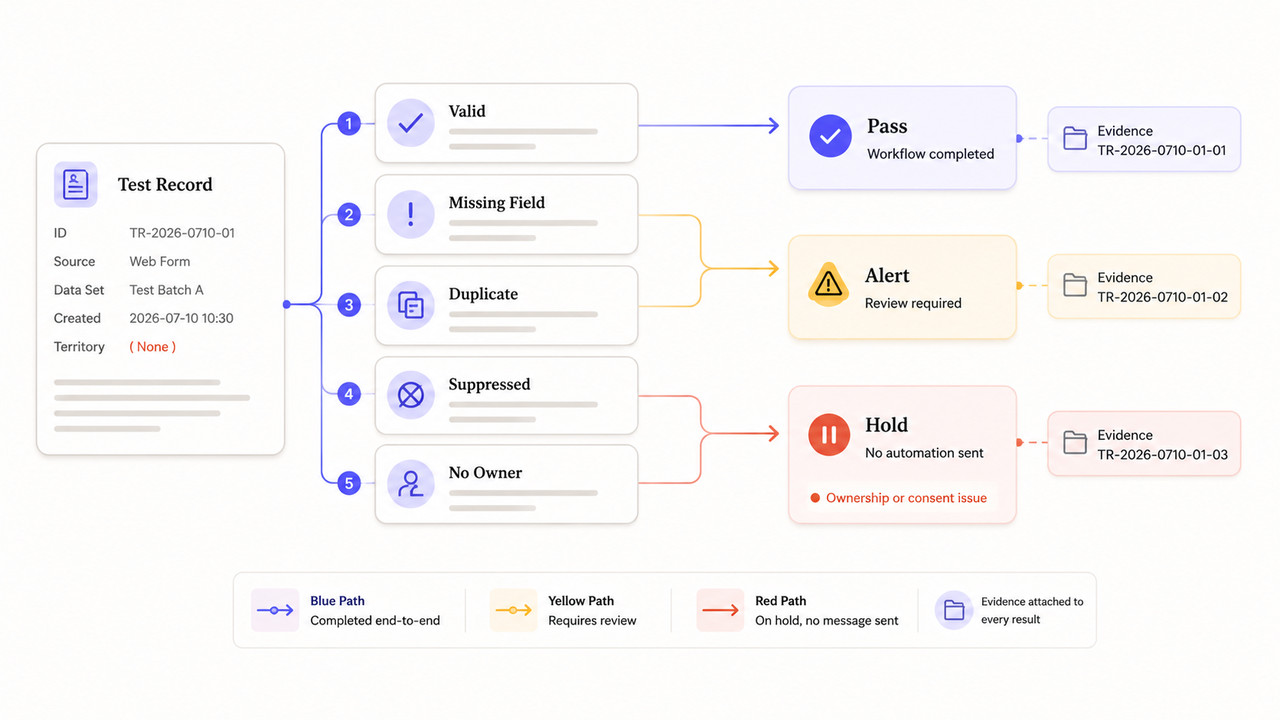
A workflow is not accepted because its configuration screen looks correct. Test the state changes and business consequences.
Build test cases for:
- A valid record entering normally
- A record missing a required field
- A duplicate contact or account
- An opted-out or suppressed contact
- A territory with no active owner
- An integration timeout
- A contact that qualifies during a delay
- A customer who should exit prospect nurture
- A staff member whose access has been removed
Each test should state the input, expected actions, prohibited actions, resulting fields, alerts, and evidence captured. Test in a safe environment or with controlled records where the platform permits it.
For higher-risk custom applications and integrations, the OWASP Application Security Verification Standard can help technical teams define verification requirements. The marketing consultant should not present a workflow test as a substitute for formal security review.
The final documentation package should include:
- Current-state architecture
- Approved future-state design
- Data dictionary
- Field mappings
- Workflow specifications
- Test cases and results
- Access register
- Error and monitoring procedures
- Change log
- Known limitations
- Maintenance calendar
- Deactivation and rollback instructions
Handoff requires a named operator. Walk that person through how to pause a workflow, inspect a failed record, change an owner, test an update, and escalate an integration problem.
Do not close the engagement while the only working knowledge remains in the consultant’s account or meeting recordings.
Compare Consultants, Proposals, and Deliverables
Compare proposals against the operating problem, not the number of workflows offered.
| Evaluation area | What to verify |
|---|---|
Discovery | Interviews, stack review, journey tracing, data sampling |
Workflow design | Entry, exit, exclusions, owner, exception |
Integration scope | Named systems, objects, fields, direction, errors |
Governance | Approval rights, access, privacy and security reviews |
Implementation | Who configures each platform |
Testing | Cases, expected results, evidence and defect handling |
Documentation | Exact artifacts delivered |
Training | Operators, administrators and business owners covered |
Handoff | Access removal, open issues, maintenance owner |
Boundaries | No unsupported integrations or outcome guarantees |
Clarify whether the consultant only recommends changes, configures systems, manages developers, or supports the launch. Those are different scopes.
Ask for a sample workflow specification and redacted handoff document. A polished strategy presentation proves the provider can explain an idea; it does not prove another operator can maintain the implementation.
Define change control before work starts. New tools, additional journeys, historical data cleanup, custom development, and regulatory review should not quietly enter the original scope.
FAQ
Can consulting start before the company selects a CRM?
Yes. Process and data discovery can improve the selection.
Define required lifecycle stages, objects, fields, user roles, integrations, reports, approval rules, and maintenance capacity first. The consultant can then compare products against documented requirements instead of reshaping the business around whichever demonstration looks most impressive.
Avoid detailed implementation work until the target platform and migration boundaries are approved.
What if teams use different definitions of a qualified lead?
Keep the workflow unapproved until the conflict is resolved. Ask each team to state its definition, required fields, evidence, exclusions, and next action. Test both definitions against a recent sample.
A revenue owner should approve the operational definition and review schedule. The consultant can structure the decision, but should not silently choose which department is correct.
Who maintains automations after key staff members leave?
Assign a role, not only a person. The maintenance owner needs platform access, documentation, alert routing, test records, and authority to pause a workflow.
Keep at least one backup owner for critical automations. When staff leave, remove their access, transfer open issues, verify service accounts, and test the escalation path before treating the handoff as complete.
Can old workflows be archived instead of completely rebuilt?
Yes, when their purpose, dependencies, data effects, and replacement status are understood. Export or document the configuration, record the last active date, preserve relevant approval and test history, and disable triggers carefully.
Do not archive a workflow merely because nobody recognizes its name. Trace current dependencies first so that retirement does not interrupt routing, suppression, reporting, or customer communication.
When should security teams join a marketing automation project?
Bring them in before approving integrations that move sensitive data, create service accounts, expose APIs, change identity controls, or connect high-impact systems.
Security review is also appropriate when the project handles regulated information, custom code, extensive customer exports, or external administrative access. Early review allows requirements to shape the design instead of delaying an otherwise finished implementation.
Conclusion
Marketing automation consulting is valuable when it leaves the business with more than configured software. The accepted delivery should include an audited stack, approved lifecycle rules, explicit field ownership, controlled access, tested workflows, usable documentation, and a maintenance owner.
Do not close the project until an internal operator can explain why each critical automation starts, how it stops, what happens when it fails, and which record proves the result.