Types of AI Agents: A Guide for Small Teams
Types of AI agents differ in how they use context, pursue goals, weigh trade-offs, learn from feedback, and coordinate work.
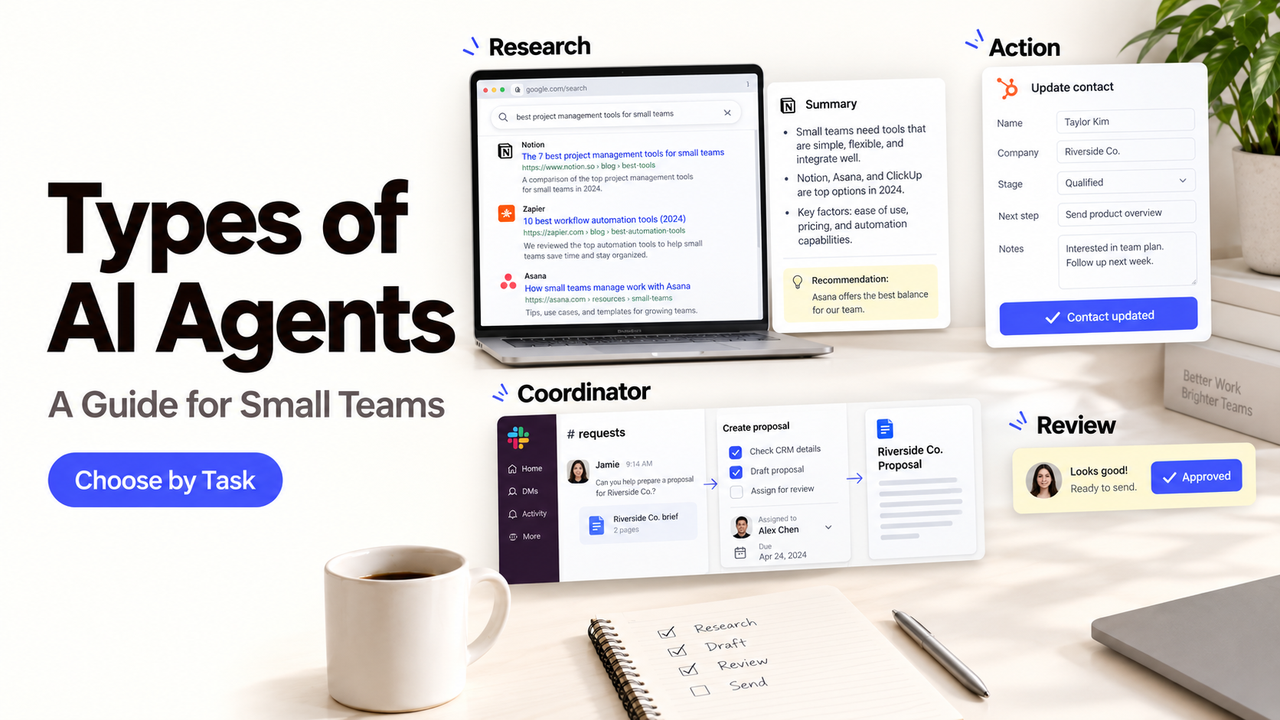
Most teams do not need the “highest” type of AI agent. They need the simplest pattern that can handle the task’s missing information. Lead routing, a support case, and open-ended research are different jobs.
This guide explains five useful types of AI agents in business terms. It also separates agent type from two labels that often muddy the choice: tool-using and multi-agent.
Why Agent Types Matter in Business Workflows
An agent type describes how the system chooses its next action. Does it respond to the current condition, remember what happened earlier, plan toward a goal, compare trade-offs, or change through feedback?
That question affects the surrounding work. Reactive routing needs a clear rule table. Goal-based research needs a stopping condition. Learning needs carefully selected feedback.
The categories are useful working models; no universal product standard enforces them. IBM’s current overview of AI agent types uses five main groups: simple reflex, model-based reflex, goal-based, utility-based, and learning agents. Other sources may combine, rename, or subdivide them.
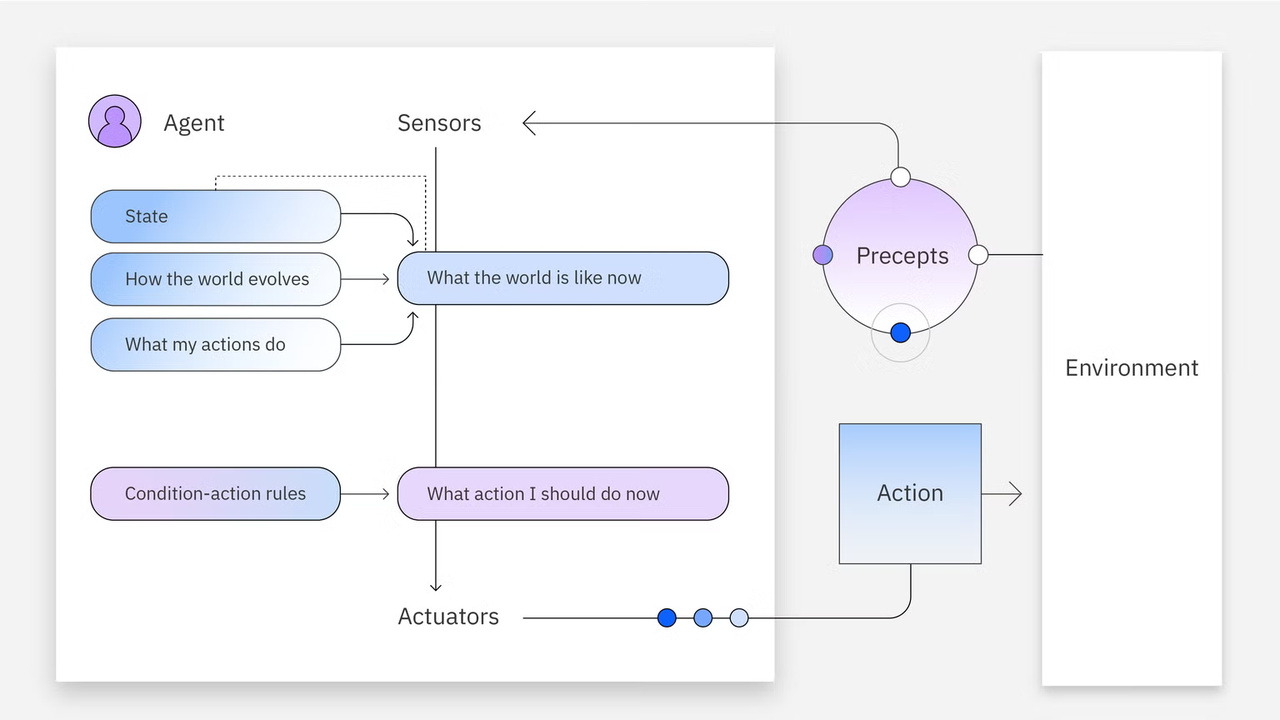
For this guide, “reactive” covers the simple reflex pattern. Focus on the decision method. One deployed system may combine several patterns.
Five Types of AI Agents
These five patterns answer different questions rather than ranking technical maturity.
Reactive Agents for Predictable Conditions
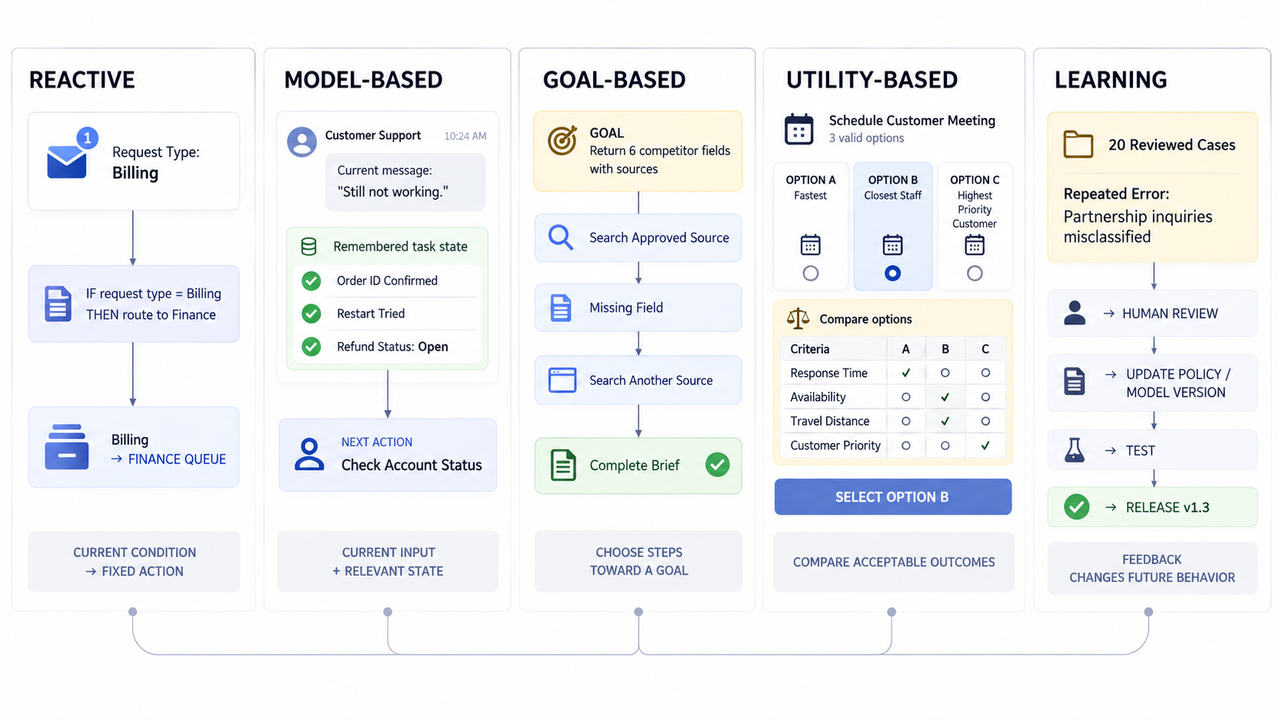
Reactive AI agents map a current condition to an action. They do not need a stored picture of what happened before.
An inbox agent might send a known billing code to the billing queue. The same input should produce the same route.
It becomes fragile when context changes the meaning. “Cancel” in a new request and “do not cancel” in a follow-up cannot be handled safely by spotting one word.
Model-Based Agents for Contextual Decisions
A model-based agent maintains an internal picture of the current situation. Its action depends on new input and relevant state from earlier steps.
A support agent might remember that a customer confirmed an order number and tried one fix. It can continue without asking for the same information.
The internal model must stay accurate. If the order was refunded in another system but the agent’s state still says “open,” more memory produces a worse answer. Decide which system supplies the current status.
Goal-Based Agents for Multi-Step Tasks
A goal-based agent selects actions that move it toward a defined result. It may plan several steps instead of applying one condition-action rule.
A research agent could aim to produce a cited competitor brief. It may try another approved source when a required field is missing.
The goal needs a finish line. “Research this company” invites unnecessary searching. “Return these six fields with source links, or mark a field unavailable” gives the agent a result it can recognize.
Utility-Based Agents for Trade-Offs
A utility-based agent is useful when several outcomes satisfy the goal, but some are more desirable than others. It compares options against an explicit scoring function or preference model.
A scheduling agent might weigh response time, staff availability, travel distance, and customer priority. Choosing among acceptable slots requires trade-offs.
The difficult work lies in the weights. If customer priority quietly outweighs every other factor, the agent may produce a technically valid schedule that the team considers unfair or impractical.
Learning Agents for Feedback-Driven Adaptation
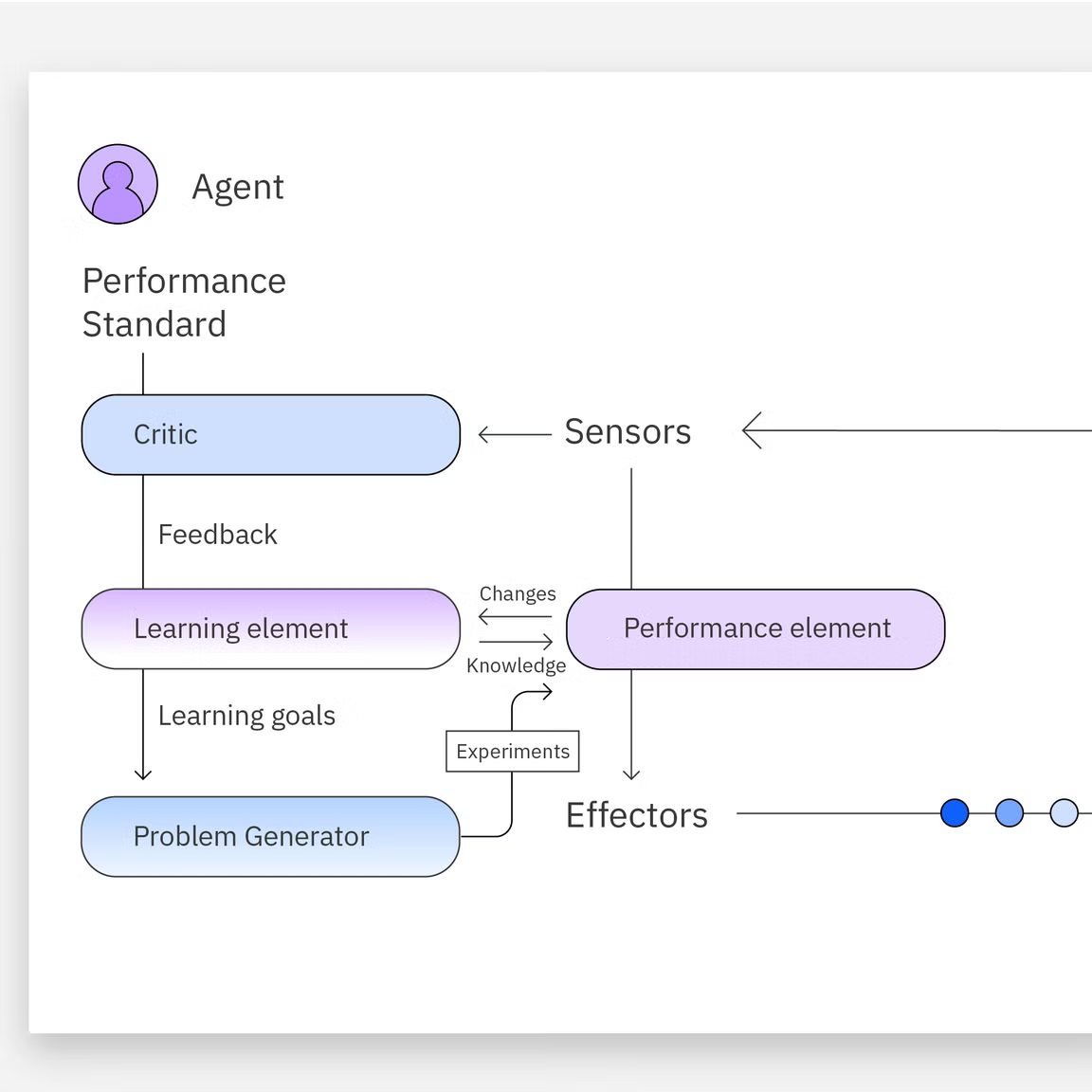
A learning agent changes its behavior using experience or feedback. It may improve a classifier or revise a decision policy.
That does not mean every correction should instantly retrain a live agent. A small team may collect reviewed outcomes, inspect recurring mistakes, and release an updated version on a schedule. This slower loop makes a bad label easier to catch before it spreads.
Learning can overlap with other patterns. An agent may pursue a goal while learning which action works better. The label describes how its behavior changes.
How Tool-Using and Multi-Agent Systems Fit the Taxonomy
Tool use and agent count answer different questions. Treating them as extra rungs confuses the taxonomy.
Tools Expand Capability Without Defining the Agent Type
A tool lets an agent search, calculate, read a database, or request an external action. It changes what the agent can do, not necessarily how it chooses.
A reactive agent can call a routing function. A goal-based agent can call search repeatedly while pursuing a brief. Both are tool-using agents, but their decision patterns remain different.
Describe tool access separately: the allowed action, reachable data, and whether the result is a suggestion or system change.
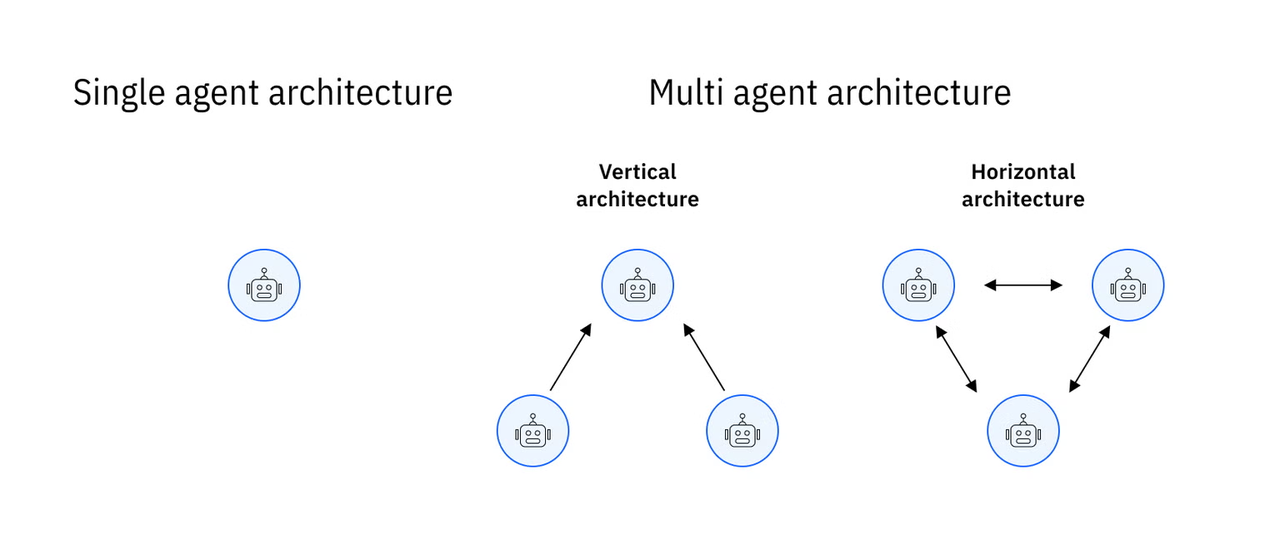
Multi-Agent Systems Describe Coordination Between Agents
A multi-agent system assigns work to more than one agent. One might gather sources, another check citations, and a third assemble the brief. Each participant can follow a different decision pattern.
More agents do not guarantee better reasoning. Use several when the jobs need distinct instructions, tools, or evaluation methods. Otherwise, one agent with separate steps is easier to understand.
Choose an Agent Type for the Task
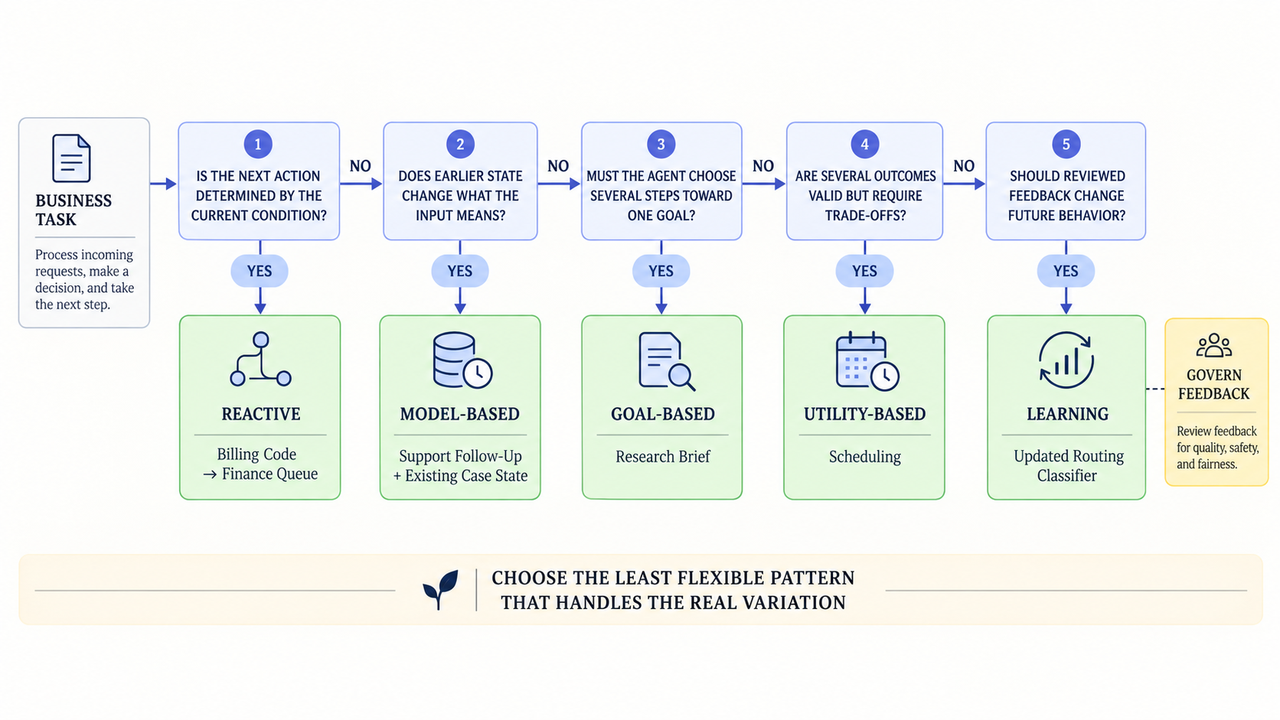
Start with the task’s uncertainty and ignore the most impressive product label. The following table is our editorial task-fit aid; no standards body created it.
What the task requires | Sensible starting pattern | Sign that the pattern is too simple |
Apply a stable condition and action | Reactive | Earlier events change what the input means |
Use current input plus remembered state | Model-based | The agent must plan several possible steps |
Find a route to one clear outcome | Goal-based | Several acceptable outcomes require trade-offs |
Rank outcomes against stated preferences | Utility-based | The preferences should change through reviewed feedback |
Improve behavior from selected feedback | Learning | The team cannot explain or govern what updates behavior |
Match Decision Flexibility to Environmental Variability
Look at what changes from case to case. If only a status field changes, a reactive rule may be enough. If missing information changes the route, the agent may need state or planning.
A model-based agent can use an updated record without changing its policy. Learning is relevant when feedback should alter future choices.
Match Human Review to the Risk of Each Action
Agent type does not set the review level. A simple rule that sends money can deserve more scrutiny than a goal-based agent drafting an internal summary.
Place review before the consequence. A person can inspect a draft after generation. An update to a CRM, ad account, or customer message may need approval before the tool runs.
Start With the Simplest Agent That Can Do the Work
For the first version, name the input, allowed decision, and finished result. Select the least flexible pattern that handles ordinary variation.
SpringBrand publishes this guide. If an existing agent needs a specific GTM action, compare the available SpringBrand APIs by input and result before adding another agent.
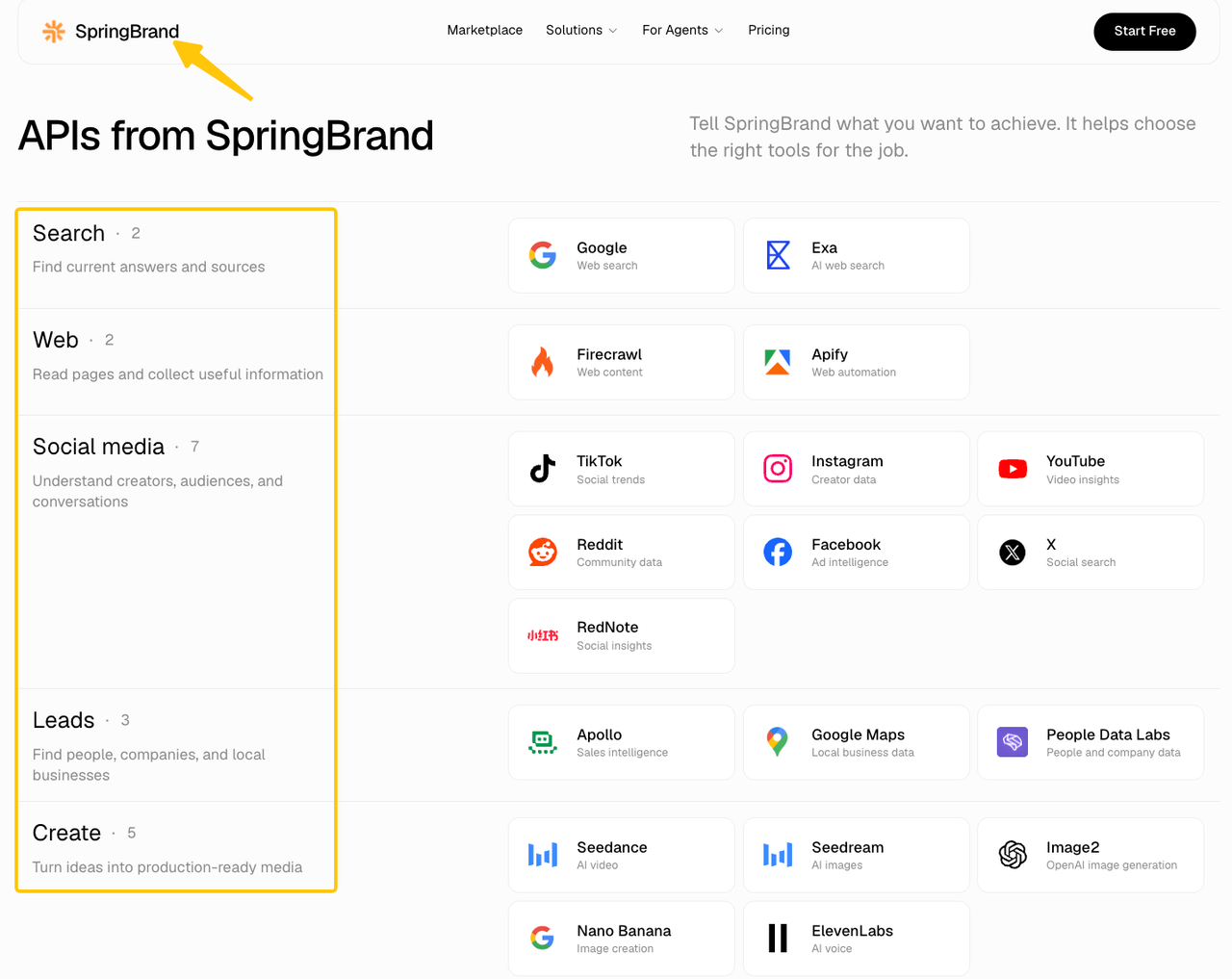
An API expands capability. The caller’s decision pattern determines whether it behaves reactively, pursues a goal, or learns. SpringBrand’s current catalog does not prove support for every type or hosting model described here.
The product examples below were checked against official documentation on September 15, 2026. Each shows one implementation choice; the same agent type can be built differently.
FAQ
Can one deployed agent switch between reactive and goal-based behavior?
Yes. One deployed agent can react to a known condition and plan when a case requires it. IBM notes that learning agents can use goal- or utility-based reasoning. Document which behavior applies in each state; “hybrid” alone explains little.
Can a monitoring agent run on a schedule without continuous model use?
Yes. An external scheduler can invoke the agent only when a check is due. Google documents using Cloud Scheduler to trigger a Cloud Run service. Check idle infrastructure costs and failed-run retries separately.
How should teams version an agent when its operating pattern changes?
Create a new version and retest the behaviors affected by the change. Microsoft Foundry’s agent development lifecycle treats saved versions as immutable and recommends evaluations after meaningful changes. Record the instructions, model, tools, decision pattern, and test set that belong to each release.
Which agent types can run in a private or self-hosted environment?
Any of the five patterns can be implemented privately in principle; hosting is a separate architecture choice. Microsoft Agent Framework’s Ollama integration supports local models and locally invoked tools. Verify every dependency, because a local model can still call an external API or remote data store.
Can several single-purpose agents share one approval queue?
Yes, if the workflow host collects their requests and preserves the requesting agent’s identity. The orchestration layer owns the queue. Microsoft Agent Framework documents human review in multi-agent orchestrations, where approval-required tools can pause work before execution. Test simultaneous requests and rejected actions before using one queue operationally.
Conclusion
The useful types of AI agents describe decision patterns rather than badges of sophistication. Choose reactive behavior for stable rules, add state when context matters, and add planning or trade-off logic only when the task requires it.
Learning and multi-agent coordination introduce separate questions. Do not add either until the team can explain what should change, who supplies the signal, and why one simpler agent no longer fits.