Competitor Analysis for SEO: A 6-Step Guide With Sources
Written by
SpringBrand
Editorial team

Reviewed by
Springbrand Audit Team
Editorial review team
Springbrand Audit Team supports editorial quality through source checking, clarity, and consistency across the blog.
Updated
Published
A six-step method for competitor analysis for SEO: find who ranks for your keywords, compare what they win, and decide what to fix first.
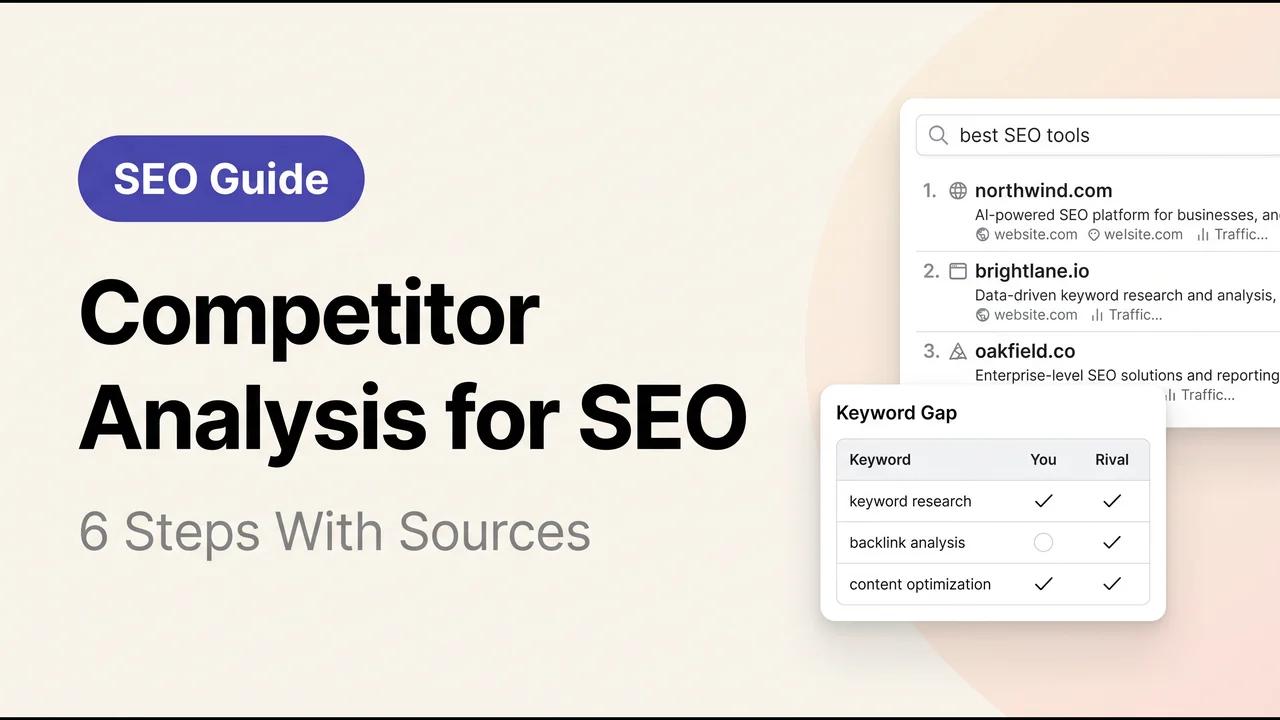
Competitor analysis for SEO means finding the sites that rank for the searches you want, then comparing their keywords, top pages and backlinks with yours to see what to fix first. It is worth it if you have a keyword list and a page you can change. Skip it if you have no target searches yet; pick those first.
Your SEO competitors are often not your business rivals. The six steps below work with a spreadsheet, a suite such as Semrush or Ahrefs, or an agent. For the wider picture of automating this work, see our guide to SEO automation.
Key points:
- Start from the live search results for your keywords, not from your list of business rivals.
- Compare four things: who ranks, what they rank for, which pages earn their traffic, and who links to them.
- Treat every third-party traffic number as an estimate and write down its source and date.
- End with one action per competitor, not a slide deck.
What Does an SEO Competitor Review Actually Cover?
A good review answers one question: why does that page outrank mine, and what can I change? On Reddit, one marketer asked the right first question bluntly:
"Are you doing competitor analysis for the sake of it? It shouldn't be like that."
That comment comes from r/marketing. Before you open any tool, pick one goal: plan a new site, recover a page that lost rankings, or prepare a client proposal. Competitor analysis for SEO then has a scope, and you know when you are done.
The scope of competitor analysis for SEO is narrower than a business competitor review. You are not comparing pricing or sales teams. You are comparing search results, keywords, page content and links.
How Do I Find My SEO Competitors?
Competitor analysis for SEO starts with the results page: search your target keywords and record which domains appear in the top 10 most often. Those domains are your SEO competitors, even if they sell something else.
The result often surprises people. When SpringBrand checked Google's top 10 for 33 of its own target keywords on November 12, 2026, the most frequent domains were reddit.com (16 of 33), youtube.com (14 of 33) and semrush.com (7 of 33), not the products it competes with for customers. That check is published on our SEO competitor analysis page.
Ahrefs' guide suggests a related filter: if your site has lower authority, you "may want to rule out" large, high-authority brands and compare yourself with sites you can realistically beat (Ahrefs, checked November 18, 2026). Forums and video sites also deserve their own group, because you answer them with a different format, not a better product page.
How Do I Do an SEO Competitor Analysis Step by Step?
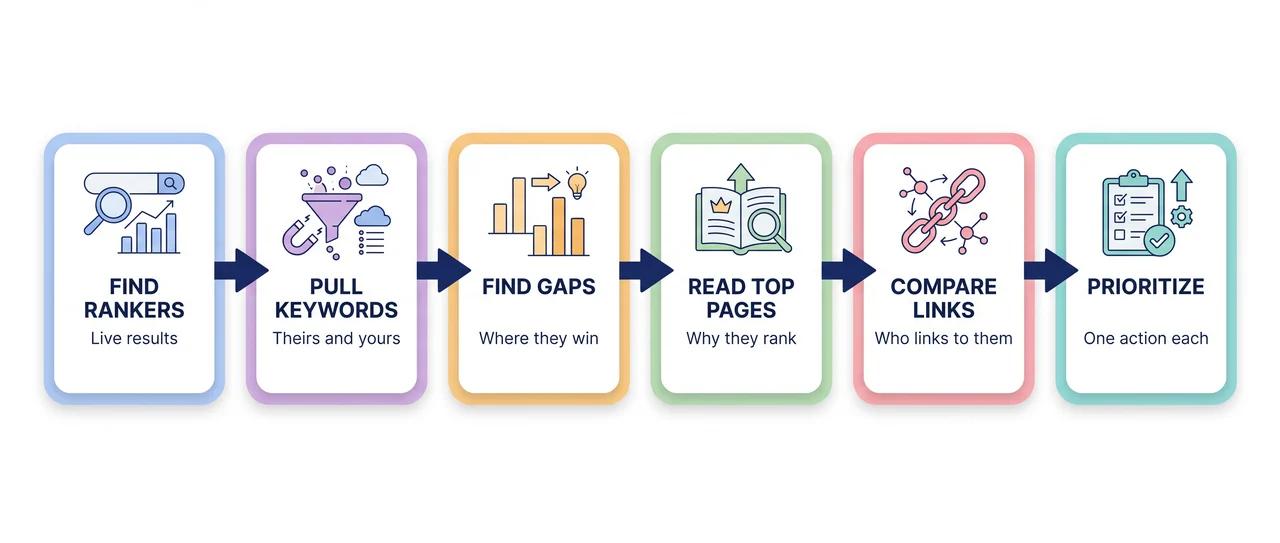
One Reddit user asked for exactly this: "Be great to see some sort of checklist that people follow or some process that would cover off key areas when review competitors" (r/PPC). Here is the checklist we use for competitor analysis for SEO:
- Find the domains that rank in the top 10 for your target keywords.
- Pull each competitor's ranking keywords with position and search volume.
- List the keywords they rank for and you don't.
- Read their top pages and note what they cover that yours doesn't.
- Compare referring domains and find sites that link to them but not to you.
- Rank the gaps by volume, difficulty and fit, and turn the top few into page briefs.
Steps 2 and 3: Keywords and gaps
Keywords alone tell you little. As one SEO wrote on r/SEO, "You need to know what they rank for that you don't." Keep only keywords where a competitor sits in the top 10 and you do not appear at all, then remove anything harder than your site can realistically rank for.
In Ahrefs' Content Gap report, the "Main positions only" toggle removes rankings inside SERP features so you compare normal organic results (Ahrefs guide). The same idea applies in any tool: compare like with like.
Step 4: Top pages
The pages that earn most of a competitor's traffic show you which format wins. Read the headings, the questions each page answers, and how recently it was updated. One SEO on r/SEO described the manual version: "I scan the competitor's whole site first, map the structure + content clusters, and compare it with my website to find gaps."
Step 5: Backlinks
List the referring domains that link to two or more competitors but not to you. Those are the realistic outreach targets. A single high-authority link to one rival is usually not something you can copy.
Step 6: Prioritize
Score each gap on three things: search volume, how hard the top 10 looks, and how well it fits your product. The output of competitor analysis for SEO should be one action per competitor, such as "publish a comparison page" or "update the pricing guide," and stop there.
Which Tools Do I Need, and What Do They Cost?
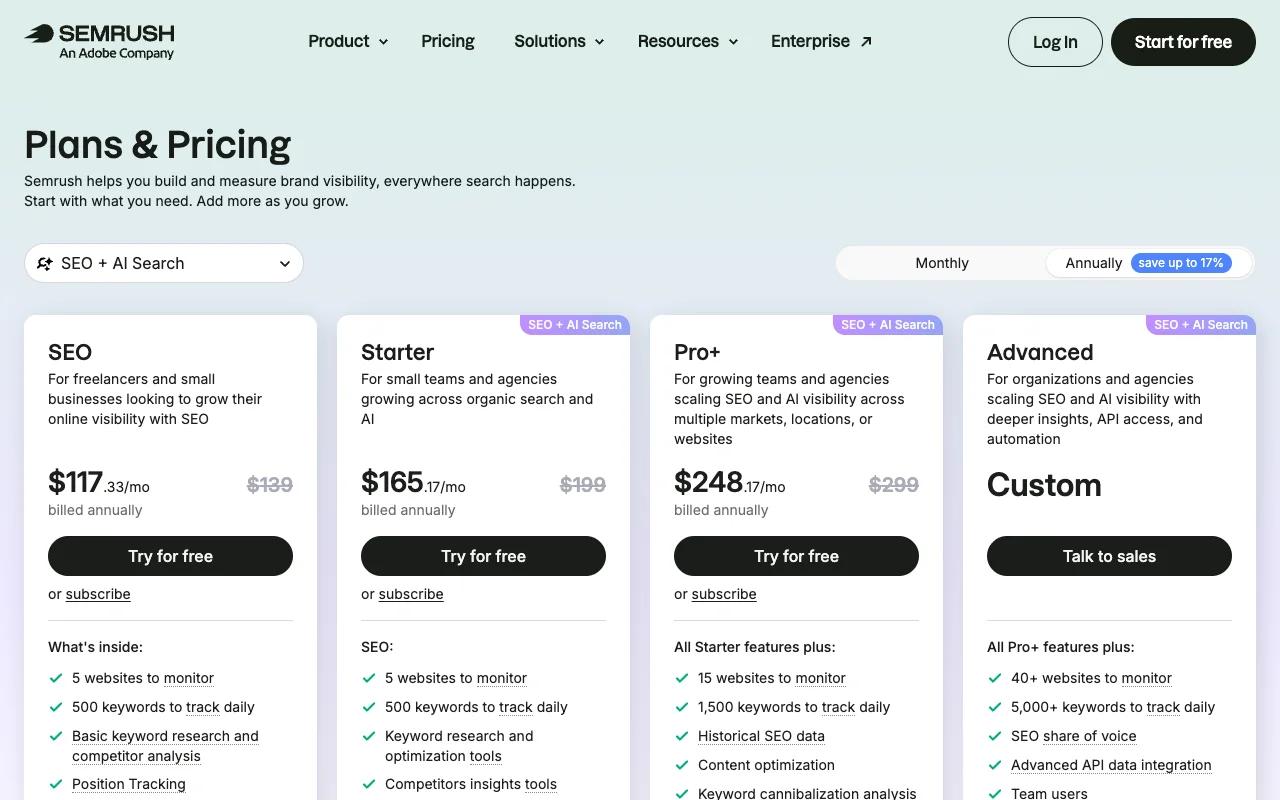
You can do competitor analysis for SEO by hand, but data on rivals' keywords and links comes from third-party indexes. Prices below were read on the vendors' own pages on November 18, 2026.
| Need | Option | Access and price (checked Nov 18, 2026) |
|---|---|---|
Your own search data | Google Search Console | No cost; the Performance report's default view covers the past three months (Google) |
Competitor keywords and links | Semrush | $0 plan: 1 demo project, 10 reports per day; SEO plan $139/mo (Semrush) |
Competitor keywords and links | Ahrefs | Starter $29/mo; Lite $129/mo (Ahrefs) |
Traffic size | Similarweb website checker | 3 searches per day without an account (Similarweb) |
Per-run analysis | SpringBrand | 300 credits at signup, then 100 a month; a task uses about 15–40 credits (SpringBrand pricing, checked Nov 18, 2026) |
Third-party traffic figures are modeled. Similarweb's own page cites a SparkToro study that says its "strength lies with sites that receive between 5K-100K GA users/month." Outside that range, compare scale, not exact visits.
For a wider comparison of suites, see our competitor analysis tools guide.
How Do I Turn the Findings Into an Action List?
To close out competitor analysis for SEO, put one row per competitor in a table: competitor, shared keywords, keywords they rank for and you don't, their top pages, backlink overlap, and next action. Every figure needs its source and the date you pulled it.
Disclosure: SpringBrand publishes this guide. Our SEO competitor analysis agent fills that table from Semrush, Ahrefs and DataForSEO data, reads competitors' top pages with Firecrawl and Exa, and labels traffic numbers as estimates. It does not run on a schedule; you run it again when you want an update. Run it in SpringBrand if you check competitors a few times a quarter and would rather not keep a monthly suite plan.
Does AI Search Change the Analysis?
It adds one more place to look when you do competitor analysis for SEO. People now ask which pages get cited in AI answers, not only which rank. One r/SEO user wanted to "enter a competitor's website/domain and see" which prompts they appear for in ChatGPT, Perplexity and Gemini (r/SEO). Add a short check of AI answers for your top keywords to step 1, and note which competitor pages are cited.
FAQ
What is the first step in competitor analysis for SEO?
The first step in competitor analysis for SEO is to search your target keywords and list the domains that appear in the top 10 most often. Those are your search competitors, whether or not you meet them in sales.
How is an SEO competitor review different from a business competitor review?
It compares search results, keywords, pages and links rather than pricing, features or sales. Your business rivals and your search rivals often overlap only partly.
Do I need a paid tool?
Not to start. For a first pass at competitor analysis for SEO, Search Console, manual searches, Semrush's $0 plan and Similarweb's daily checks cover a first pass. A paid index helps when you need full keyword and backlink lists for several competitors.
How often should I repeat it?
Repeat it when you plan new content, when a page loses rankings, or each quarter for your most important keyword groups. Search results change, so date every pull.
How many competitors should I include?
Three to five is enough for most sites. Pick the domains that appear most often in your top 10 and that you could realistically outrank.
What should I do first after the analysis?
Pick the single gap with the best mix of volume, difficulty and fit, and write a page brief for it. One shipped page teaches you more than a longer report.
Conclusion
Good competitor analysis for SEO starts from the search results, compares keywords, pages and links, and finishes with one action per competitor. If you would rather not run the pulls by hand, try the SEO competitor analysis agent in SpringBrand.
Explore SpringBrand
Turn ideas into working workflows
Connect agents, APIs and tools in one workspace. Start with a task you want to get done.
Get started free
One account. 10,000+ APIs & capabilities
Give your agent APIs and plugins without separate keys or integrations for every provider.
Explore APIs
No tool expertise needed
Describe your GTM task. SpringBrand chooses the right APIs and plugins for your agent automatically.
Find tools for your task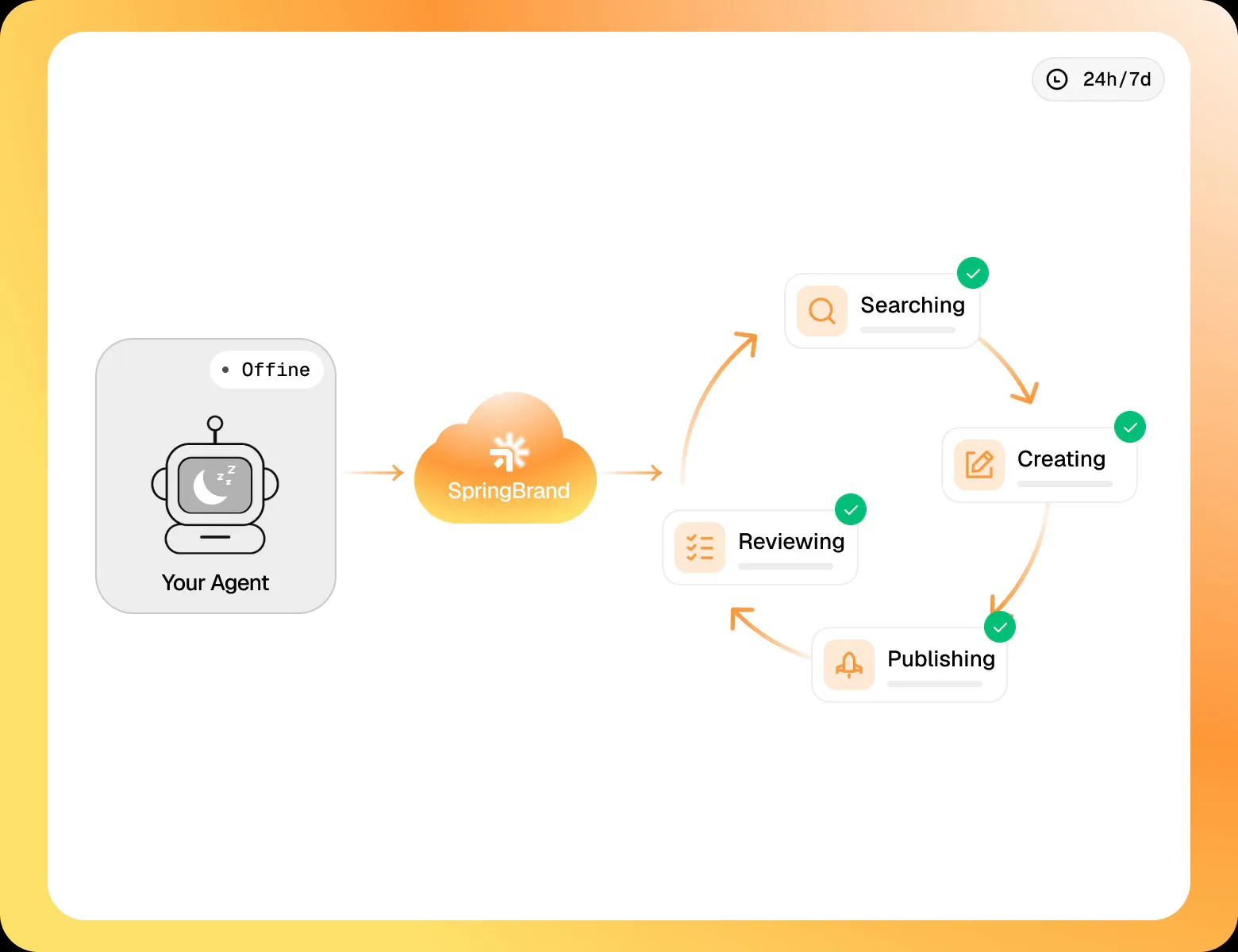
Run tasks 24/7
Connect your agent to SpringBrand to keep tasks running automatically, day and night.
Connect your agent