Content Gap Analysis: A Repeatable Team Workflow
Use content gap analysis to find missing, weak, or misaligned coverage and turn the findings into a prioritized, reviewable team workflow.
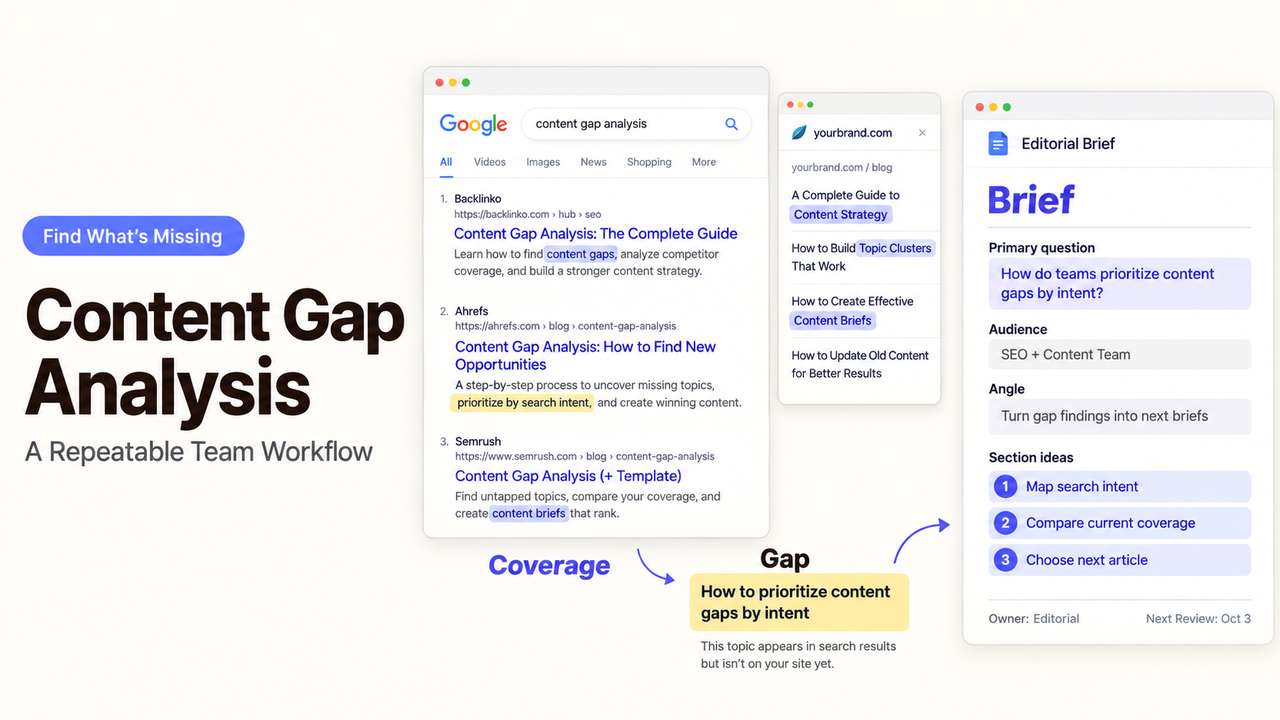
A competitor may rank for 2,000 queries your site does not. That does not leave you with 2,000 useful assignments. Some terms describe products you do not sell, audiences you cannot help, or questions your existing pages already answer in different language.
A practical content gap analysis turns those raw differences into editorial decisions. It combines search evidence, current coverage, audience needs, and business fit. The result is a reviewed queue of pages to create, update, merge, or skip.
This guide shows how a team can repeat that process without surrendering important decisions to a tool.
What Should a Content Gap Analysis Answer?
A content gap analysis should answer where your coverage is missing, weak, outdated, or mismatched—and which of those findings deserve action. It should also explain why a proposed page belongs on your site.
Start with one product category, customer journey, or page cluster. Define the audience, market, language, time period, and business outcome before collecting keywords.
For every candidate gap, require five answers:
- What need or decision does the audience have?
- What evidence shows that the need exists?
- Does an existing page already address it?
- Can the team add something accurate and useful?
- What action should follow: create, update, merge, or skip?
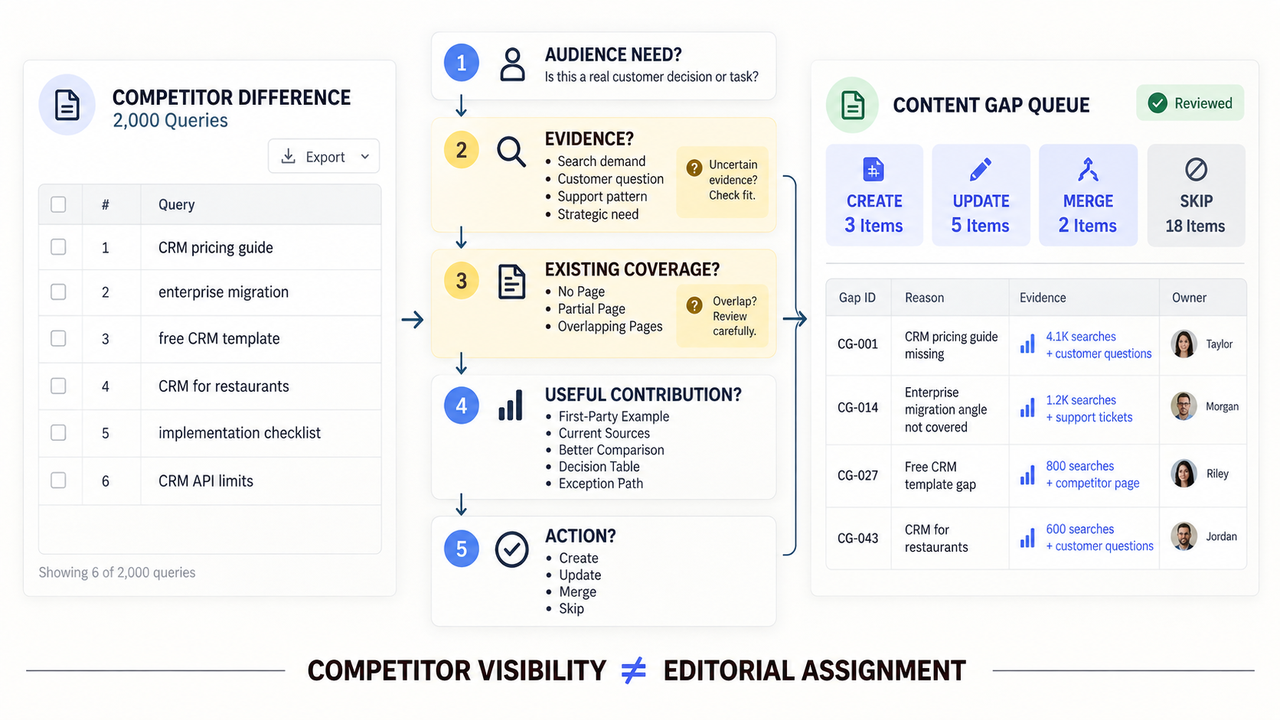
This stops a competitor keyword gap analysis from becoming a copy list. Competitor visibility does not prove that a topic fits your customers or authority.
Gather the Inputs Before Comparing Pages
Use several inputs because each exposes a different blind spot. Keep the source, market, device, date range, and collection date with every export.
Search Performance and Existing Coverage
Begin with an inventory of each URL, purpose, reader, publication and update dates, owner, and status.
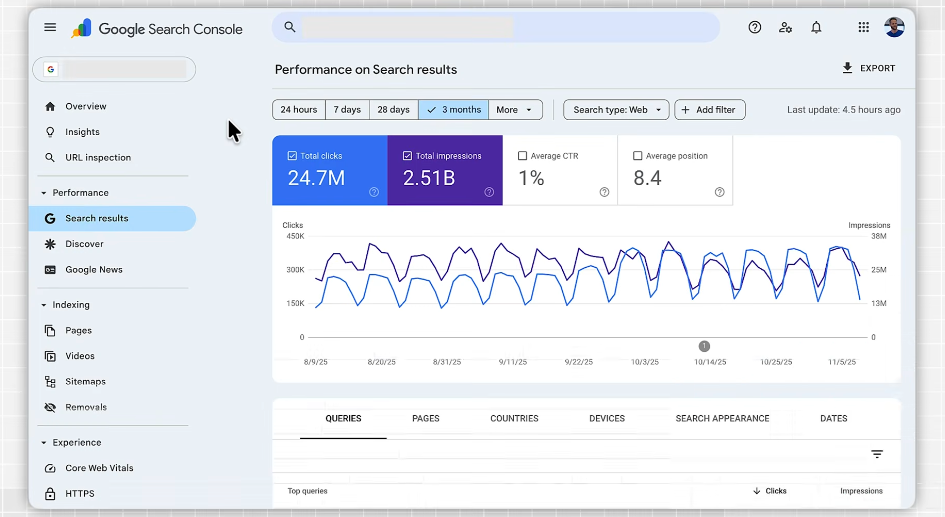
Then add search-performance evidence. Google Search Console's Performance report groups data by queries, pages, countries, devices, search appearance, and dates. It also warns that aggregation changes by dimension. Treat clicks, impressions, CTR, and position as different signals rather than one quality score.
Look for three patterns:
- queries receiving impressions but answered only partially;
- several pages appearing for the same need without a clear primary page;
- pages losing relevant visibility after their facts, examples, or audience assumptions became dated.
A page with little search traffic may still support onboarding, sales, customer success, or an important internal link path.
Competitor Pages and Audience Questions
Choose competitors by topic, not only by company. This competitive content analysis may include a publication, documentation site, marketplace, or specialist that competes for a question but not for revenue.
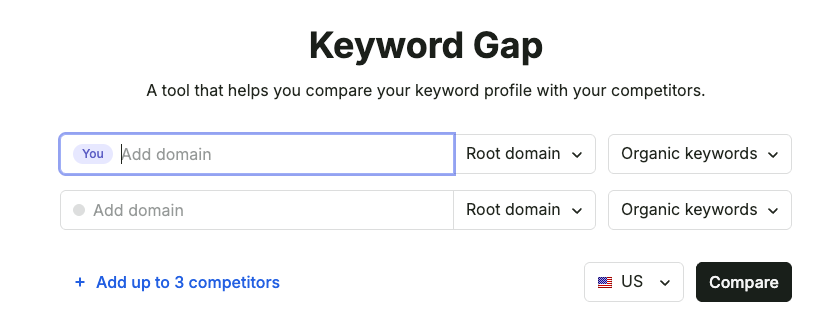
A keyword gap tool can show terms and pages associated with other domains. For example, Semrush's current Keyword Gap documentation describes database, device, intent, position, and date filters. Its historical access and report limits vary by subscription. Record those settings so a later refresh is comparable.
Read a sample of the actual pages. Note their audience, task, evidence, entities, format, and unanswered questions. Add permitted insights from sales, support, site search, communities, and interviews.
Do not paste private customer material into a third-party tool by default. Remove identifying details and follow your organization's access and retention rules.
Classify the Gaps You Find
Classify each finding before assigning a score. The label determines whether the right response is a new page, a revision, consolidation, or no work at all.
Missing Topics and Subtopics
A missing topic has no suitable destination on your site. A missing subtopic belongs inside an existing page but is absent or too thin to help the reader finish the task.
Check the scale before creating a URL. A distinct decision may justify a page; one missing detail may belong in an established article.
Record the expected contribution. It could be a first-party example, a clearer comparison, a current source set, a decision table, or an exception path. “Competitors cover it” is not enough.
Weak, Outdated, or Misaligned Coverage
Weak coverage exists but does not answer the need completely. Outdated coverage relies on old facts, screenshots, products, or policies. Misaligned coverage targets the wrong reader, stage, region, or outcome.
These are usually update candidates. Do not interpret every traffic decline as a content problem; seasonality, result changes, tracking, and demand can also change.
When two pages compete for the same job, consider merging them. Preserve useful sections, links, and redirects rather than publishing a third overlapping page.
Search-Intent and Entity Gaps
An intent gap appears when a page covers the subject but not the reader's task. A definition page will not fully satisfy someone comparing approaches or trying to complete a workflow.
An entity gap omits a person, product, standard, location, relationship, or attribute needed to understand the topic. Add one only when it resolves ambiguity or supports the page's purpose.
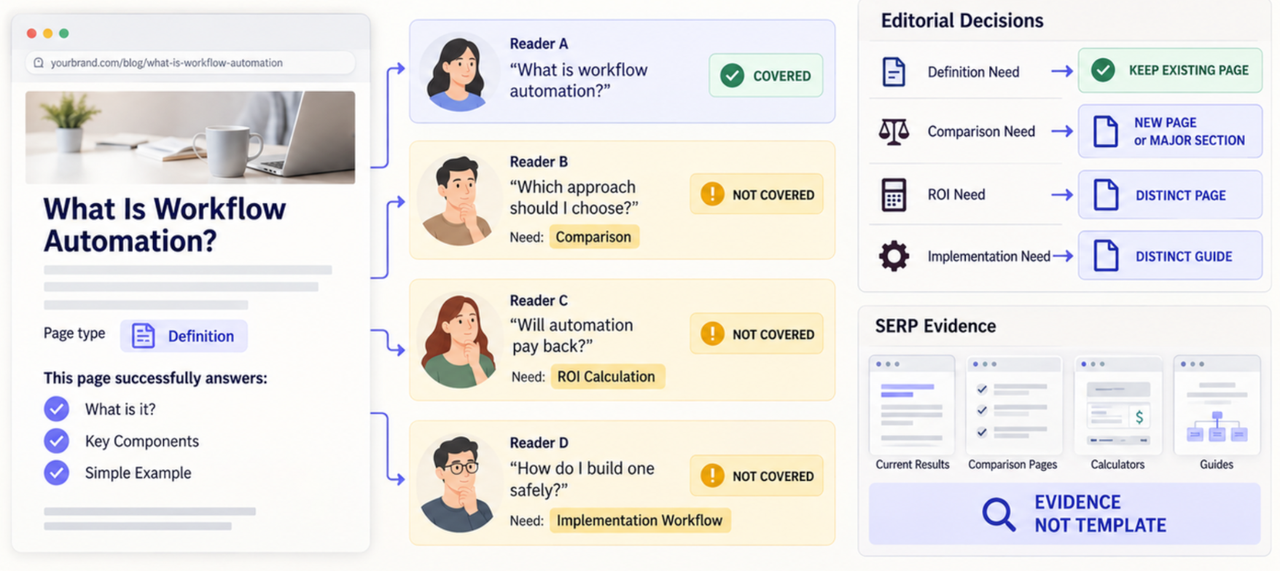
Review current search results as evidence, not a permanent template. Results vary by time, place, device, and user context. The goal is to understand the task behind the result set, not reproduce its headings.
Prioritize Gaps by Value and Effort
Prioritize a gap only after the team can state its reader value and evidence. Volume and difficulty can inform the decision, but they should not make it.
Score Business Fit and Evidence
Use a compact scorecard with separate fields for:
- audience and business fit;
- strength of demand evidence;
- usefulness of the team's proposed contribution;
- confidence in available sources;
- risk of overlap with existing pages;
- production and maintenance effort.
Keep the notes visible because a total score alone creates false precision. A zero-volume topic can still support a valuable decision, new category, or recurring customer question.
Treat “information gain” as an editorial test: what will this page contribute beyond the shared baseline? It is not a promised ranking factor or a substitute for useful content.
Choose Create, Update, Merge, or Skip
Choose create for a supportable task with no suitable page. Choose update for an incomplete page, merge when pages divide one intent, and skip when fit, evidence, contribution, or ownership is missing.
“Skip” is a valid decision, not a lost opportunity. Save the reason and review date. That record stops rejected ideas from returning every quarter with no new evidence.
Turn the Backlog Into a Repeatable Workflow
Turn every approved gap into a traceable work item with an owner, evidence, decision, and review gate. Automation can prepare the record, but a person should approve the editorial action.
Assign Owners, Briefs, and Review Gates
Give each item a gap ID, source date, affected URLs, audience need, proposed action, and evidence links. Add its expected contribution, owner, and next review date.
The Brief should state the page promise, boundaries, required sources, overlap risks, and acceptance criteria. Give intent, business fit, information gain, and merge decisions named human reviewers.
An Agent can collect exports, group similar phrases, compare inventories, and prepare a draft Brief. It should not silently publish pages, delete URLs, or decide that a competitor term belongs in your strategy. This is a workflow pattern, not a claim that SpringBrand supplies SEO data or a particular connector.
Refresh the Analysis Without Rebuilding It
Keep dated input files, settings, classifications, and decisions. Next time, refresh the same scope instead of starting with an empty spreadsheet.
Review high-priority clusters more often than stable evergreen areas. Reopen skipped items only when the audience, evidence, offering, or competitive landscape changes. Archive completed and rejected items without erasing their reasoning.
Conclusion
A useful content gap analysis does not measure success by the length of its keyword list. It shows where coverage fails a real audience need and records why the team will create, update, merge, or skip the work.
Use tools to assemble evidence and reduce repetitive sorting. Keep intent, business fit, information gain, and consolidation decisions with accountable people. The result is a smaller backlog, stronger Briefs, and a workflow the team can refresh without relearning its own reasoning.
FAQ
Can a zero-volume topic still be a meaningful content gap?
Yes. Reported volume may miss emerging, specialized, local, or low-frequency needs. Use customer questions, strategic relevance, support demand, and the value of the underlying decision as additional evidence, while labeling uncertainty.
How should teams handle gaps with no clear ranking competitor?
Start with the audience problem rather than a competing URL. Use internal search, interviews, support patterns, adjacent queries, and first-party expertise to decide whether a useful page is possible. No ranking competitor can mean an opportunity, weak demand, or a task better served outside search.
Do content-gap tools retain dated snapshots after a competitor removes a page?
It depends on the product, plan, and dataset. Semrush currently limits historical keyword data to specified subscription tiers, but that does not prove that it preserves a removed page's full content. Export dated findings and retain only material your policies and applicable rights permit.
Do AI answer citations reveal gaps that keyword tools miss?
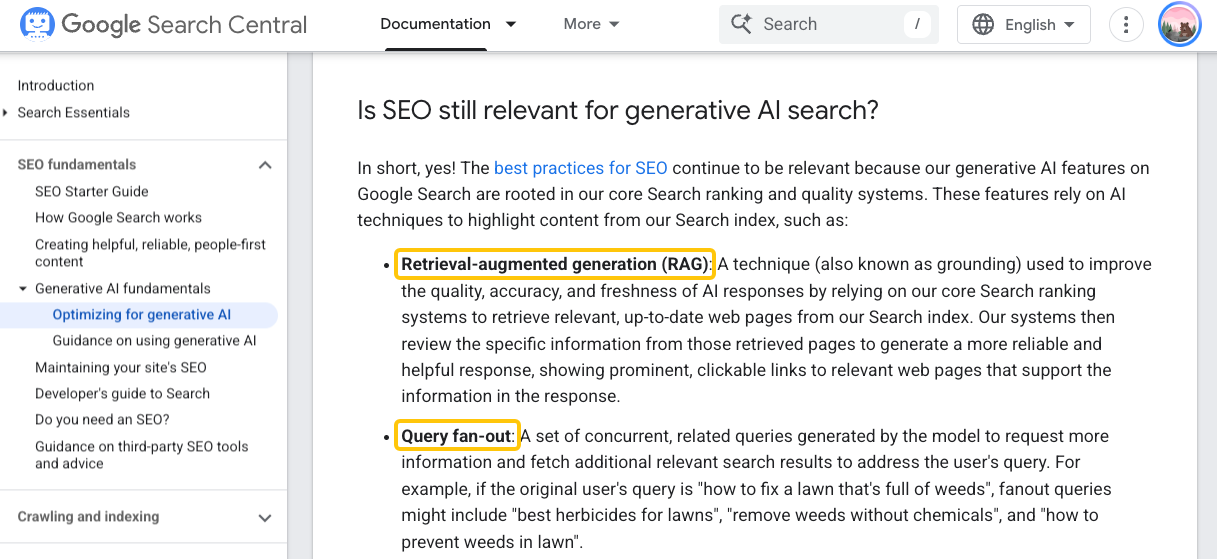
They can reveal source, entity, and follow-up-question gaps, but they are not a complete demand dataset. Google's current generative AI search guidance says AI features may use related query fan-out and now have a Search Console performance report. It also warns that third parties do not have access to Google’s internal ranking or AI systems.
How long should an unprioritized gap stay in the backlog?
Give it an explicit review or expiry date based on planning cadence and topic volatility. If no owner, evidence, or business reason appears after repeated reviews, archive it. A searchable archive is more useful than an active backlog nobody trusts.